
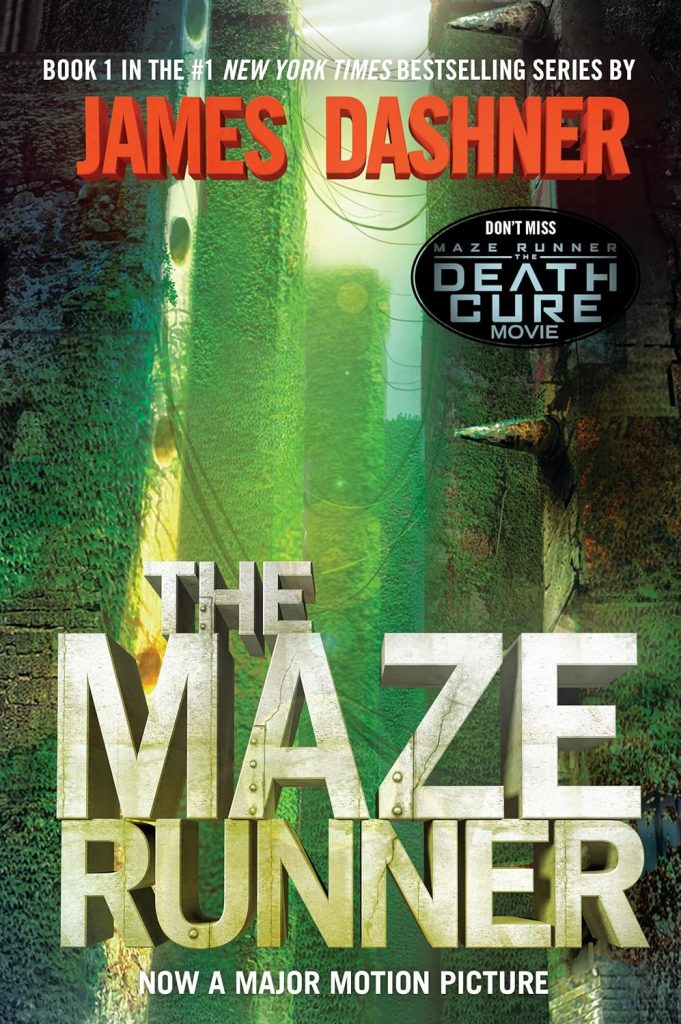
When The Maze Runner hit shelves in 2009, it slid straight into that golden era of YA dystopia—post-Hunger Games, pre-everyone-getting-exhausted-by-trilogies. James Dashner built a high-concept survival story that reads like someone locked Lord of the Flies inside a sci-fi escape room. It’s fast, tense, full of invented slang and withheld information, and unapologetically plot-driven. This isn’t literary dystopia. It’s pure momentum.
And honestly? Sometimes that’s exactly what you want.
What’s it about?
The book opens with a teenage boy waking up in total darkness, riding in a metal box that’s rattling upward. He doesn’t remember his name, his family, or anything about his past—except the word “Thomas.” When the box opens, he finds himself surrounded by a group of boys in a strange enclosed settlement called the Glade.
The Glade is a grassy clearing surrounded on all sides by towering stone walls. Beyond those walls lies a massive, shifting labyrinth known only as the Maze. Every morning, giant stone doors grind open, revealing pathways that rearrange themselves every night. Every evening, the doors slam shut. Anyone caught inside after dark dies—usually at the hands of monstrous biomechanical creatures called Grievers, who roam the Maze when the sun goes down.
The boys in the Glade have built a fragile society. There are farmers, builders, med-jacks, and most importantly, Runners—the elite group who venture into the Maze each day to map it, trying to solve its pattern and find a way out. Two leaders anchor the group: Alby, steady and rule-focused, and Newt, calmer, diplomatic, holding things together when tensions rise. Minho, the Keeper of the Runners, is bold and sharp. And then there’s Gally, suspicious and volatile, who doesn’t trust Thomas from the start.
Thomas arrives and immediately feels pulled toward the Maze. He doesn’t know why, but parts of it feel familiar. Almost like muscle memory. That instinct makes the others wary. Newcomers are supposed to spend weeks adjusting before even thinking about running. Thomas wants in immediately.
Then the pattern breaks.
A day after Thomas arrives—something that’s never happened before—a girl is sent up in the box. She’s unconscious, clutching a note that reads: “She’s the last one. Ever.” Her name is Teresa, and she’s the first girl to ever appear in the Glade. Shortly after her arrival, the Maze’s structure begins changing more aggressively. Supplies stop coming. The sky shifts. The sense of controlled experiment turns into something far more urgent.
Thomas starts having flashes of memory when he’s near Teresa—fragments suggesting they knew each other before the Glade. Worse, he begins to suspect that he had something to do with creating the Maze itself. The realization is both horrifying and galvanizing.
As the Grievers become more aggressive and the Maze’s behavior shifts, Thomas and Minho get trapped outside overnight. Instead of dying, they survive—discovering a pattern in the Maze’s walls and the creatures’ movements. That survival cements Thomas as a Runner and accelerates the group’s push to decode the labyrinth.
The Maze turns out not to be random but coded. Its shifting walls form words—coordinates. A map. A way out. But the exit isn’t a door leading to safety. It’s a confrontation with the creators of the experiment, an organization called WICKED (World In Catastrophe: Killzone Experiment Department).
When the boys finally escape the Maze, they discover the world outside has been devastated by solar flares and disease. The Maze wasn’t a prison—it was a test. A trial designed to identify individuals capable of surviving and solving complex problems in extreme conditions.
The novel ends not with resolution but with another layer of manipulation revealed. The Gladers were never in control. And their survival might only be Phase One.
What This Chick Thinks
The pacing is relentless
This book wastes zero time. From page one, you’re disoriented alongside Thomas. Dashner withholds information aggressively—sometimes almost frustratingly—but it creates propulsion. You want answers. And the lack of them is the engine.
World-building through confusion
The slang—“shuck,” “klunk,” “shank”—is divisive. It drops you into a culture mid-stream, which I actually appreciate. It reinforces that these boys have built their own micro-society. But it can also feel slightly try-hard at times, especially early on. Once you adjust, it blends into the background.
Character depth takes a backseat
This is very much a plot-first book. Thomas is brave and instinctive, but not deeply introspective. Teresa functions more as mystery than fully fleshed-out person in this installment. The strongest character work arguably goes to Newt and Minho, who bring steadiness and spark to the group dynamic. Emotional complexity exists, but it’s secondary to survival mechanics.
The Maze is the star
The shifting labyrinth is a fantastic central device. It’s physical, threatening, almost sentient. The Grievers are grotesque enough to be memorable without tipping into absurdity. The design of the Maze—coded, patterned, deliberate—is clever in a satisfying puzzle-box way.
The twist lands—but it’s familiar territory
The “it was an experiment all along” reveal doesn’t exactly reinvent dystopian fiction. But Dashner executes it cleanly. The moral ambiguity of WICKED adds intrigue moving forward, even if it doesn’t fully unpack the ethical horror yet.
Final Thoughts
The Maze Runner is a high-concept, adrenaline-fueled dystopian survival story that prioritizes tension over introspection. It’s not trying to be lyrical or philosophical—it’s trying to trap you in a moving box and make you run. And it succeeds. The questions about memory, agency, and manipulation hover beneath the surface, but the real thrill is the escape.
It’s a page-turner in the purest sense.
Rating: 8/10
Try it if you like:
- The Hunger Games — Suzanne Collins
Survival under controlled conditions, teenagers navigating deadly systems, moral ambiguity baked into the premise. - The 5th Wave — Rick Yancey
Sci-fi survival with shifting alliances and large-scale manipulation behind the scenes. - Gone — Michael Grant
Teens trapped in an enclosed environment without adults, society fracturing under pressure. Darker and more chaotic, but similarly intense.
