
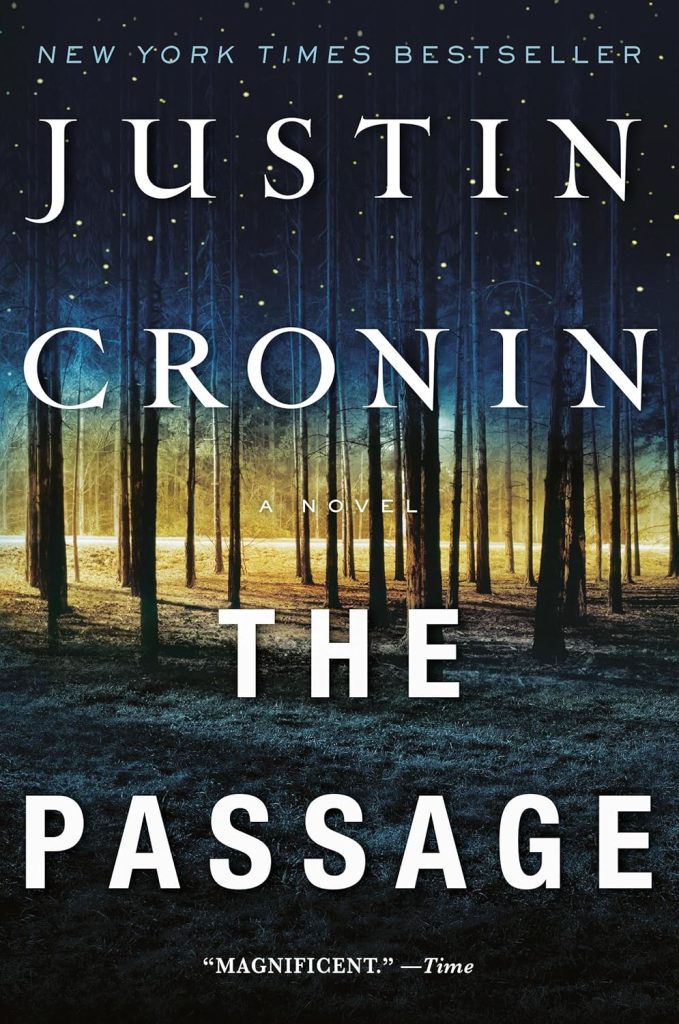
Before The Passage was a book, it was a challenge. As the story goes, Justin Cronin—a literary fiction writer with a PEN/Hemingway under his belt—wanted to write something epic, something big and commercial. So he asked his daughter, “What should it be about?” Her answer: “A girl who saves the world.” What followed was a genre-bending trilogy that starts with The Passage (2010), an 800-page juggernaut that mixes government conspiracies, vampire apocalypse, post-collapse survival, and—somehow—a deeply emotional meditation on loneliness, time, and love.
It was a hit. Ridley Scott snapped up the rights before the book even came out. Critics called it The Stand meets The Road, and while that’s not wrong, it undersells how deeply The Passage commits to being both a blood-soaked blockbuster and a melancholic literary epic. It’s ambitious as hell. Sometimes too ambitious. But I’ll be honest—I kind of loved the audacity of it.
What’s it about?
The novel begins in the near future, before the world falls apart. A secret U.S. government experiment known as Project NOAH is attempting to harness a virus discovered in a remote region of Bolivia. The virus grants heightened strength and near-immortality—but at the cost of humanity. The initial human test subjects are death row inmates. It does not go well.
These infected men become something monstrous—feral, light-sensitive creatures who feed on blood and operate with hive-like intelligence. When the containment inevitably fails, civilization collapses with shocking speed. Cities empty. Power grids fail. The infected—soon called “virals”—spread across the country like a plague.
But before the fall, the government conducts one final experiment on a six-year-old girl named Amy Harper Bellafonte. Amy is different. The virus changes her, but she retains her mind. She becomes something liminal—part child, part something ancient and unknowable. And when the world ends, she disappears into it.
Then the novel jumps forward nearly a century.
The United States is now a wasteland. Humanity survives in isolated colonies protected by massive floodlights that keep the virals at bay. One such colony, located in California, becomes our central setting. Here we meet a tight-knit group of survivors: Peter Jaxon, steady and introspective; his brother Theo; fierce Alicia (“Lish”); Michael, the technical brain; Sara, compassionate and resilient; and a handful of others who have grown up knowing only fear of the dark.
When a strange girl appears outside the colony walls—still a child despite the passing decades—it destabilizes everything. It’s Amy.
Her arrival coincides with the failing of the colony’s lights. The power source sustaining their protection begins to falter. The group is forced to leave the safety of their walls and journey across the ruined landscape to find answers—and possibly a way to fight back.
Their journey becomes a classic quest narrative: through abandoned cities, overgrown highways, derelict military outposts. Along the way, they encounter remnants of old America—both hopeful and horrifying. They discover that the original virals weren’t just random monsters; they were men with histories, hierarchies, and evolving intelligence. The “Twelve” original infected subjects now function almost like vampire generals, commanding armies of lesser virals.
Amy, meanwhile, is both guide and enigma. She speaks rarely. She seems to communicate in dreams. She carries the weight of the virus in her veins but also the potential key to ending it. Her presence ties the past to the present—the bureaucratic hubris that created the catastrophe to the fragile human hope that might undo it.
As the group moves eastward, the novel alternates between large-scale action and deeply intimate character moments. There are betrayals. There are deaths. There are reunions with lost remnants of government projects that never fully shut down. The world feels layered—history piled on history.
By the end of the book, humanity hasn’t triumphed. But it has struck a blow. The journey transforms the survivors from sheltered colonists into something closer to resistance fighters. And Amy remains at the center—not a savior in shining armor, but a quiet, watchful presence who has endured more than anyone else alive.
What This Chick Thinks
It’s apocalypse as character study
Yes, there are monsters. Yes, there’s gore. But Cronin lingers on faces, memories, inner lives. The novel cares deeply about who these people are before and after disaster. Peter’s steady moral compass. Alicia’s ferocity masking grief. Even minor characters get small, humanizing details. It’s not just about survival—it’s about what kind of people survive.
The scale is both its power and its problem
This book is huge. It sprawls. The early government-conspiracy chapters feel almost like a different novel than the post-apocalyptic sections. The time jump can be jarring. There are moments where the pacing slows to a crawl while Cronin meditates on landscape or memory. But there are also stretches—particularly during the journey sequences—where the narrative hums with energy.
If you want lean dystopia, this isn’t it. If you want immersive dystopia, you’re in the right place.
Amy is fascinating—and frustrating
Amy is more symbol than fully articulated character. She’s meant to be mysterious, almost mythic. That works thematically, but emotionally I sometimes wanted more access to her interiority. We see what she represents. We don’t always see what she feels. Still, the restraint gives her a haunting quality that lingers.
The virals are genuinely scary
They’re not romanticized. Not brooding antiheroes. They’re animalistic, relentless, deeply uncanny. And the idea that some retain shreds of memory makes them worse. There’s something deeply unsettling about monsters that remember being human.
It’s weirdly hopeful
Despite the bleak setting, The Passage is suffused with a quiet belief in endurance. In love. In found family. The apocalypse doesn’t erase tenderness. It tests it.
Final Thoughts
The Passage is ambitious, atmospheric, and unapologetically epic. It’s not a quick read, and it doesn’t streamline itself for convenience. But if you’re willing to sink into its world, it rewards you with emotional depth and a sense of scale that few dystopian novels attempt.
It’s about the end of the world—but more than that, it’s about what survives it.
Rating: 8.5/10
Try it if you like:
- The Stand — Stephen King
Another sprawling post-apocalyptic epic with a massive cast and a battle between darkness and fragile human hope. - Station Eleven — Emily St. John Mandel
A quieter, more lyrical look at civilization after collapse, focused on art and memory rather than monsters. - Swan Song — Robert McCammon
A darker, horror-leaning apocalypse novel with strong character arcs and mythic undertones.
