
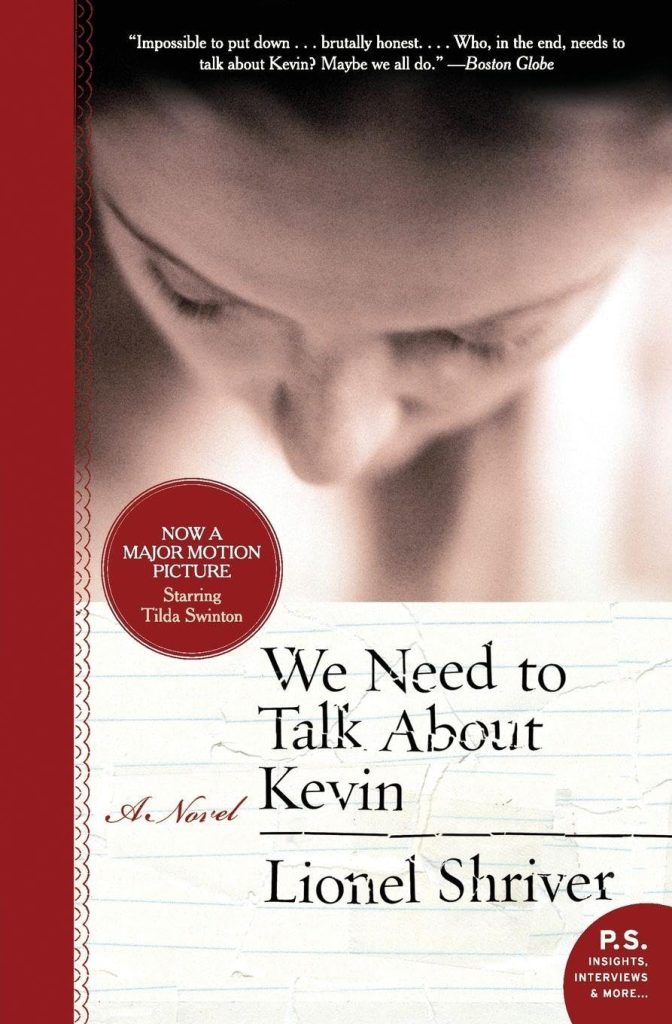
Published in 2003, We Need to Talk About Kevin is one of those novels that people either press into your hands with urgent intensity or warn you about in hushed tones. Lionel Shriver wrote it in the aftermath of Columbine, and while the book never names a specific real-world tragedy, it very clearly lives in that cultural shadow. It’s structured as a series of letters from a mother to her absent husband, written after their teenage son commits a school massacre. The hook sounds sensational. The execution is anything but. This is not a thriller. It’s a slow, suffocating psychological autopsy—of a child, yes, but also of motherhood, marriage, and the stories we tell ourselves about blame.
It’s uncomfortable in the way that good literature sometimes is. It presses on nerves most novels politely avoid.
What’s it about?
The novel is told entirely through letters written by Eva Khatchadourian to her estranged husband, Franklin, in the aftermath of what she refers to as “Thursday.” We know early on that their son, Kevin, committed a horrific act of violence at his high school. We know people died. We know Kevin is in prison. The suspense isn’t about what happened. It’s about how it happened—and whether it could have been stopped.
Eva begins long before the crime. She writes about her life before Kevin: a successful travel guide entrepreneur, independent, cosmopolitan, not particularly maternal. She marries Franklin, a cheerful, all-American optimist who wants children with an almost patriotic zeal. Eva is ambivalent about motherhood from the start, and that ambivalence becomes the novel’s fault line.
Kevin is difficult from infancy. He screams endlessly. He resists toilet training. He withholds affection. He seems, in Eva’s telling, calculatingly hostile. She describes him as watching her, studying her, pushing boundaries not in tantrums but in deliberate acts. Franklin, meanwhile, sees a misunderstood boy. Where Eva sees malice, Franklin sees normal childhood rebellion. The gap between their perceptions grows into a canyon.
As Kevin grows older, his behavior becomes more disturbing. He manipulates teachers. He charms other adults. He torments his younger sister, Celia. He exhibits a chilling emotional vacancy. Eva tries therapy, discipline, detachment. Nothing shifts him. Or perhaps—this is the novel’s most unsettling question—perhaps her dislike shapes him. Perhaps he reflects her rejection back at her, magnified.
The letters move back and forth in time. We see Kevin as a sarcastic, hyper-articulate teenager obsessed with archery. We see Eva visiting him in prison after the massacre. We see the crumbling of her life: vandalism of her home, social exile, grief layered with shame. Franklin’s role becomes clearer over time, and the narrative drip-feeds us the events of “Thursday” in fragments, increasing the dread even though we know the outcome.
When the massacre is finally described in full, it’s horrifying in its precision. Kevin doesn’t use guns—he uses a crossbow. The violence is intimate. Calculated. The choice feels deliberate, theatrical even. And then the novel pivots again—not toward justice or closure, but toward aftermath. Toward the long, quiet echo of catastrophe.
In the final sections, Eva continues to visit Kevin in prison. He is no longer the impenetrable prodigy of cruelty he once seemed. There are hints—small, flickering—of uncertainty. Regret, maybe. Or at least confusion. The novel ends without solving the central riddle. Was Kevin born this way? Did Eva’s coldness forge him? Was it chance? Chemistry? Choice?
The book refuses to answer.
What This Chick Thinks
This is not an easy book—and it’s not trying to be
Shriver doesn’t soften anything. Eva is not written to be likable. She’s articulate, analytical, occasionally cruel in her assessments of her own child. But she’s also deeply self-aware. The letters feel like confession and defense simultaneously. She’s constantly interrogating her own role. That ambiguity—her reliability as narrator—is what makes the novel so unsettling.
The motherhood angle is what lingers
Plenty of books explore violent young men. Far fewer ask whether motherhood itself can be a site of alienation. Eva admits she didn’t bond with Kevin. That she resented the physical toll of pregnancy. That she missed her old life. Reading that feels almost taboo. Society demands maternal instinct as default. Eva doesn’t have it. And Shriver doesn’t punish her for that—but she doesn’t absolve her either.
Kevin is terrifying because he’s articulate
He’s not a silent, brooding cliché. He’s witty. He’s precise. He spars with Eva intellectually. Their conversations feel like chess matches. That’s what makes him chilling. He’s not chaotic. He’s controlled. Whether that control masks emptiness or rage is part of the mystery.
The prose is dense and deliberate
This is not a breezy read. The sentences are long, analytical, almost essayistic at times. Eva circles ideas, dismantles them, rebuilds them. Sometimes it feels repetitive—but that repetition mirrors obsession. She’s trying to understand. She’s trying to narrativize something that resists narrative.
It will make you uncomfortable in ways that feel personal
I found myself bristling at Eva. Then defending her. Then doubting her. The book sets traps like that. It doesn’t let you settle into easy moral territory. And in a story about violence, that refusal to simplify feels honest.
Final Thoughts
We Need to Talk About Kevin is bleak, incisive, and deeply disturbing—not because of the violence, but because of the questions it raises about nature, nurture, and the terrifying opacity of other people, even the ones we raise. It’s a novel about blame, and how it never quite lands where we want it to.
It’s not a comfort read. It’s a confrontation.
Rating: 9/10
Try it if you like:
- Defending Jacob — William Landay
Another novel about parents grappling with the possibility that their child may be capable of something monstrous. - A Mother’s Reckoning — Sue Klebold
A nonfiction memoir from the mother of one of the Columbine shooters, exploring grief, denial, and hindsight. - The Push — Ashley Audrain
A psychological novel about a mother who fears something is wrong with her daughter—and questions her own perceptions in the process.
