
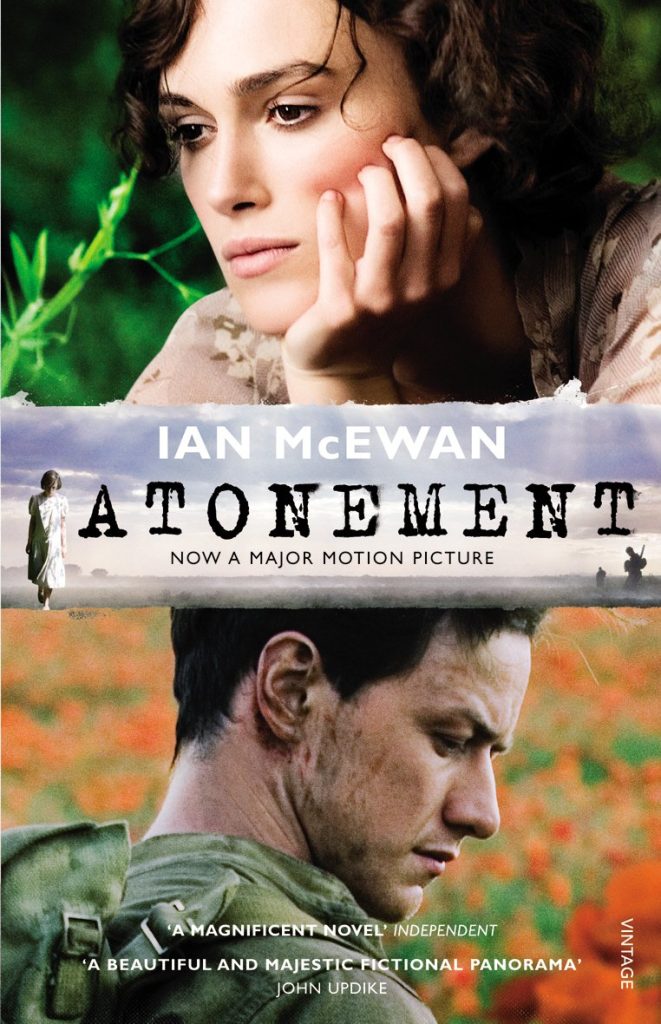
Ian McEwan published Atonement in 2001, and it very quickly cemented itself as one of those modern literary novels that people argue about in book clubs for years. It was shortlisted for the Booker Prize, later adapted into a very glossy, devastating film, and has that very particular early-2000s prestige sheen: elegant prose, moral reckoning, historical sweep. McEwan had already built a reputation for psychological precision and unease (his earlier work could be downright chilly), but Atonement feels like the book where his craft and his ambition met in perfect, slightly terrifying alignment. It’s about love and war, yes—but mostly it’s about storytelling. And whether you can ever undo damage once it’s done.
What’s it about?
The novel opens on a sweltering summer day in 1935 at the Tallis family estate in the English countryside. Thirteen-year-old Briony Tallis is precocious, dramatic, and desperate to be taken seriously as a writer. She has just completed her first play and is staging it for her visiting cousins. Briony sees the world in narrative terms—heroes, villains, motives—and that tendency becomes the book’s fault line.
Her older sister, Cecilia, has just returned from Cambridge. Cecilia is intelligent, restless, and quietly frustrated by the expectations placed on her. Also in the house is Robbie Turner, the housekeeper’s son, educated at Cambridge with financial support from Briony and Cecilia’s father. Robbie and Cecilia grew up together, their relationship simmering for years in a haze of unspoken tension and class awkwardness.
That afternoon, Briony witnesses a charged encounter between Cecilia and Robbie by the fountain. She doesn’t understand what she’s seeing—desire filtered through adolescent imagination—but she senses it’s important. Later, she intercepts a letter Robbie has written to Cecilia. There are two versions: one polite, one explicit and impulsive. It’s the explicit one that ends up in Briony’s hands. To her thirteen-year-old mind, it confirms a narrative she is already beginning to construct: Robbie as threat.
That night, in the darkness near the estate’s lake, Briony sees her cousin Lola being assaulted. She believes—fervently, absolutely—that Robbie is the attacker. Her testimony, given with unwavering certainty, seals his fate. Robbie is arrested. Cecilia, who knows he’s innocent, breaks with her family and stands by him. A single accusation fractures multiple lives.
The novel then shifts.
Part Two follows Robbie years later during World War II, as he retreats toward Dunkirk with the British Army. The section is visceral and disorienting—mud, blood, exhaustion, shattered towns. Robbie’s internal life is tethered to Cecilia through letters and memory. He believes that once he returns, they can build something together. The war sequences are harrowing and intimate, a stark contrast to the manicured lawns of Part One.
Part Three follows Briony, now eighteen, training as a nurse in London during the Blitz. She has renounced her privileged upbringing and is attempting, in her own mind, to atone. She works long hours, scrubs floors, tends to wounded soldiers, and tries to discipline her imagination into something more honest. Eventually, she seeks out Cecilia and Robbie to confess her mistake and attempt to set things right.
And then the novel pivots again.
In the final section, set decades later, we learn that Briony became a novelist. The story we’ve been reading is her book. And the version where Robbie and Cecilia reunite? That was fiction. In reality, Robbie died of septicemia before Dunkirk’s evacuation. Cecilia was killed in the Blitz. They never got their life together. Briony could not undo what she did. The only atonement available to her was narrative mercy.
The revelation reframes everything. The book becomes not just a story of love destroyed, but of authorship, guilt, and the limits of art.
What This Chick Thinks
The first section is almost unbearably tense
That summer day stretches like elastic. Every conversation feels loaded. McEwan slows time to a crawl, so that when the accusation lands, it feels both shocking and inevitable. Briony isn’t malicious—she’s imaginative and certain, which is somehow worse.
Briony is the villain and the victim
I love that McEwan doesn’t let her off the hook. She was a child, yes. But she was also arrogant in her certainty. Watching her grow into someone who understands the magnitude of what she did is painful in a very human way.
The war section is a whole different novel
Robbie’s march to Dunkirk is grim, cinematic, and almost hallucinatory. It widens the scope dramatically. Some readers find the tonal shift jarring. I found it clarifying—this is what was stolen from him.
That ending is ruthless
The metafictional twist works because it isn’t clever for clever’s sake. It’s devastating. Briony gives her lovers the ending she denied them in life. But she can’t rewrite history. The book asks whether storytelling is redemption—or just self-soothing.
Final Thoughts
Atonement is controlled, intelligent, and emotionally brutal. It’s about the catastrophic power of misinterpretation—and about whether art can ever compensate for harm. It’s one of those novels that leaves you quiet afterward, slightly wrung out, and maybe a little suspicious of certainty.
Rating: 9/10
Try it if you like:
- Never Let Me Go by Kazuo Ishiguro – Quiet, restrained heartbreak with a slow realization of irreversible loss.
- The Remains of the Day by Kazuo Ishiguro – Another exploration of regret, memory, and the cost of emotional repression.
- The English Patient by Michael Ondaatje – Lyrical wartime love story where history and intimacy collide.
