
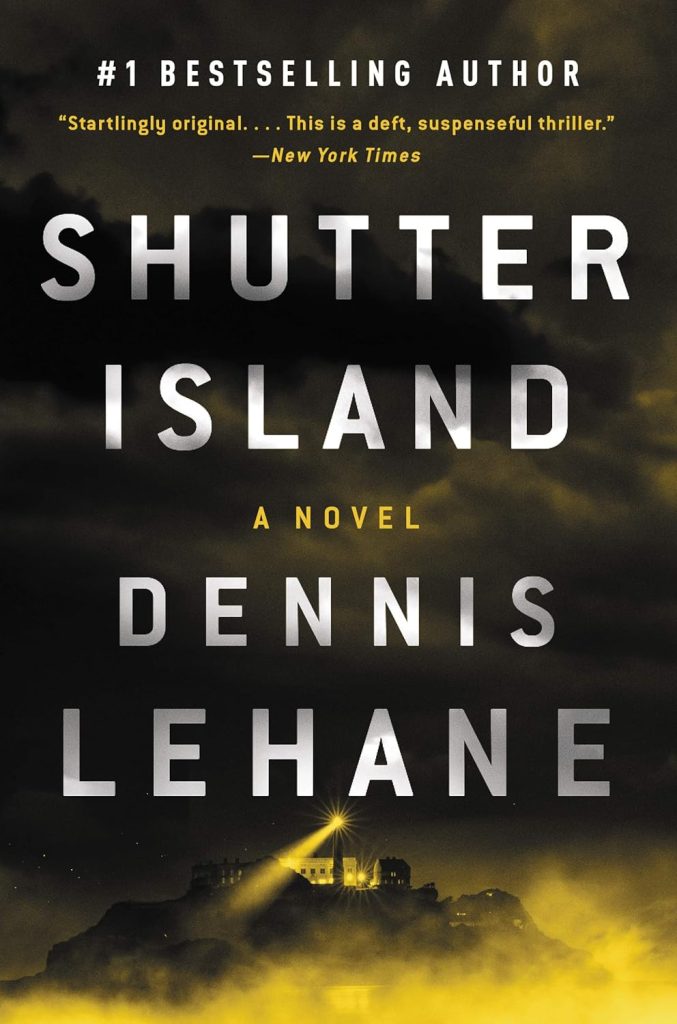
Dennis Lehane published Shutter Island in 2003, and it sits in that delicious space between crime thriller and psychological horror. Lehane was already known for gritty Boston crime fiction (Mystic River, anyone?), but this one feels more claustrophobic, more gothic. It’s the kind of book that reads like a straight procedural… until it absolutely doesn’t. There’s a fog-drenched island, a crumbling asylum, a missing patient, and a U.S. Marshal who might be losing his grip. It’s pulpy in its premise, but the execution is sharp and unnerving. You think you’re reading a mystery. You’re actually reading a slow unspooling of the mind.
What’s it about?
The novel opens in 1954 with U.S. Marshal Teddy Daniels and his new partner Chuck Aule arriving by ferry at Ashecliffe Hospital, a psychiatric facility for the criminally insane located on Shutter Island, off the coast of Massachusetts. The weather is grim, the sea churning, and Teddy is already uneasy before they dock.
They’re there to investigate the disappearance of Rachel Solando, a patient who apparently vanished from a locked room. The window bars are intact. The guards swear she couldn’t have escaped. Yet she’s gone. The situation feels impossible from the start, and Lehane leans into that locked-room mystery tension beautifully.
As Teddy interviews staff and patients, something feels off. The doctors—particularly Dr. Cawley—are polite but evasive. The facility operates on experimental psychiatric methods, and Teddy suspects darker practices: mind control, secret government experiments, maybe even Cold War brainwashing. He starts to believe the island is hiding something far more sinister than a missing patient.
Complicating everything is Teddy’s own history. He’s haunted by memories of World War II, particularly the liberation of Dachau. Those flashbacks are brutal and disorienting, blending trauma with present paranoia. He’s also grieving the death of his wife, Dolores, who died in a fire set by an arsonist named Andrew Laeddis—a man Teddy believes might somehow be connected to the island.
The deeper Teddy digs, the more the narrative destabilizes. Notes appear. Rachel may have left a cryptic message. Storms cut off the island from the mainland. Chuck disappears at one point. Teddy’s migraines worsen. He begins to question not just the staff, but the very structure of reality on the island.
Then comes the pivot.
In a final, devastating reveal, Teddy Daniels is not a U.S. Marshal investigating a conspiracy. He is Andrew Laeddis, a patient at Ashecliffe. His entire investigation has been an elaborate therapeutic role-play designed by Dr. Cawley and the staff to force him to confront reality. Andrew killed his manic-depressive wife after she drowned their children. Unable to live with the truth, he constructed a new identity—Teddy Daniels—and a narrative in which he hunts a villain rather than being the man who failed to see his wife’s unraveling.
The missing patient, the conspiracy, the partner—all of it was staged to break through Andrew’s delusion. For a brief moment, it seems to work. He remembers. He understands.
But in the final scene, Andrew appears to relapse—or perhaps he chooses to. He calmly asks, “Which would be worse: to live as a monster, or to die as a good man?” The implication is chilling. He may be choosing lobotomy over living with the truth.
The book ends there. No tidy bow. Just that question echoing.
What This Chick Thinks
The atmosphere is doing heavy lifting
The setting is almost theatrical in its gloom—storms, cliffs, barred windows—but it works because it mirrors Teddy’s mental state. The island feels like a skull you’re trapped inside.
The twist is bold—and earned
I’m always wary of “it was all in his head” reveals, but this one is layered. Lehane plants clues throughout—Teddy’s inconsistencies, Chuck’s odd compliance, the staff’s strange patience. On a reread, it’s almost obvious. The structure rewards attention.
Trauma as both explanation and shield
Teddy/Andrew’s wartime memories aren’t decorative. They’re part of his psychological fracture. The novel doesn’t excuse him—but it contextualizes him. That balance matters.
The ending is the real gut punch
It’s not the reveal that lingers. It’s that final choice. Did he relapse? Or did he decide that annihilation was easier than living with what he’d done? That ambiguity elevates the book from thriller to tragedy.
Final Thoughts
Shutter Island is a tightly wound psychological thriller that uses genre conventions to explore guilt, trauma, and self-deception. It’s creepy, propulsive, and unexpectedly philosophical by the end. The mystery hooks you—but the moral question is what stays.
Rating: 8.5/10
Try it if you like:
- The Girl with the Dragon Tattoo by Stieg Larsson – Dark investigation with morally complicated characters and a bleak atmosphere.
- Gone Girl by Gillian Flynn – Psychological manipulation and narrative unreliability with a sharp twist.
- The Turn of the Screw by Henry James – Ambiguous sanity and a setting that may be haunted—or may be the mind itself.
