
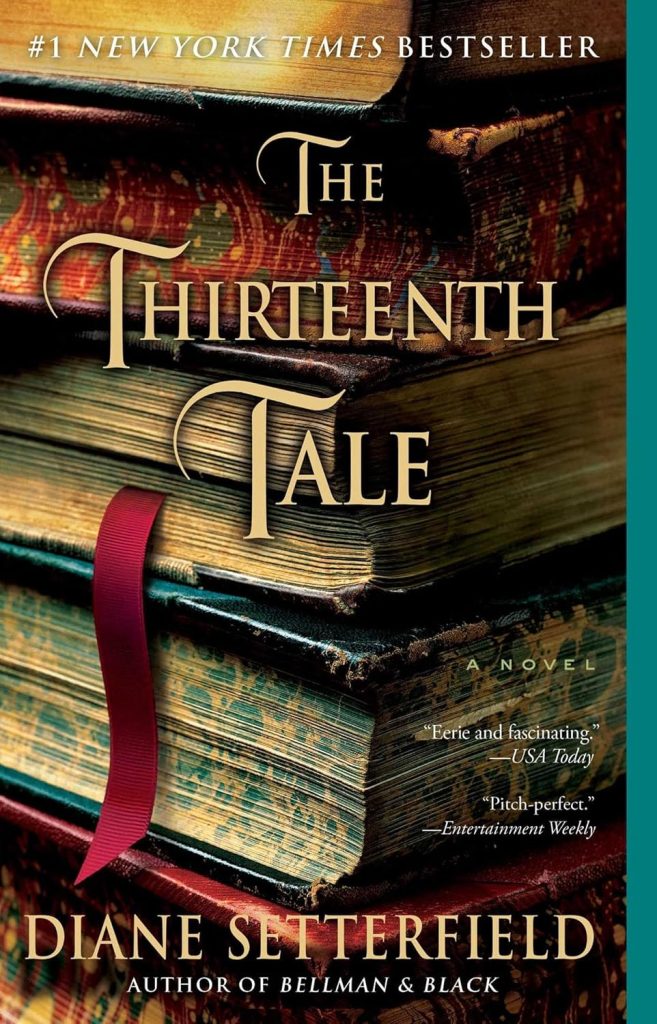
When The Thirteenth Tale came out in 2006, it arrived wrapped in gothic fog and literary nostalgia. Diane Setterfield’s debut was marketed as a love letter to Victorian storytelling—think Brontë windswept moors and Dickensian secrets—but with a contemporary awareness of how stories get shaped and reshaped over time. It became a bestseller almost immediately, which makes sense because it presses every cozy-button a certain kind of reader has: crumbling estates, reclusive authors, hidden twins, fire, madness, unreliable narration. It’s indulgent in the best way—like settling into an old armchair that creaks just enough to feel haunted.
And yes, it knows exactly what it’s doing.
What’s it about?
The novel opens with Margaret Lea, a quiet, solitary biographer who works in her father’s antiquarian bookshop. Margaret has a complicated relationship with truth. She’s spent her life surrounded by other people’s stories, preferring them to her own, especially because her own childhood includes a wound she rarely names: the loss of her twin sister shortly after birth. That quiet absence hums beneath everything she does.
Margaret is summoned by Vida Winter, a famously reclusive and wildly successful author known as much for her shifting, contradictory life stories as for her books. Over the years, Winter has given journalists dozens of mutually exclusive biographies—different parents, different childhoods, different tragedies—treating the press like a playground for fiction. But now, old and dying, she claims she wants to tell the truth. And she has chosen Margaret to record it.
Margaret travels to Miss Winter’s decaying Yorkshire estate, Angelfield House—a place that already sounds like it should come with thunder and locked doors. What unfolds is a nested narrative: Vida Winter recounting her childhood in the strange and isolated Angelfield family, while Margaret transcribes and reacts, occasionally investigating details herself.
The Angelfield story begins with the wild, feral twins Adeline and Emmeline, raised in near-total neglect by their eccentric family. The house is less a home and more a labyrinth of decay. The girls are strange—mute at times, violent, inseparable. Their uncle Charlie is both predator and victim of his own dysfunction. The adults orbiting the twins either ignore them or enable the chaos.
Into this gothic mess arrives Hester Barrow, a governess with sharp edges and a sharp mind. She attempts to impose structure and education onto the twins’ unruly existence. But the house resists order. There are secrets in the attic, in the garden, in the fire-scorched remains of parts of the estate. And hovering over everything is the question of identity: which twin survived? Who is telling this story? And what actually happened the night Angelfield burned?
As Vida’s tale deepens, Margaret becomes less passive recorder and more participant. She uncovers inconsistencies. She senses omissions. Her own twin grief begins to echo disturbingly with the twins in Vida’s story. The line between biography and confession blurs. Is Vida telling the truth now—or simply a more convincing lie?
The climactic revelations untangle the mystery of the twins’ identities and the origins of Vida Winter herself. Fire becomes both literal and symbolic destruction. The truth, when it comes, is less about shock value and more about reclamation: a woman who has hidden behind fiction deciding, finally, to be seen.
The novel closes not with tidy gothic triumph but with something quieter: Margaret reckoning with her own long-suppressed grief and choosing to step back into her own life rather than living exclusively inside other people’s stories.
What This Chick Thinks
Gothic, but self-aware
This book knows it’s playing in the Brontë sandbox. There are moors. There’s a ruined estate. There are disturbed siblings and shadowy family trees. But it doesn’t feel like cosplay—it feels like homage with purpose. Setterfield leans into the atmosphere without parodying it.
Storytelling as survival
What really hooked me wasn’t the twin mystery (though that’s juicy). It was the idea that stories are armor. Vida Winter lies because it gives her control. Margaret hides in books because it’s safer than facing her own loss. The novel keeps asking: when does storytelling protect you, and when does it isolate you?
The pacing is deliberate
This is not a twist-every-chapter thriller. It unfolds slowly, with repetition and layering. Sometimes I wanted it to tighten the screws faster. But the gradual build mirrors the act of listening to someone confess something they’ve rehearsed for decades.
Twins as metaphor—and complication
The twin motif is heavy. Identity, doubling, fragmentation—it’s all right there on the surface. But because Margaret’s personal history is tied to it, the symbolism feels emotionally earned rather than decorative.
Final Thoughts
The Thirteenth Tale is lush, moody, and unabashedly gothic. It’s a book about books, about grief, about the way we rewrite ourselves to survive. If you like layered narratives and crumbling estates with secrets in every corridor, this one absolutely delivers.
It’s not reinventing the genre—but it understands it deeply.
Rating: 8.5/10
Try it if you like:
- Rebecca — Daphne du Maurier
For another brooding estate, ambiguous memory, and slow revelation of buried truths. - The Shadow of the Wind — Carlos Ruiz Zafón
A literary mystery wrapped around the power of books and the danger of obsession. - Fingersmith — Sarah Waters
Twisty identity swaps, gothic tension, and a slow-burn unraveling of what’s real and what’s constructed.
