
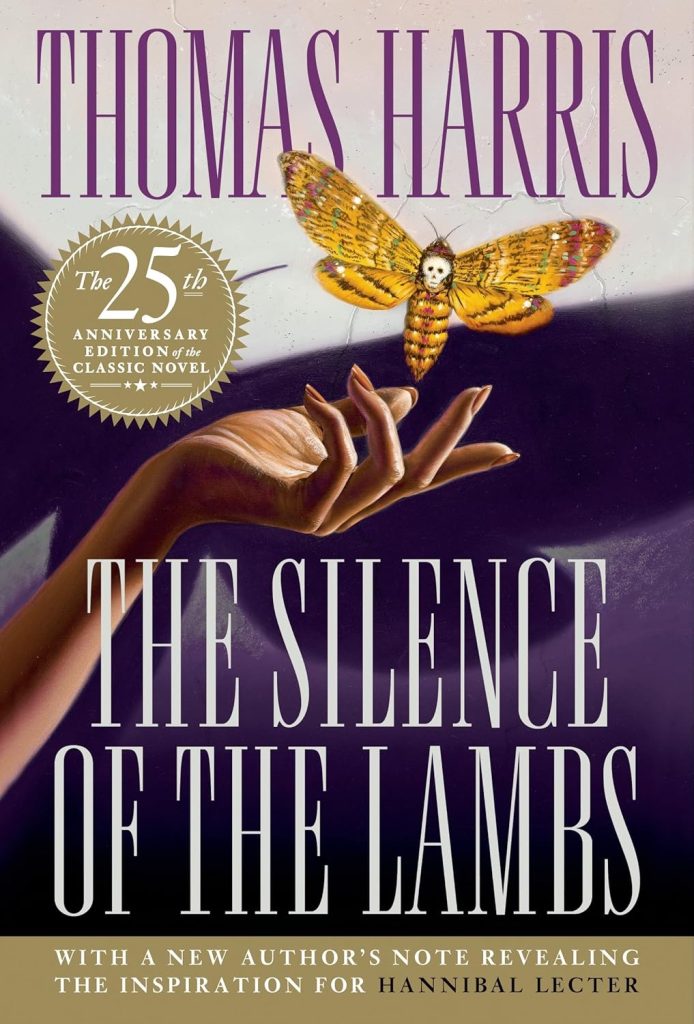
Published in 1988, The Silence of the Lambs is one of those rare thrillers that escaped its genre cage and became cultural mythology. Thomas Harris had already introduced Hannibal Lecter in Red Dragon, but this is the book that turned him into an icon—refined, terrifying, weirdly magnetic. It won’t surprise anyone that the 1991 film adaptation swept the Oscars, but the novel itself is doing something slightly different: it’s colder, more procedural, more psychologically granular. It’s not just about catching a killer. It’s about ambition, power, vulnerability, and the cost of being underestimated.
This is crime fiction with teeth—and not just Hannibal’s.
What’s it about?
The novel centers on Clarice Starling, a young FBI trainee pulled from Quantico by Jack Crawford, head of the Bureau’s Behavioral Science Unit. A serial killer nicknamed “Buffalo Bill” is abducting and murdering women, skinning them post-mortem in a grotesque ritual that suggests something deeply psychological at play. The FBI is running out of time. The latest victim is the daughter of a U.S. senator, and political pressure is mounting.
Crawford sends Clarice to interview Dr. Hannibal Lecter, a former psychiatrist and incarcerated cannibalistic serial killer. The hope? That Lecter’s insight into the criminal mind might help profile Buffalo Bill. Lecter is imprisoned in a high-security psychiatric facility, contained behind glass and steel. But from the moment Clarice meets him, it’s clear that physical containment doesn’t equal power.
Their first encounter sets the tone. Lecter is courteous, precise, unnervingly perceptive. He dissects Clarice within minutes—her accent, her background, her ambition. He offers information in exchange for personal revelation. Quid pro quo. He doesn’t just want data—he wants intimacy. And he knows exactly how to extract it.
Meanwhile, Buffalo Bill continues his abductions. We are given chilling glimpses into his world: a basement prison, a captive woman trapped in a well, a man attempting to transform himself through violence and skin. Harris doesn’t sensationalize Bill so much as he anatomizes him. The novel delves into his childhood trauma, his fractured identity, and his obsessive need to become someone else. Importantly, Harris avoids equating Bill’s pathology directly with transgender identity (though this aspect remains controversial and debated). Bill’s crimes are rooted in abuse, rejection, and psychopathy—not gender identity—but the line is one the book treads carefully and not always comfortably.
As Clarice investigates, the procedural elements unfold with mounting tension: interviews, autopsy reports, forensic clues, psychological profiling. But the emotional spine of the novel is her relationship with Lecter. Each visit peels back layers. He senses her hunger—to prove herself, to escape her Appalachian roots, to silence the memory of the lambs screaming during her childhood on her uncle’s farm. That memory becomes the book’s metaphor: Clarice trying to save something innocent, something doomed.
Lecter manipulates events even from behind bars. He dangles clues. He engineers his own transfer to a different facility. And in one of the novel’s most famous sequences, he stages a brutal, brilliant escape that showcases both his monstrousness and his terrifying intelligence. The escape doesn’t derail the central plot—it intensifies it. Clarice is now racing against time without Lecter’s leash.
The investigation leads to a breakthrough, but not through luck—through Clarice’s empathy and attention to detail. She sees what others dismiss. She listens differently. In the final confrontation, she finds herself alone in Buffalo Bill’s darkened basement, stripped of backup and technology. The climax is nerve-shredding—Bill stalking her in night vision, her blind and vulnerable. It’s not glamorous. It’s terrifying.
Clarice survives. Bill doesn’t. But the novel doesn’t end with applause. It ends with a letter from Lecter—now free, somewhere in the world—thanking her for the “stimulating” correspondence and promising he has no plans to hunt her. He has other old acquaintances in mind.
The lambs, we’re left to understand, may never fully stop screaming.
What This Chick Thinks
Clarice Starling is the real star
It would be easy to let Hannibal dominate this book, but Harris keeps Clarice at the center. She’s ambitious, intelligent, and painfully aware of being underestimated in a male-dominated institution. The scenes where men stare too long, condescend too easily, or test her competence are some of the most quietly enraging parts of the book. Clarice isn’t invincible—she’s disciplined. And that makes her compelling.
Her childhood backstory—the lambs, the orphaned vulnerability—could have tipped into cliché, but Harris handles it with restraint. It’s not trauma porn. It’s motivation. She wants to stop the screaming. That’s it. It’s heartbreakingly simple.
Hannibal Lecter: terrifying because he’s small
Lecter isn’t in the book as much as pop culture makes you think. But every scene he’s in hums. He’s not loud. He’s not chaotic. He’s polite. Curious. Almost affectionate toward Clarice in his own twisted way. That civility makes him worse. He doesn’t rage. He calculates. And the quid pro quo dynamic between them is some of the sharpest dialogue in crime fiction.
Buffalo Bill is disturbing in a grounded way
The basement scenes are hard to read—not because they’re gratuitous, but because they’re claustrophobic. Harris focuses on sensory detail: darkness, dampness, breath. The horror feels intimate. That said, the portrayal of Bill has aged into complicated territory. While the book explicitly states he is not transgender, the imagery of transformation-through-skinning has understandably sparked debate. It’s worth reading critically.
The procedural spine keeps it tight
Unlike some thrillers that get lost in spectacle, this one stays rooted in investigation. Autopsies matter. Interviews matter. Small deductions matter. The pacing is tight without being frantic. Harris trusts the reader to follow psychological nuance without spoon-feeding.
It’s bleak—but not nihilistic
What surprised me most is that The Silence of the Lambs isn’t as cynical as I expected. Yes, it’s violent. Yes, it’s dark. But Clarice’s empathy is treated as strength, not weakness. The novel suggests that understanding—even of monsters—can be a tool for justice.
Final Thoughts
The Silence of the Lambs is a masterclass in psychological suspense. It’s tense without being flashy, disturbing without being gratuitous, and anchored by one of the most compelling heroines in crime fiction. Hannibal Lecter may be the icon, but Clarice Starling is the soul.
It’s unsettling, sharp, and difficult to put down.
Rating: 9/10
Try it if you like:
- Red Dragon — Thomas Harris
Lecter’s earlier appearance, featuring profiler Will Graham and another chilling killer. More procedural, equally intense. - The Girl with the Dragon Tattoo — Stieg Larsson
Dark, investigative thriller with a fierce, complicated female lead navigating violence and power structures. - In the Woods — Tana French
Psychological crime fiction that leans heavily into character and atmosphere, with emotional depth layered beneath the mystery.
