
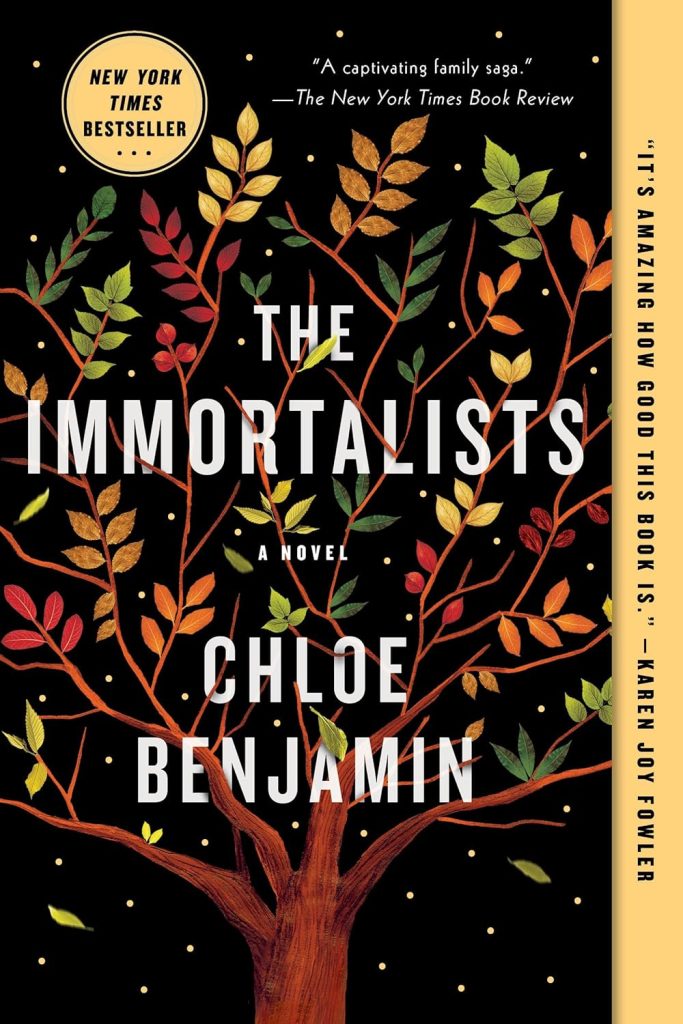
When The Immortalists came out in 2018, it felt like one of those high-concept literary novels that could’ve gone either way. The premise is irresistible: four siblings visit a traveling psychic as children and are each told the exact date they will die. That’s it. That’s the hook. But what Chloe Benjamin does with that hook is less thriller, more meditation. It’s not about whether the predictions are true—it’s about what happens when you believe they are.
Set across decades and cities—New York, San Francisco, Las Vegas—the novel traces the Gold siblings from 1969 into the early 21st century. It’s lush, character-driven, and very interested in the tension between fate and choice. It asks: if you knew when you were going to die, would you live bigger? Safer? Wilder? Or would the knowledge quietly cage you?
What’s it about?
It begins on the Lower East Side of Manhattan in 1969. The Gold children—Varya, Daniel, Klara, and Simon—are young, restless, and deeply curious when they hear about a woman in their neighborhood who claims to see the future. She tells you the date of your death. No more, no less.
It’s Simon, the youngest, who pushes them to go. They sneak out one afternoon, climb the stairs to the psychic’s apartment, and, one by one, are told their fates. The book never reveals exactly what she says in that moment—we only learn the dates later, as each sibling’s story unfolds.
The novel is structured in four sections, one for each sibling, moving roughly in order of their predicted deaths.
Simon
Simon is told he will die young. So he leaves. He runs from New York to San Francisco in the late 1970s, drawn to the city’s burgeoning gay scene and the promise of a life lived loudly and unapologetically. Simon’s section pulses with freedom—disco lights, bathhouses, love affairs, found family. He refuses caution. He refuses invisibility. If his life is going to be short, he’ll make it electric.
But this is the early 80s. The AIDS crisis looms, first as rumor, then as horror. Friends get sick. Fear replaces glitter. Simon’s storyline becomes a portrait of a generation caught between liberation and catastrophe. His belief in the prophecy shapes him—not in subtle ways, but in open defiance. He chooses risk. He chooses joy. And whether the prophecy is fate or self-fulfilling becomes a question that lingers long after his section ends.
Klara
Klara, the dreamy second-youngest, also receives an early death date. But her reaction is different. She channels her fear into mysticism. She becomes a magician—literally—obsessed with illusion, reincarnation, and the possibility of bending reality. She moves to Las Vegas and builds a career on spectacle, smoke, and misdirection.
Her section is lush and theatrical. Klara is theatrical. She believes, deeply, in the possibility that the psychic’s prediction can be undone. She studies death, studies spiritualism, searches for loopholes. She falls in love, becomes a mother, and builds a life that feels almost enchanted. But there’s always a ticking clock beneath the sequins.
Her relationship with belief—faith versus denial—is one of the novel’s strongest threads. Klara doesn’t want to surrender to fate. She wants to outsmart it.
Daniel
Daniel, pragmatic and controlled, reacts to his prediction with suspicion. He becomes a doctor—an army physician, eventually—trying to tether himself to science, logic, certainty. He doesn’t want to believe the psychic. He doesn’t want to grant her power. But the date lives in his mind anyway.
Daniel’s section feels colder, more restrained. He’s disciplined, emotionally guarded, trying to outrun anxiety by controlling everything he can. He marries, builds a respectable life, avoids chaos. But his skepticism isn’t freedom—it’s tension. The prophecy sits like a splinter. And when events unfold that echo his predicted death, his rationality starts to crack.
His arc wrestles most directly with the idea of self-fulfilling prophecy. If you fear something long enough, do you eventually create it?
Varya
Varya, the eldest, is told she will live the longest. Instead of relief, this knowledge becomes its own burden. She dedicates her life to longevity research, studying aging in monkeys, chasing the science of life extension. If she is meant to outlive everyone, what does that even mean? What kind of life is she preserving?
Her section is quieter, more contemplative. Varya grapples with loneliness, guilt over her siblings’ deaths, and the question of whether knowing your lifespan robs you of the ability to simply exist. Her long life isn’t glamorous—it’s heavy. She carries memory like a second skin.
As the novel moves toward its close, the siblings’ lives—though physically distant—feel interwoven. Their childhood visit to the psychic becomes less about prediction and more about perception. Each sibling lived in response to that moment. Whether the dates were true almost becomes irrelevant. The prophecy shaped them. That’s the truth that matters.
In the final chapters, the mystery of the psychic is gently probed—not with a dramatic reveal, but with a suggestion that the power was never in her. It was in what the children chose to believe.
What This Chick Thinks
The structure is genius
Dividing the novel by sibling is such a smart move. Each section feels like its own novella—distinct tone, pace, emotional register. Simon’s story is vibrant and tragic. Klara’s is lush and mystical. Daniel’s is tense and cerebral. Varya’s is reflective and heavy. You get four different answers to the same question: how do you live under a deadline?
Fate vs. free will is handled with restraint
I loved that Benjamin doesn’t turn this into a thriller about whether the psychic is real. She sidesteps the obvious genre trap. The book isn’t about supernatural mechanics—it’s about psychology. The prophecy becomes a lens. It shapes identity, ambition, fear. That’s far more interesting than a twist.
Simon’s section is the standout
Emotionally, Simon’s arc hits hardest. The backdrop of the AIDS epidemic gives the prophecy devastating context. It’s not just about a predicted death—it’s about a historical one. His joy feels urgent. His recklessness feels both brave and heartbreaking. That section alone could stand as a novel.
It’s not without softness
At times, the prose leans toward lyrical abstraction. Some emotional beats feel slightly polished, like they’ve been sanded down for symmetry. The siblings occasionally feel more symbolic than messy. But the thematic cohesion is so strong that I didn’t mind.
The lingering question
What stayed with me most wasn’t “Was the psychic right?” It was this: would knowing your death date free you—or trap you? The novel doesn’t answer. It just shows four possibilities.
Final Thoughts
The Immortalists is thoughtful, elegantly structured, and emotionally resonant. It takes a high-concept premise and refuses to sensationalize it. Instead, it offers a meditation on fear, ambition, family, and the stories we tell ourselves about time. It’s not explosive. It’s contemplative. And it lingers like a question you’re still turning over weeks later.
Rating: 8.5/10
Try it if you like:
- Life After Life — Kate Atkinson
Another novel obsessed with mortality and possibility, following one woman across multiple lifetimes. - The Dutch House — Ann Patchett
A sibling-focused family story with emotional layering and long-term consequences. - Never Let Me Go — Kazuo Ishiguro
A quieter, more haunting meditation on fate, knowledge, and how foreknowledge shapes identity.
