
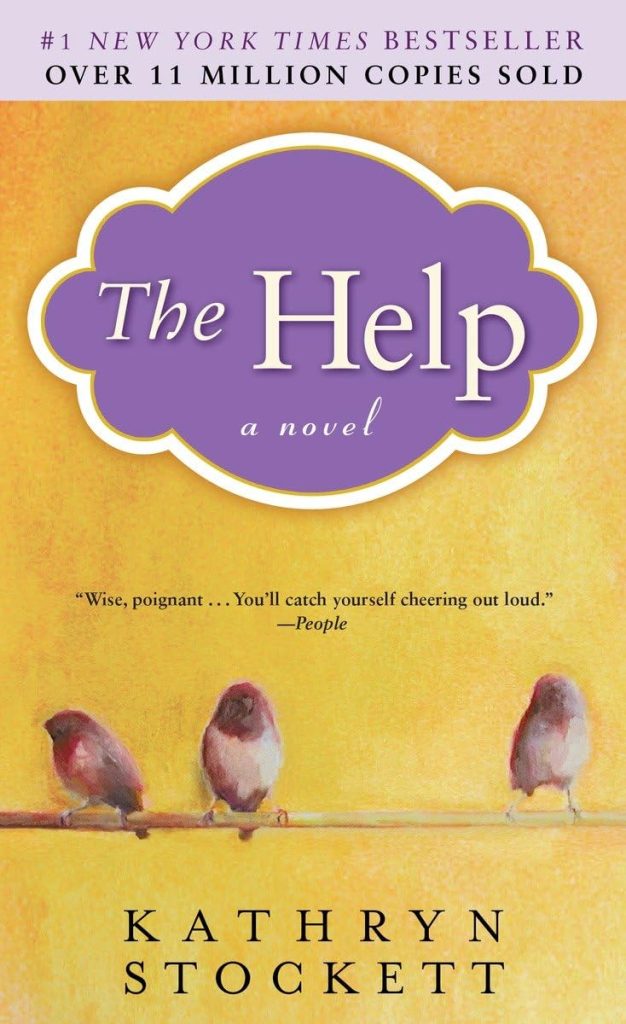
When The Help was released in 2009, it became an instant publishing phenomenon: a debut novel that topped bestseller lists for over 100 weeks, got turned into an Oscar-winning movie, and sparked both adoration and critical debate. Set in 1960s Jackson, Mississippi, The Help tells the story of Black maids and the white women who employ them—and how one young white woman decides to write it all down. It’s part historical fiction, part coming-of-age story, part social commentary, and part feel-good redemption arc. It’s also deeply readable, emotionally engaging, and, yes, complicated.
What’s it about?
The novel opens in 1962, during the thick of the Jim Crow era, with the voices of three women:
- Aibileen, a middle-aged Black maid who has raised 17 white children, currently caring for toddler Mae Mobley Leefolt while grieving her own son’s recent death;
- Minny, Aibileen’s sharp-tongued best friend and an incredible cook, who keeps getting fired for speaking her mind; and
- Skeeter Phelan, a white, 23-year-old aspiring journalist fresh out of Ole Miss, unmarried, tall, awkward, and increasingly uncomfortable with the social world she’s expected to conform to.
Skeeter returns home to Jackson with vague dreams of writing, only to find that her childhood maid, Constantine, who practically raised her, has vanished under mysterious circumstances. No one will talk about it. This loss becomes the quiet emotional spine of the book and nudges Skeeter into seeing her world differently.
She lands a job writing a cleaning advice column for the local paper—but because Skeeter has never cleaned a day in her life, she turns to Aibileen for help. Their meetings start tentatively, almost transactionally. But soon Skeeter starts to ask bigger questions—about what it’s like to work for white families, to raise white children who grow up to become their mothers, to be invisible while in plain sight.
What emerges is a risky, clandestine collaboration: Skeeter decides to collect the stories of Black maids in Jackson and publish them anonymously. It’s dangerous work—for all of them. If the maids are caught speaking out, they could lose their jobs, their homes, or worse. But as more women come forward, something shifts. Their voices begin to stack up, and the act of telling the truth becomes its own quiet revolution.
Each maid’s story adds texture to the mosaic: tales of humiliation, tenderness, fear, exhaustion, and pride. Some stories are devastating. Others are shockingly funny. And one story—Minny’s infamous “Terrible Awful Thing” involving a pie and a racist employer—is so outrageous it becomes the safeguard that makes the whole book possible. It’s petty justice, yes, but also power reclaimed.
Meanwhile, Skeeter’s social life is unraveling. Her friends, especially the icy queen bee Hilly Holbrook, are furious about her sympathies. Hilly, who pushes the “Home Help Sanitation Initiative” to require separate outdoor toilets for Black maids, represents the insidious normalcy of Southern racism. Skeeter’s rebellion costs her: she loses friends, potential romance, and the fragile approval of her conservative mother. But she keeps going.
As the book moves toward publication, tension builds. The maids know that no pseudonym can fully protect them. The community begins to stir. Consequences land. But so does a kind of freedom—not in the legal or political sense, but in the private, deeply human sense of being heard.
The novel closes with changes small and large. Some women lose their jobs. One gains a measure of safety. A friendship deepens. A truth is printed. A voice travels farther than it ever has before. And while no system is overthrown, no villain unseated, The Help suggests that even a crack in the surface of injustice can matter.
What This Chick Thinks
Compulsively readable, even when it shouldn’t be
Let’s just start here: the writing flows. Kathryn Stockett has that rare talent for voice—Aibileen’s calm grace, Minny’s spitfire delivery, Skeeter’s fumbling earnestness. You inhale chapters without realizing it. Even when the subject matter is heavy—racism, grief, humiliation—the book keeps its momentum. That tension between style and subject is part of what makes it feel good to read, even when what you’re reading is awful. That’s a tricky, risky line to walk.
Aibileen is the soul of the book
Her chapters are the quietest, but the most devastating. The way she talks to Mae Mobley—trying to protect that child from absorbing the racism that surrounds her—is a masterclass in emotional restraint. Aibileen is tired, deeply lonely, and still clings to a kind of moral clarity that feels almost radical in its gentleness. She’s the character that lingers long after the last page.
The power of telling, not fixing
One of the smartest choices the novel makes is showing that telling stories doesn’t solve everything. These women don’t become rich. Racism doesn’t vanish. But what changes is their sense of agency. There’s a line somewhere that basically says, “We are not just the help. We are people.” That doesn’t sound revolutionary—but in this context, it is. The act of speaking, of being documented, matters.
But the perspective is… complicated
There’s no getting around this: The Help is a book about Black maids in the 1960s written by a white woman in the 2000s. That fact alone doesn’t invalidate it—but it does make it messy. There’s an undeniable tension between the emotional impact of the story and the question of who gets to tell it. Skeeter is often positioned as the vehicle for change, which raises uncomfortable echoes of the “white savior” trope, even if the book tries to complicate that.
Some of the criticism the book has received—about oversimplification, about smoothing the sharpest edges of systemic racism—is completely fair. And if you find yourself thinking, “Wait, am I supposed to feel good after this?”… yeah. Same. It wants you to.
But I’d argue that it also wants you to see how fragile comfort is. And how much risk it took for these women to say anything at all.
The comedy cuts both ways
Minny is hilarious. The pie story is legendary. The social satire—Hilly’s party planning, the Junior League politics, the façade of Southern gentility—is on point. But sometimes the humor skirts a little too close to caricature, especially when it’s used to soften scenes that might otherwise be rawer. That said, the comedy also makes the horror land. Racism isn’t always overt violence—it’s social ritual, enforced with cake and side-eye.
Final Thoughts
The Help is engaging, emotional, problematic, and powerful—all at once. It’s not perfect. It doesn’t dismantle systems. But it shines a light on people who were rarely given a voice, and even though that voice is filtered through a white author’s imagination, it still manages to say something true. The book is a gateway, a conversation starter, a story about how dignity can survive silence—and how telling the truth, even once, can shake the walls.
Rating: 8/10
Try it if you like:
- The Secret Life of Bees — Sue Monk Kidd
Another Southern-set novel exploring race, grief, and unconventional family structures, with lyrical prose and emotionally charged relationships. - The Nickel Boys — Colson Whitehead
A much darker, more historically grounded take on institutional racism and injustice. Less comforting, more confrontational—but essential. - Small Great Things — Jodi Picoult
A contemporary courtroom drama about race, privilege, and medical ethics, written with similar intentions but also surrounded by similar controversies.
