
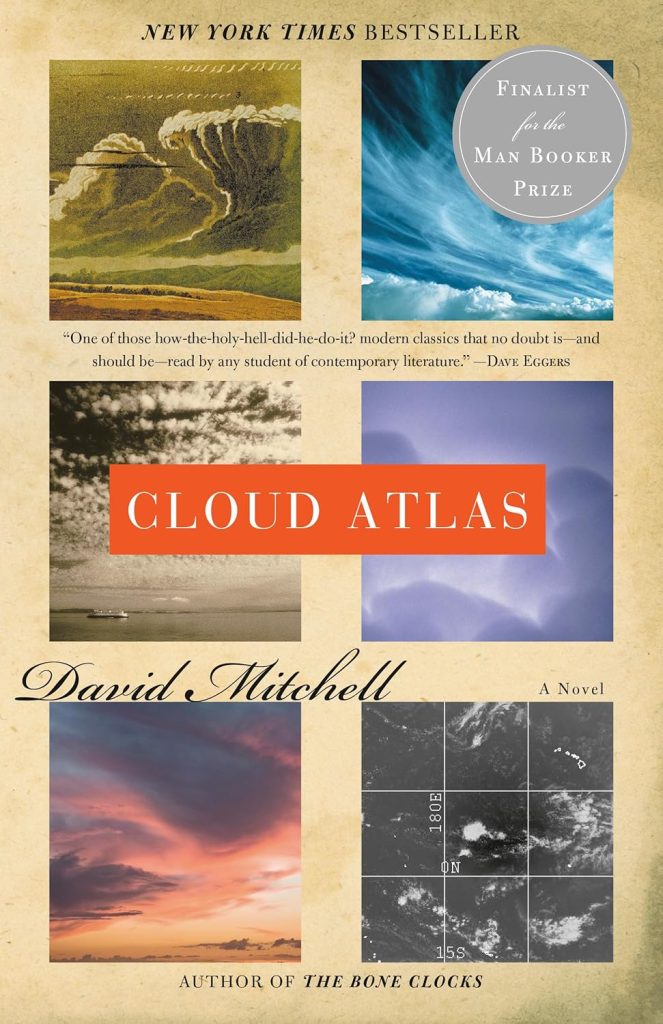
David Mitchell’s Cloud Atlas, published in 2004, is one of those rare literary feats that almost dares you to underestimate it. You start reading, thinking you’ve picked up a historical travelogue, or maybe a dystopian thriller, or possibly an epistolary romance—and then you realize: it’s all of them. Structured as six interlocking narratives, each written in a different style and spanning radically different times, voices, and genres, Cloud Atlas is as much about storytelling itself as it is about humanity. It’s ambitious, eccentric, and occasionally maddening—but it’s also one of the most structurally playful and intellectually satisfying novels I’ve read in years. It’s literary fiction doing its best impression of a symphony, with every instrument crashing in and out until, somehow, it all resolves.
What’s it about?
Well. Buckle in.
Cloud Atlas is composed of six nested stories, each cutting off abruptly at its midpoint—like a Matryoshka doll sliced in half—before returning, in reverse order, to complete each narrative in the second half of the book. Every story is written in a distinct voice, set in a different era (from the 19th century to a distant, post-apocalyptic future), and every protagonist either discovers or references the previous narrative in some form. It’s meta without being smug, and the connective tissue is less about plot and more about patterns: power, resistance, exploitation, recurrence, memory.
- The Pacific Journal of Adam Ewing (1849)
We begin with Adam Ewing, an American notary crossing the South Pacific aboard a ship en route from the Chatham Islands. He’s writing in his journal, detailing encounters with missionaries, colonizers, and the brutal treatment of the Indigenous Moriori people. Ewing befriends a runaway slave, Autua, and becomes increasingly ill—possibly poisoned by a shifty doctor who may or may not be keeping him sick for profit. It’s a seafaring, colonial-era travelogue laced with moral anxiety and hidden agendas. But then—just as things start to feel dire—the journal cuts off mid-sentence. - Letters from Zedelghem (1931)
The next story unfolds via letters written by Robert Frobisher, a young, penniless, and wildly charismatic composer who cons his way into becoming the amanuensis for a reclusive, aging genius in Belgium. Frobisher is bisexual, sharp-tongued, brilliant, and more than a little reckless. He composes a piece called The Cloud Atlas Sextet—a musical work that echoes the novel’s own structure. His letters (addressed to his lover Rufus Sixsmith) are witty, caustic, and dripping with mid-century decadence, but the deeper we go, the more the letters reveal Frobisher’s decline—artistically, emotionally, and morally. And then? Another abrupt end. - Half-Lives: The First Luisa Rey Mystery (1975)
Jump cut to a full-on 1970s political thriller. Half-Lives follows Luisa Rey, a determined young journalist investigating corporate corruption at a nuclear power plant in Buenas Yerbas, California. The story reads like a paperback spy novel—fast pacing, shadowy villains, exploding cars—but it’s also grounded by Luisa’s stubborn idealism and her growing sense that the truth might cost her life. She uncovers a report by an old physicist (Rufus Sixsmith—yes, that one) that could shut down the plant and save countless lives. Her story ends mid-climax, quite literally with a gun aimed at her chest. - The Ghastly Ordeal of Timothy Cavendish (Early 21st Century)
Easily the most comedic of the six, this one follows Timothy Cavendish, a grumpy, aging vanity publisher who accidentally makes a fortune when one of his gangster clients commits a murder. Fleeing from the dead author’s angry brothers, Cavendish ends up imprisoned in what he thinks is a hotel—but is actually a sinister nursing home. His attempts to escape become increasingly ridiculous. It’s all told in first person, in a voice that’s half Philip Roth, half sitcom narrator. Cavendish’s plight is hilarious, until it’s suddenly… not. - An Orison of Sonmi~451 (Dystopian Future Korea, called Nea So Copros)
Now we’re into sci-fi territory. Sonmi~451 is a genetically-engineered “fabricant” (clone) designed to serve in a dystopian fast-food chain. In her world, corporations run everything, humans are divided by caste, and “ascension” is promised but rarely delivered. Sonmi begins to awaken—becoming sentient, literate, revolutionary. Her story is told via interview, as she recounts her involvement in an underground movement and the horrific revelations about what happens to fabricant workers. Her awakening is both ideological and emotional. She becomes a martyr, a myth, and a mirror for every act of rebellion that came before her. - Sloosha’s Crossin’ an’ Ev’rythin’ After (Post-apocalyptic far future, “The Big Island”)
The inner core of the novel is narrated by Zachry, a tribesman living on a post-collapse Hawaii-like island, speaking in a broken, dialect-heavy voice that reflects centuries of linguistic decay. His people live in fear of the “Kona”—brutal raiders—and worship the remnants of a tech-filled past. Zachry’s world changes when Meronym, a visitor from a more advanced civilization (“the Prescients”), arrives to study them. Zachry’s story is the bleakest, yet most spiritually resonant: a brutal struggle for survival, interwoven with questions about morality, myth, and whether humans are doomed to repeat the same cycles.
Then the novel works its way back out, finishing each story in reverse order. We return to Sonmi’s fate, Cavendish’s escape, Luisa’s investigation, Frobisher’s tragedy, and finally Adam Ewing’s resolution. By the end, the stories reflect each other—not through direct causality, but through themes and reincarnated souls (a comet-shaped birthmark appears across timelines). Each protagonist, in their own way, fights against power, lies, and erasure. And each narrative, when read beside the others, becomes a meditation on legacy and recurrence: the idea that we are not isolated, that our actions ripple forward, that resistance matters, even if no one remembers it.
What This Chick Thinks
Structure as story
The architecture of Cloud Atlas is famous for a reason. Mitchell isn’t just showing off—though let’s be clear, he is definitely showing off—but the structural design is the point. These aren’t just six stories slapped together. They interrupt each other, echo each other, and build a cumulative tension. It’s like literary relay racing. And when we return to each one in reverse, the emotional payoff is surprisingly strong. Every arc lands harder because of the time spent away.
Voice-driven brilliance
Mitchell pulls off a wild stylistic range here. Each section could believably be written by a different author. Frobisher’s letters are decadent and tragic. Cavendish’s memoir is laugh-out-loud funny. Sonmi’s tale is clinical and mournful. Zachry’s dialect-heavy narration is maybe the toughest to get into, but it’s vital—it’s the novel’s spiritual anchor. The virtuosity is kind of thrilling, honestly. You don’t just read these sections—you enter them.
Big themes, zero subtlety
This is a novel about power, history, reincarnation, colonialism, capitalism, violence, freedom, art, truth, and what endures. And it is not shy about telling you that. Sometimes Mitchell leans too hard into his thesis—there are lines that feel like underlined boldface messages to the reader—but when the storytelling is this compelling, I’ll allow a bit of philosophical earnestness.
The slow start is real
Let’s be honest: the first 50 pages are work. Adam Ewing’s journal, with its archaic language and colonial jargon, almost made me quit. But once Frobisher kicks in, the book starts to flex. It rewards patience. But this is very much a novel that demands attention, especially early on. Casual readers might bounce off it before they get to the good stuff.
It’s not a puzzle—it’s a pattern
People sometimes treat Cloud Atlas like a code to be cracked, but it’s more of a melody. The pleasure is in the recurrence—the names, the choices, the betrayals, the redemptions. Mitchell isn’t arguing for literal reincarnation (though he plays with the idea); he’s showing that human stories repeat. That we rise and fall in the same rhythms. That freedom is always contested, always fragile. That kindness and cruelty travel together. That storytelling is memory.
Final Thoughts
Cloud Atlas is bold, bizarre, intricate, and occasionally overwrought—but it’s also a love letter to storytelling in all its forms. It’s not about decoding the plot. It’s about noticing how every human struggle contains the seeds of another. It asks a lot. It gives more. And by the time you close it, you’ll be thinking in echoes.
Rating: 9/10
Try it if you like:
- The Overstory — Richard Powers
Another sprawling, multi-threaded epic, this time with trees, climate, and deep time. Less genre-hopping, same interlocking human web. - The Bone Clocks — David Mitchell
Mitchell revisits many of Cloud Atlas‘s themes in a more linear (but still weird) structure, with deeper dives into metaphysics and soul wars. - If on a winter’s night a traveler — Italo Calvino
A metafictional classic that plays with form and fractured narratives. Trickier and more surreal, but spiritually kin.
