
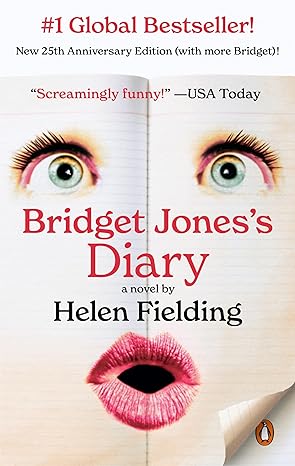
Helen Fielding unleashed Bridget Jones’s Diary into the world in 1996, and it basically detonated an entire subgenre—modern “chick lit,” messy-woman comedy, diary-style confessionals, whatever label you want to use. Before Bridget, female protagonists in mainstream fiction were rarely allowed to be so blatantly chaotic, self-sabotaging, funny, insecure, hopeful, wrong, and relatable. Fielding drew loosely on Pride and Prejudice, infused it with 90s singleton angst, and created a cultural icon whose influence still ripples through everything from rom-coms to Instagram humor. It’s light and fizzy, sure—but it’s also sneakily sharp in how it captures the gap between who we are and who we’re told to be.
What’s it about?
The book unfolds as a year-long diary written by Bridget Jones, a thirtysomething Londoner whose life is a rotating carousel of calorie counting, cigarette tallies, awkward flirtations, office mishaps, and emotional spirals. The entire thing reads like a confessional that accidentally went public: Bridget documenting her New Year’s resolutions (“Reduce thighs by three inches,” “Form functional relationship with responsible adult”), only to repeatedly break them by week two. Or day two.
She works at a publishing house where she secretly (and not-so-secretly) pines after her charismatic, wildly inappropriate boss, Daniel Cleaver. Their flirtation is built on slick emails and sexual tension and the kind of banter that ages questionably but makes total sense for two people who mistake charm for sincerity. Daniel is fun—but unreliable, messy, and chronically noncommittal. Bridget knows this, and also absolutely does not know this.
Her social life is a chaotic comfort. We meet her core friend group: Shazzer (feminist firebrand with a sailor’s mouth), Jude (emotionally dramatic, spiritually fragile, constantly reading self-help), and Tom (lovely and flamboyant and deeply invested in Bridget’s happiness). Their group chats—well, pre-chat chats, pub debriefs—are full of advice that is equal parts empowering, misguided, and completely unhinged. But they’re ride-or-die, and they form the emotional scaffolding Bridget clings to when her romantic life implodes.
Then there’s her family. Bridget’s mum is having a midlife crisis in real time, chasing reinvention through tacky talk shows and a sketchy Portuguese “businessman.” Her dad is bewildered and quietly heartbroken. There are holiday dinners, misguided matchmaking attempts, and constant commentary about Bridget’s weight, singleness, and “biological clock” ticking like a time bomb in the corner.
Enter Mark Darcy. A stiff, awkward, socially wooden barrister who keeps appearing at family functions wearing terrible jumpers and looking like he’d rather be anywhere else. Bridget writes him off immediately—he seems judgmental, unfriendly, and allergic to fun. But as the year rolls on, Mark’s awkwardness becomes surprisingly endearing, while Daniel’s charm begins to curdle. Especially when Daniel is revealed to be exactly the kind of commitment-phobic disaster everyone warned her about.
Bridget’s romantic arc is framed through her cycle of high and low self-esteem, misinterpretations, emotional leaps, catastrophizing, and tiny victories. She oscillates between believing she is unlovable and believing she is the heroine of her own rom-com—and both feel completely believable. The diary entries chart every wobble: drunken calls, disastrous dinner parties, humiliating misunderstandings, minor triumphs at work, major blowups at home.
Meanwhile, her professional world is shifting. After the breakup with Daniel, Bridget quits her job in a blaze of impulsive pride and reinvents herself as a TV journalist—sort of. Her first on-camera appearance is a mess (think: knickers on display), but also a turning point where she realizes she’s capable of reinvention even when she faceplants. Literally.
The emotional climax arrives slowly, almost by accident. Mark reappears not as a romantic savior, but as someone who’s quietly, steadily been showing up. He advocates for Bridget, defends her to his horrible parents, respects her weirdness, and sees her humanity in a way Daniel never did. Their dynamic shifts from awkward to tender. Bridget begins to trust she might actually deserve someone kind. And Mark, in his painfully proper way, finally lets his feelings show.
By the time New Year’s rolls around again, Bridget isn’t transformed into a new woman—she’s simply more herself. A little braver. A little more honest. A little less inclined to measure her worth in pounds, cigarettes, and male attention. The diary doesn’t end with a wedding or a moral. It ends with a woman choosing to treat herself with more tenderness than she did a year ago—and in its own messy way, that’s the whole point.
What This Chick Thinks
Bridget is a train wreck in the BEST way
There’s something incredibly comforting about how unfiltered she is. Not aspirational—just honest. She says the embarrassing thing. She obsesses over the wrong men. She panics, overeats, overthinks, and occasionally triumphs. You don’t admire Bridget; you root for her, because she’s doing her best even when her best is a flaming disaster.
The satire hits surprisingly hard
Fielding has a scalpel for social critique. Weight-obsessed culture? Nailed. Office sexism? Absolutely. Pressure to get married by thirty? Hammered. Family hypocrisy? Served with a martini and a barbed compliment. The book skewers the expectations placed on women with humor that’s funny precisely because it’s cruelly accurate. The comedy isn’t fluff—it’s armor.
Daniel vs. Mark feels timeless
Daniel is chaos in loafers. Mark is slow-burn decency. The romance works because Fielding doesn’t pretend Bridget needs to change to earn love—she just needs to stop mistaking inconsistency for affection. Watching her shift from chasing someone exciting to choosing someone kind feels earned, not preachy.
The format is perfect—for this story
The diary entries are breathless, choppy, hilarious, and intimate. They reflect Bridget’s mental weather in real time. But the format also means some emotional beats land sideways. Big events get swallowed by joke timing. Serious moments get half a paragraph. It works—but occasionally I wanted just a couple more lines to let things resonate before we darted off to calories or cigarettes again.
Occasionally dated, always human
The 90s gender politics aren’t always graceful. Some jokes have aged like unrefrigerated dairy. But at its core, the story holds because it’s about self-worth, desire, embarrassment, hope, and the deeply human urge to be loved without performance. Bridget’s voice is the glue, and her vulnerability makes the whole thing sing.
Final Thoughts
Bridget Jones’s Diary is fizzy, flawed, and deeply lovable. It’s an iconic snapshot of a woman trying—and failing, and trying again—to build a life that feels like hers. Fielding’s blend of satire, vulnerability, and observational comedy still sparkles, even when the cultural trappings have aged. It’s a comfort read that doesn’t pretend life is tidy, and that might be why it still resonates.
Rating: 8/10
Try it if you like:
- High Fidelity — Nick Hornby
Another messy narrator spiraling through self-doubt, bad decisions, and romantic delusion—just with music instead of cigarettes and calories. - Eleanor Oliphant Is Completely Fine — Gail Honeyman
Not a comedy, but a similarly intimate character portrait about loneliness, reinvention, and learning to be kinder to yourself. - I Don’t Know How She Does It — Allison Pearson
A different flavor of chaos—working-mother burnout—but with the same mix of humor, self-scrutiny, and cultural commentary.
