
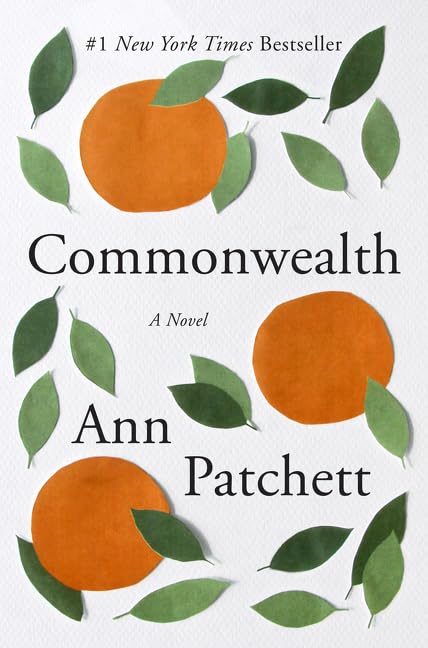
Ann Patchett is known for novels that feel both intimate and sweeping—like someone whispering secrets across generations. Commonwealth, published in 2016, is maybe her most autobiographical-feeling book (though she says it isn’t exactly). It spans fifty years, centers around a blended, fractured family, and unfolds not with a twisty plot, but with deep, layered observation. It’s about the stories families tell, the ones they bury, and what happens when someone writes them all down.
It’s funny, melancholic, gentle, and quietly brutal. It doesn’t try to dazzle. It just settles into your skin like memory.
What’s it about?
It starts with a kiss.
At a christening party in Los Angeles in the early 1960s, Bert Cousins—a prosecutor with a briefcase full of orange juice and gin—crashes the celebration for baby Franny Keating, the second daughter of Fix and Beverly Keating. Midway through the party, Bert kisses Beverly in the kitchen. She kisses him back. It’s not a torrid affair yet. But it’s the beginning of everything falling apart.
What follows is a quiet domestic implosion. Beverly and Bert eventually leave their spouses and marry each other. Between them, they have six children: two Keatings, four Cousins, shuffled between homes in Virginia and California, raised in proximity but not always affection. Summer visits become feral and semi-parentless; step-sibling lines blur and harden. One child dies. The rest grow up in the shadow of that day, though no one talks about it directly.
Decades later, Franny—now in her twenties and directionless—begins a relationship with a famous author named Leon Posen. She tells him her family story: the kiss, the divorce, the sibling alliances and betrayals, the death, the unspoken aftermath. Posen turns it into a bestselling novel. Suddenly, the people whose lives were already shaped by silence find themselves being publicly narrated. The boundary between private pain and literary success collapses.
The novel shifts perspectives frequently—between siblings, parents, lovers, decades—creating a tapestry rather than a linear plot. You get glimpses: of Albie, the youngest, who spends years adrift and angry; of Fix, the original father, aging into something softer; of Jeanette, quiet and observant, trying not to drown in other people’s drama; of Cal, the sibling who dies but is never entirely gone. Some moments stretch across chapters. Others flash by in half a page. Time skips. Memory folds in on itself.
The titular “commonwealth” is both literal and metaphorical: a reference to the state of Virginia, yes, but also a meditation on what it means to share the weight of a family—divided, recombined, surviving through mutual familiarity more than love.
There’s no climax, no big courtroom scene or family reunion where everything gets fixed. Instead, Patchett traces the soft, invisible lines that connect these people across decades. Their griefs are real, but so are their accommodations. They don’t get closure. They get older. And in a way, that’s the point.
What This Chick Thinks
Patchett writes people like they’re furniture you’ve lived with
Not shiny, not new. Worn. Familiar. Every character in Commonwealth feels lived-in. There’s no exposition dump, no backstory monologue. She introduces them mid-moment, like you’re eavesdropping at a family gathering where you don’t know who’s related to whom. But give it time, and suddenly, you do. You know them.
Franny, the loose center of the novel, isn’t especially ambitious, especially damaged, especially anything. And that’s her power. She’s real in a way that feels rare in fiction. She moves through the world observing, absorbing, not always acting. But her choices ripple—especially that moment when she gives her family away, in story form.
The timeline messiness is the point
If you want clean narrative lines, this book might frustrate you. It skips. It circles. A child dies and you don’t find out how until deep into the novel—and even then, it’s a retelling, distorted through memory. But this is how family stories actually work. No one ever sits down and says, “Here’s what happened.” You gather the shape from overheard phone calls, unspoken tension, half-truths. Patchett gets that.
The death is the ghost that never leaves
Without spoiling, the death that haunts this book is handled with devastating restraint. It’s not just about what happens. It’s about what no one does afterward. The way grief is swallowed, performed, avoided. One of the most heartbreaking moments is a character—years later—realizing no one told them they weren’t responsible. Because everyone just assumed they knew.
Parents are people, which is both freeing and awful
One of the biggest emotional threads here is the realization that the adults—Fix, Bert, Beverly, Teresa—are not villains or saints. They’re bored. Lonely. Sometimes selfish. Sometimes tender. There are no capital-M Monsters here, just people who made choices and then had to live with them. As the kids age, their perceptions shift. And that shift—seeing your parents as fallible humans—is one of the novel’s quietest devastations.
What is forgiveness, actually?
There are no big apologies in Commonwealth. No one grovels. No one offers emotional catharsis. Instead, there are small gestures: a phone call answered, a visit made, a sibling tolerated at dinner. The novel suggests that forgiveness, in families, is often proximity. You don’t forgive someone with words. You forgive them by continuing to show up.
Final Thoughts
Commonwealth is a family saga that refuses to be epic. It’s subtle, elliptical, and sometimes so quiet it feels like memory itself—blurry around the edges, but sharp in the middle. It’s about how people drift apart and come back, not because of love, but because of shared history. Patchett doesn’t hand you resolution. She hands you something better: recognition.
Rating: 9/10
Try it if you like:
- The Most Fun We Ever Had — Claire Lombardo
Another layered, decades-spanning family story with shifting perspectives, emotional messiness, and sisters trying to figure out what holds them together. - Ask Again, Yes — Mary Beth Keane
Two families linked by a single violent act, and the ripple effects across generations. Less fluid than Patchett, but similarly invested in nuance over spectacle. - Olive Kitteridge — Elizabeth Strout
A portrait-in-pieces of a single town and a prickly woman at its center. Stories accumulate meaning slowly, like layers of paint. Quiet, exacting, deeply human.
