
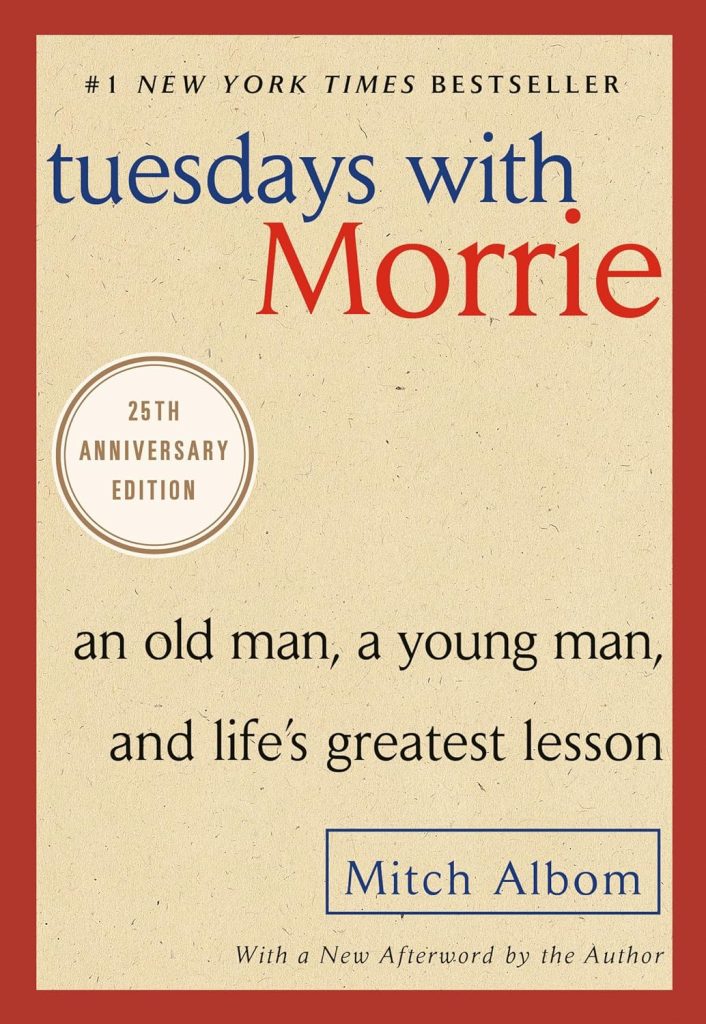
When Tuesdays with Morrie was published in 1997, it quietly became one of those books that lives on coffee tables, dorm room shelves, and bedside stacks across generations. Mitch Albom, then a sports columnist, wrote it as a way to pay his old college professor’s medical bills—a simple, tender act of homage that spiraled into a global bestseller. On the surface, it’s a book about dying. But it’s really about paying attention—to people, to love, to the moments we usually rush past. It’s slim, heartfelt, often quoted at graduations and funerals, and somehow both sentimental and grounding at the same time.
What’s it about?
The story is true. Mitch Albom, years out from college and neck-deep in his busy, ambitious life as a sports journalist, sees his old sociology professor, Morrie Schwartz, being interviewed by Ted Koppel on Nightline. Morrie, now in his seventies, has been diagnosed with ALS—Lou Gehrig’s disease—a slow, cruel condition that will take away his ability to move, then speak, then breathe.
Mitch, guilty about having lost touch, reaches out. What begins as a single visit becomes a ritual: every Tuesday, he flies to Morrie’s home in suburban Boston to sit by his recliner and talk. About life. About death. About regrets, relationships, emotions, culture, forgiveness, fear, God, love, and everything in between. Morrie becomes a kind of sage, not because he’s perfect or all-knowing, but because he’s running out of time and choosing to be fully awake for it.
The book’s structure mirrors a class syllabus—each chapter a new “lesson” on a big topic. Albom records these Tuesdays like a student again, scribbling wisdom between lines of personal reflection. Morrie is never preachy, never theoretical. He tells stories from his life, reacts honestly to his body’s decline, and remains stubbornly committed to the idea that being present with other people is the only real antidote to fear.
We learn about Morrie’s background: the mother who died when he was young, the stepmother who gave him warmth, the hard-earned academic career, the passion for teaching, the quiet home with his beloved wife Charlotte. But the focus is the conversations. Morrie’s views are shaped by his experience but also defy easy categorization—he believes in spiritual connection, cries openly during discussions, critiques the American obsession with wealth and achievement, and insists that the best way to prepare for death is to live consciously.
Meanwhile, Mitch undergoes a quiet transformation. At the start, he’s successful but spiritually adrift—tethered to work, disconnected from his emotions, hiding behind the speed of modern life. Through Morrie, he begins to confront things he’s been avoiding: vulnerability, guilt, love, mortality. Their conversations become both elegy and therapy session.
As Morrie’s condition worsens—he loses the ability to wipe his mouth, to move his arms, to cough safely—the Tuesdays continue. He asks to be massaged while they talk, to keep his muscles from atrophying. He insists on small pleasures: the sunlight through the window, the feeling of a hand in his. He is dying, but also fully alive.
The final chapters are devastatingly gentle. Morrie chooses the terms of his goodbye, as much as ALS allows. Mitch is there for the end—not just physically, but emotionally, which is what Morrie was always teaching. The book closes with Mitch reflecting not just on Morrie’s death, but on the way it reoriented his life.
What This Chick Thinks
Sentimental—but earned
I usually roll my eyes at anything described as “life-affirming,” but Tuesdays with Morrie kind of disarms you. It knows it’s sentimental. It wants to be. But because the emotions come directly from lived experience—and from a man actively dying—it never feels manipulative. There’s no saccharine overlay. It’s just one person being incredibly honest while another tries to listen better.
Morrie is a rare kind of teacher
Morrie’s superpower is emotional fluency. He’s the kind of person who doesn’t flinch at tears, who asks the question no one else wants to, and then sits with you in the silence that follows. What struck me most wasn’t his wisdom—it was his openness. He wasn’t trying to be profound. He just refused to waste time pretending life wasn’t hard or short. And there’s something quietly revolutionary about that.
Mitch plays the right supporting role
Some memoirs struggle to balance the narrator’s ego with the subject’s importance. Not here. Mitch keeps himself in the passenger seat, even as he shows his own evolution. He’s not there to center himself—he’s there to record. And that humility makes the emotional arc stronger. When he does finally open up—about his brother, about his fear of death, about love—it lands harder because we’ve watched him resist it for so long.
It doesn’t solve grief—and doesn’t try to
What I appreciated most is that Morrie never pretends dying gets easier. He cries. He panics. He has bad days. But he also makes space for joy. He doesn’t offer closure—he offers companionship. And that makes the book weirdly comforting, even when it’s talking about loss. It’s not a guide to dying. It’s a blueprint for how to stay human, even when your body fails you.
A few soft spots
There are a few places where Albom’s writing slips into that soft-focus mode—platitudes that feel a little too Instagram-quote-ready. And the lessons, while meaningful, sometimes blur together in retrospect. The strength isn’t in the headings—it’s in the accumulation of quiet moments: Morrie struggling to breathe, Mitch adjusting his oxygen, a smile shared through tears.
Final Thoughts
Tuesdays with Morrie is a slim book with a big soul. It doesn’t shout, but it stays with you. It’s not trying to dazzle—it’s trying to tell the truth, gently and clearly, while there’s still time. It’s about mortality, yes—but more than that, it’s about how rare it is to be fully seen. And how, when someone gives you that gift, you carry it for the rest of your life.
Rating: 9/10
Try it if you like:
- When Breath Becomes Air — Paul Kalanithi
A neurosurgeon confronts his terminal cancer with clarity, humility, and literary grace. Similar themes, more introspective tone. - The Year of Magical Thinking — Joan Didion
A devastating exploration of grief and the thin membrane between normal life and the unthinkable. Less comforting, more searing. - The Last Lecture — Randy Pausch
Another teacher at the end of life, offering final thoughts with a blend of optimism and emotional grit. A perfect companion to Morrie’s voice.
