
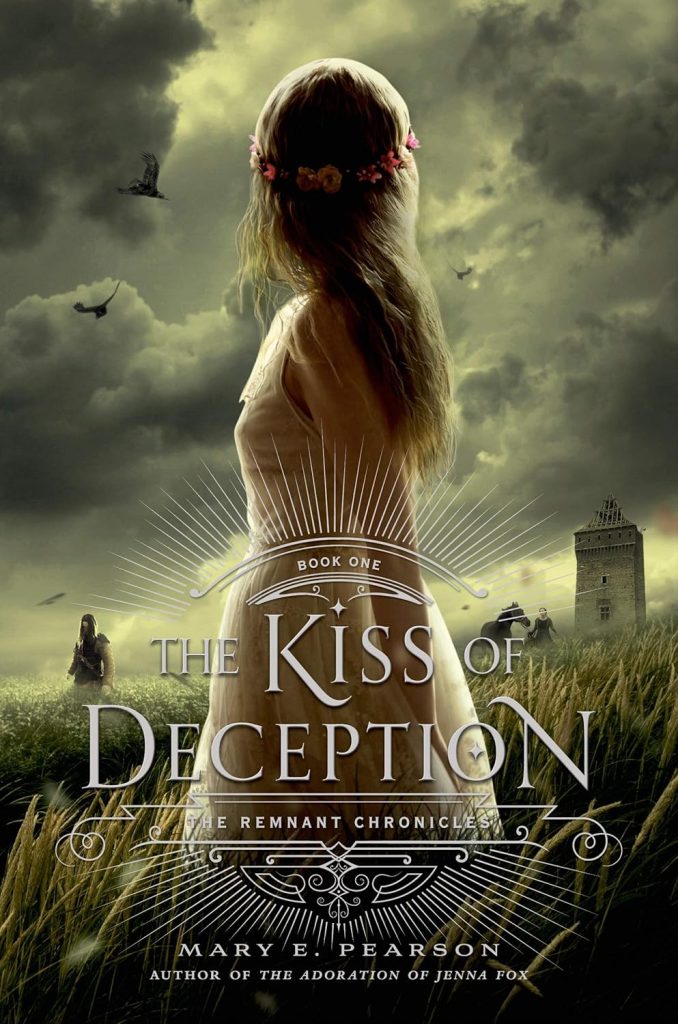
When The Kiss of Deception came out in 2014, it slotted neatly into that post-Throne of Glass, pre-everything-is-Fae YA fantasy window — but Mary E. Pearson did something slightly sneaky with it. It looks like a standard runaway princess story. It sounds like a standard love triangle story. And for the first third, you’re almost lulled into thinking you know exactly which trope lane it’s driving in.
Then it swerves — not explosively, but cleverly.
It’s less about magic (there’s very little, at least at first) and more about politics, identity, and perception. And honestly? The first twist is the kind of structural gamble that makes you sit up a little straighter.
What’s it about?
Princess Lia of Morrighan is on the brink of an arranged political marriage to a prince she’s never met. The union is meant to cement peace between kingdoms. The ceremony is elaborate. The expectations suffocating. So Lia does what fairy-tale princesses rarely get to do: she bolts.
On the morning of her wedding, she flees with her loyal friend and maid Pauline. They travel far from court to a small coastal village, where Lia takes on a new identity and tries to live as something resembling an ordinary girl. She works at an inn. She carries water. She scrubs floors. It’s not glamorous, but it’s hers.
Back in Morrighan, her disappearance causes diplomatic chaos. The jilted prince is humiliated. The alliance trembles. Meanwhile, in a rival kingdom, an assassin is dispatched to eliminate her — because a runaway royal destabilizes more than just one border.
Here’s where Pearson makes her move.
Two men arrive in the same village where Lia has hidden herself. One is the prince she was meant to marry. The other is the assassin sent to kill her. Neither reveals his identity to her. And crucially — the book does not tell the reader which is which.
For a significant portion of the novel, you’re guessing.
The chapters alternate perspectives, but Pearson deliberately withholds labels. You have to read tone, subtext, behavior. You have to decide who feels sincere. Who feels dangerous. And sometimes those instincts are wrong.
Lia forms connections with both men. One challenges her worldview. One listens quietly. One seems thoughtful and restrained. One seems watchful and strategic. The tension builds not just romantically, but politically. Lia slowly begins to sense she can’t outrun her past — and that the village she loves may be pulled into consequences meant for her.
Beyond the triangle mechanics, the novel introduces hints of a larger mythology: ancient prophecies, dormant gifts, whispers that Lia may carry a power long thought extinct in Morrighan’s royal line. It’s subtle in this first book — more suggestion than spectacle — but it’s laying groundwork.
The final act sharpens everything. Identities are revealed. Allegiances clarified. Blood is shed. The assassin’s mission collides with personal hesitation. The prince must choose between duty and feeling. Lia is forced to confront the fact that running away doesn’t exempt her from responsibility.
By the end, the story shifts from “runaway princess” to something closer to political chess with emotional casualties.
And it’s clear this is only the opening move.
What This Chick Thinks
The identity twist is the hook
Withholding who’s the prince and who’s the assassin? That’s bold. It makes the first half of the book feel interactive. You’re not just reading; you’re decoding.
Lia isn’t immediately extraordinary — and that works
She’s not a warrior. Not secretly trained. Not dazzling with magic from page one. She’s stubborn, idealistic, occasionally naïve. Her growth feels gradual rather than explosive.
It’s slower than it sounds
If you’re expecting nonstop fantasy spectacle, you might be surprised. A lot of the book lives in village scenes, character interaction, simmering tension. It’s more about emotional groundwork than battle sequences.
Romance-forward, but not hollow
Yes, it’s a love triangle. But it’s tangled up in loyalty, ideology, and survival. The romantic tension actually shifts once identities are known, which keeps it from feeling static.
The mythology is understated
There’s prophecy. There’s ancient history. There’s the suggestion of divine gifts. But Pearson doesn’t dump a lore encyclopedia on you. Some readers will want more magic earlier. I didn’t mind the restraint.
Final Thoughts
The Kiss of Deception is a character-driven YA fantasy that trades explosive world-building for tension built on secrecy and perception. It’s quieter than some of its genre peers, but it’s deliberate. And that early structural twist is strong enough to carry you through the slower sections.
It’s less about spectacle — more about choice.
Rating: 8/10
Try it if you like:
- The Winner’s Curse by Marie Rutkoski – Political tension and romance intertwined with sharp character psychology.
- An Ember in the Ashes by Sabaa Tahir – Brutal regimes and characters caught between duty and desire.
- The Cruel Prince by Holly Black – Court politics, moral ambiguity, and slow-burn power shifts.
