
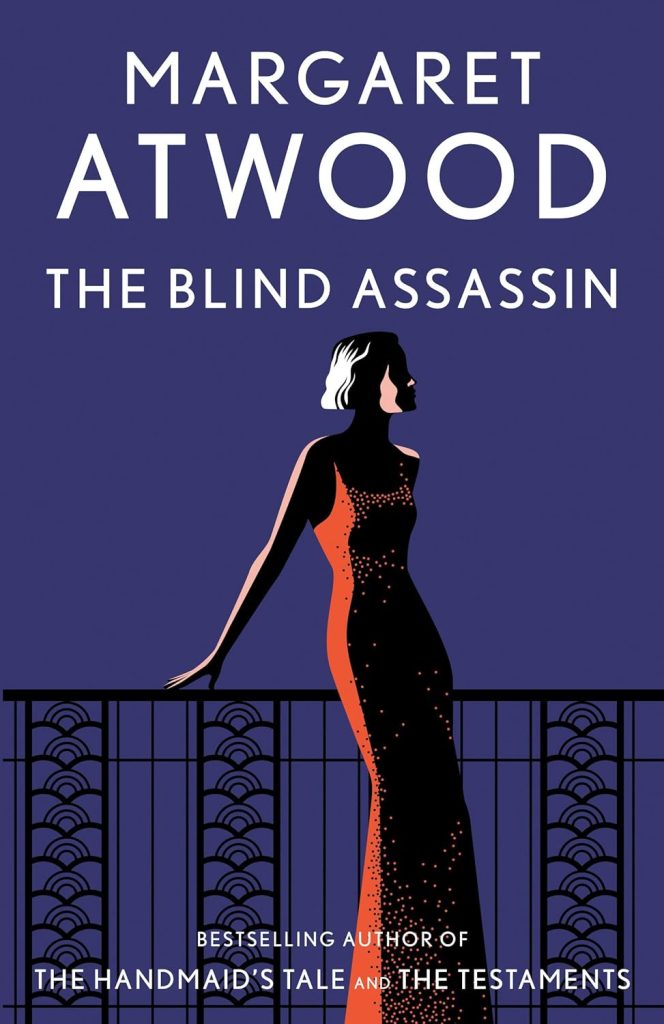
Some books sneak up on you. You think you’re reading a sweeping family saga, then suddenly you’re knee-deep in a sci-fi story-within-a-story, inside a literary mystery, wrapped in a memoir, and your whole idea of the narrator—what she’s telling you, and why—starts to shift. That’s The Blind Assassin. It’s slippery and bold and kind of a show-off, but in that Margaret Atwood way where you forgive it, because she knows what she’s doing.
I read this one in December, curled up with a heated blanket and the specific kind of winter melancholy that makes you crave something broody and dense. I knew it had won the Booker Prize in 2000, and honestly, I braced myself for it to be a bit of a slog—too literary, too self-aware, maybe a bit up its own Booker-y backside. But no. It’s definitely clever, and it asks a lot of you, but it’s also surprisingly emotional and devastating by the end. It’s not a book that yells its brilliance at you. It sort of… leads you through a hall of mirrors and then quietly stabs you in the heart.
What’s it about?
At the surface: a dead girl and a cult novel. Laura Chase, age twenty-five, drove a car off a bridge in 1945. Her death barely made the papers—until, a few years later, her novel The Blind Assassin was posthumously published and became a minor literary sensation. It was the kind of book that whispers scandal: a tragic young woman writing openly about sex and violence and power. Naturally, people assumed it was autobiographical. Naturally, no one asked too many questions. That novel begins with the unforgettable line: “Ten days after the war ended, my sister Laura drove a car off a bridge.” And so, from the jump, we know there’s another sister—and that she’s the one doing the telling.
That sister is Iris Chase, now in her eighties, and most of The Blind Assassin is her memoir, told in pieces. Her story begins in the faded grandeur of Avilion, a house with peeling wallpaper and family secrets layered like dust. She and Laura grow up the daughters of a once-powerful industrialist in a fictional Ontario town called Port Ticonderoga. Their mother dies young, their father returns from WWI emotionally unavailable and physically broken, and the girls drift in and out of privilege like they don’t know where they belong. Laura is strange—moody, intense, allergic to social niceties. Iris is the more practical one, and that’s how she ends up married off at eighteen to Richard Griffen, a rising political star and old-money businessman who’s interested in absorbing the Chase legacy. He doesn’t want Iris, really—he wants what she represents.
What follows is a long, slow undoing: of Iris’s voice, of Laura’s innocence, of their family’s dignity. Richard turns out to be controlling and quietly cruel, his sister Winifred a full-time enabler of image maintenance. Laura, still idealistic and impossible, keeps making trouble—fighting injustice, refusing to behave—and Iris tries to keep her safe the only way she knows how: by taking the hits herself. But this isn’t the kind of book that offers clean sacrifices or happy redemptions.
Woven between Iris’s chapters are two other strands. One is a trail of newspaper clippings chronicling the public-facing moments of the Chase and Griffen families: society galas, wartime charity drives, obituaries that tell half-truths. The other is the full text of Laura’s novel, The Blind Assassin—except by the halfway mark, we start to question whether it was truly Laura’s at all.
That inner novel is a pulp story about two unnamed lovers meeting in secret. The man tells wild stories of another planet, Sakiel-Norn, where children are trained to become blind assassins in a theocratic slave society. The woman listens. The chapters blur the line between metaphor and memory, fiction and confession. Over time, the characters in that story begin to map disturbingly well onto Iris’s real life: the nameless woman, the radical fugitive man who may or may not be a communist, the push and pull of desire and risk and silence.
As Iris tells her version of the past, the puzzle pieces start to fit: who really wrote The Blind Assassin, what Laura knew, why she drove off that bridge, and what Iris has been holding back for decades—not just from the world, but from herself. The final chapters tie all three strands together: the “fiction” becomes fact, the memoir becomes reckoning, and the novel-within-the-novel is revealed to be not just a literary device, but a burial shroud for the truth.
What This Chick Thinks
I went into this expecting something cold and cerebral—Booker Prize winners don’t have the best track record with warmth—but what I got was weirdly moving, even if it made me work for it. The Blind Assassin is not a book that wants to be devoured. It wants to be considered. It dares you to give up and rewards you if you don’t.
Atwood plays the long game here. Iris is not a dramatic narrator; she’s dry, observant, often bitter, occasionally hilarious. You get the sense she’s tired of being misunderstood, and finally—at the very end of her life—ready to put down the truth in her own words. The quiet power of the book is that you don’t realize what a cage she’s been in until you’ve lived in it with her. She doesn’t shout her trauma. She lets you sit beside it.
The novel-within-the-novel, at first, felt like a gimmick—but it’s not. It’s doing real thematic work. The pulpy sections, with their alien rituals and blind killers, are surreal and slightly ridiculous, but they echo the core truths of Iris’s life. Stories as code. Stories as cover. Stories as the only way to speak when speaking directly would get you crushed. The twist—that Iris wrote the book, not Laura—is not just a plot reveal. It’s a statement about who gets credit, who gets erased, and how women have historically used fiction to say the things they weren’t allowed to admit.
The language is stunning in that typical Atwood way—never flashy, always exact. She’s a master of tone, and The Blind Assassin is a tightrope walk between restraint and devastation. I found myself underlining sentences not for beauty, but because they quietly rearranged something in my brain.
But fair warning: this is not a story for readers who need a tidy plot or constant motion. It drifts. It loops. There’s a stretch in the middle that’s basically all atmosphere and social commentary. You have to trust that it’s going somewhere—and it is, but not quickly. That said, the final 100 pages snap it all into place so perfectly that I forgave every detour.
Final Thoughts
The Blind Assassin is a literary Russian doll, a slow-burn epic disguised as a family tragedy, wrapped in genre fiction and buried under silence. It’s not the kind of book that hits you immediately—it’s the kind that sticks, grows, and settles deep. If you’re patient with it, it gives you one of the most layered and quietly heartbreaking portraits of womanhood, grief, and narrative power I’ve ever read.
Rating: 9/10
Try it if you like:
- The Little Friend by Donna Tartt – Southern Gothic meets coming-of-age mystery, with a similar blend of psychological depth and a young woman picking through the wreckage of a family secret.
- On Beauty by Zadie Smith – More modern and academic, but shares that fascination with how personal histories get tangled with public lives and how families erode under the weight of ideals.
- The Sea by John Banville – Another Booker winner that takes its time, deeply interior, more about memory and loss than plot, but with that same slow-bloom emotional impact that sneaks up on you.
