
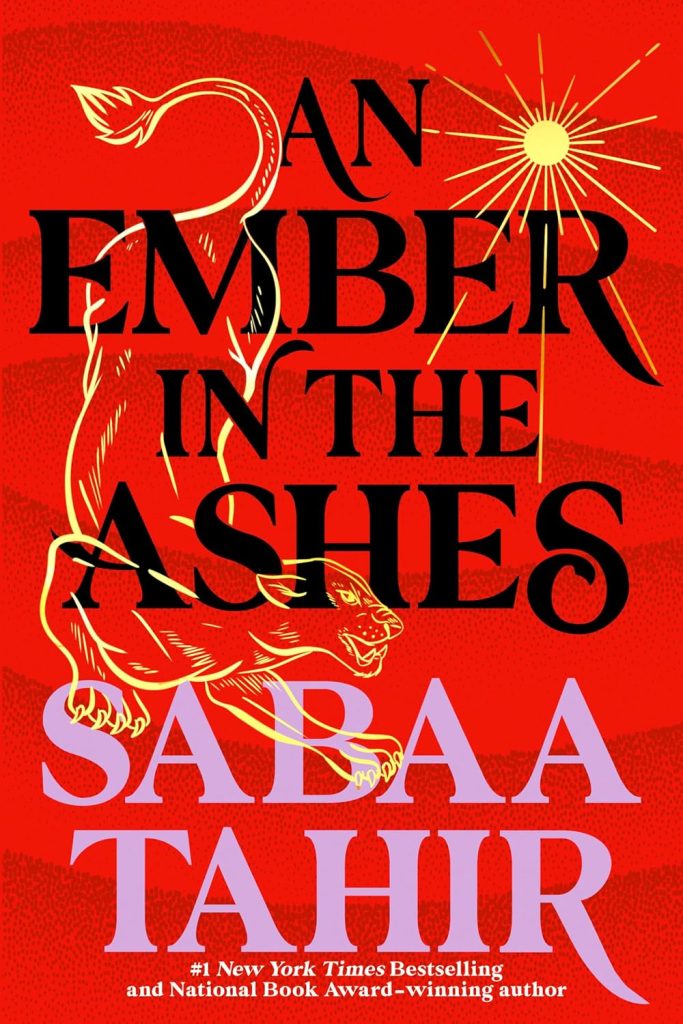
When An Ember in the Ashes came out in 2015, it was pitched as “Ancient Rome meets dystopian fantasy,” which honestly sounds like something invented in a marketing lab—but Sabaa Tahir made it work. It was her debut, and it launched into bestseller status almost immediately, eventually becoming a full series. The book sits firmly in that mid-2010s YA fantasy boom—high stakes, brutal regime, morally conflicted love interests—but what gives it teeth is how personal it feels. The oppression isn’t abstract. The violence isn’t sanitized. And the emotional choices actually hurt.
It’s not reinventing the wheel. But it spins that wheel fast.
What’s it about?
The story alternates between two narrators: Laia of Serra and Elias Veturius.
Laia is a Scholar, part of an oppressed underclass living under the iron-fisted rule of the Martial Empire. The Martials conquered the Scholars years ago and now govern through fear, military dominance, and public brutality. The book opens with Laia’s world shattering. Martial soldiers raid her grandparents’ home in the middle of the night. Her grandparents are murdered. Her older brother Darin is arrested for treason. Laia escapes—barely—and is left with one singular, desperate mission: save her brother.
To do that, she turns to the Resistance, a shadowy group of rebels fighting the Empire. They agree to help her—but only if she infiltrates Blackcliff Academy, the Empire’s elite military school, as a slave to its terrifying Commandant. Laia is not a warrior. She’s not trained. She’s terrified. But she agrees.
Then there’s Elias.
Elias Veturius is the Empire’s golden boy—a Mask in training at Blackcliff. Masks are the Empire’s most lethal soldiers, trained from childhood to suppress emotion and kill without hesitation. Elias is the son of the Commandant herself, a woman so cruel she makes other villains look gentle. But Elias doesn’t want this life. He’s haunted by the violence he’s been forced to commit. He wants freedom. He wants out.
Blackcliff becomes the story’s crucible.
The Emperor dies unexpectedly, triggering a brutal competition known as the Trials to determine the next ruler. Four top Masks—including Elias—are chosen as Aspirants. They must endure psychological and physical tests overseen by supernatural beings called Augurs. The Trials are not noble. They are sadistic, designed to expose weakness and reward ruthlessness.
Meanwhile, Laia works as a slave inside Blackcliff, enduring humiliation and abuse under the Commandant’s watchful eye. She gathers information for the Resistance while trying not to break under the cruelty of the school’s system. Her path and Elias’s begin to intersect in small, charged moments—two people trapped in different sides of the same machine.
The stakes escalate quickly. Elias must survive the Trials without losing what little conscience he has left. Laia must navigate a web of deception, betrayal, and shifting loyalties. There’s also Helene Aquilla, Elias’s best friend and fellow Aspirant, fiercely loyal to the Empire and deeply complicated in her devotion to Elias. The love triangle elements exist—but they’re tangled in ideology and survival rather than pure romance.
By the climax, blood has been spilled. Choices have been made that cannot be undone. Elias rejects the Empire in a way that detonates his future. Laia becomes more than the frightened girl she started as. And the story ends not with resolution, but with the promise of war.
What This Chick Thinks
The world is brutal—and it commits to that
This is not a sanitized YA dystopia. Public executions, torture, psychological manipulation—it’s all there. Sometimes it skirts the edge of feeling relentless, but that relentlessness is part of the point. The Empire feels genuinely oppressive, not cartoonishly evil.
Elias is the emotional anchor
I expected Laia to be the obvious protagonist (and she is central), but Elias’s internal conflict gives the book its depth. Watching someone trained for violence try to cling to humanity is compelling in a way that feels almost classical.
Laia grows—but unevenly
She starts very passive, which makes sense given her circumstances. Her growth is more survival-based than triumphant. I sometimes wanted sharper agency from her earlier on, but by the end, she earns her space in the narrative.
The Trials are gripping
The competition structure works. Each Trial reveals something about power and morality. The supernatural Augurs add a mythic layer that hints at a larger mythology beyond just empire politics.
It leans into familiar YA beats
There are tropes: brooding warrior, secret rebellion, slow-burn attraction, authoritarian regime. If you’ve read a lot of YA fantasy, none of it feels revolutionary. But it’s executed confidently, which makes it addictive.
Final Thoughts
An Ember in the Ashes is intense, fast-moving, and emotionally charged. It thrives on high stakes and moral tension rather than intricate political complexity. If you like your fantasy with brutality, internal conflict, and the promise of rebellion simmering just beneath the surface, it absolutely delivers.
It’s a strong series opener—hooky enough to make you reach for book two without hesitation.
Rating: 8.5/10
Try it if you like:
- The Poppy War by R.F. Kuang – Military fantasy with brutal training sequences and moral grayness.
- The Hunger Games by Suzanne Collins – Oppressive regime, reluctant hero, survival under spectacle.
- Six of Crows by Leigh Bardugo – Found-family dynamics and morally complicated young fighters navigating dangerous systems.
