
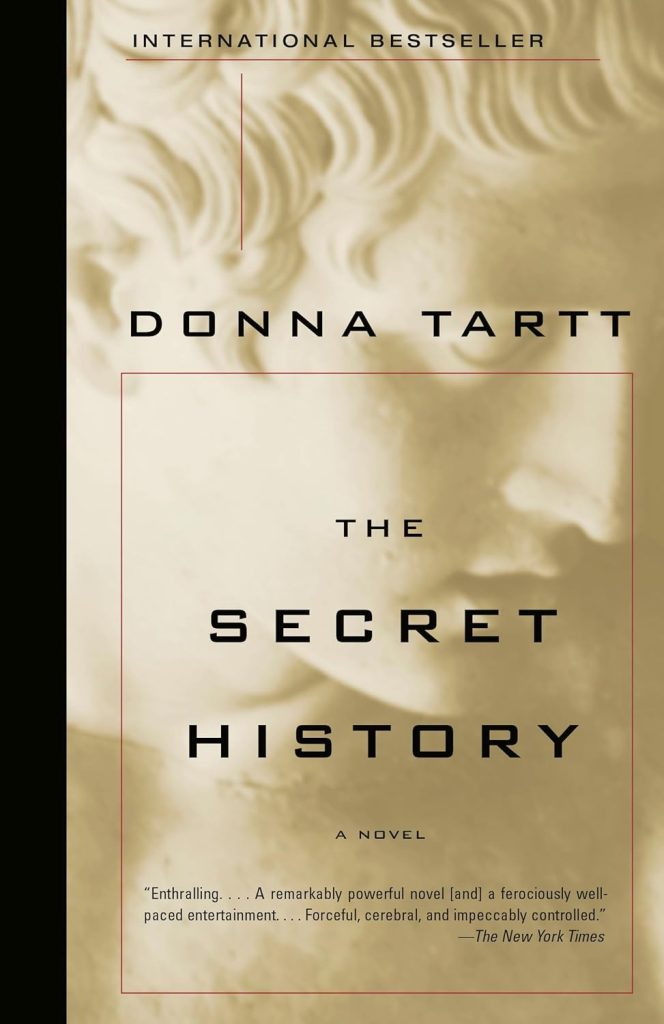
Donna Tartt was twenty-eight when The Secret History came out in 1992, and it landed like a velvet-clad thunderclap. Dark academia before dark academia had an aesthetic tag. Ivy-draped buildings, ancient Greek, morally compromised beautiful people, murder discussed over expensive wine. It’s often compared to Brideshead Revisited or Dostoevsky, and while that sounds lofty, the novel absolutely earns its reputation for atmosphere and psychological depth. Tartt writes slowly, deliberately, luxuriating in mood. This isn’t a whodunit. It’s a whydunit. The first page tells you who dies. The tension is in watching it become inevitable.
What’s it about?
The novel opens with a confession: Bunny Corcoran is dead. And the narrator, Richard Papen, along with his small circle of friends, killed him.
We rewind.
Richard is a working-class Californian who transfers to Hampden College, a small elite liberal arts school in Vermont. He’s lonely, adrift, and desperate to reinvent himself. Early on, he becomes fascinated by a tight-knit group of students who study ancient Greek under the charismatic and eccentric Professor Julian Morrow. There are five of them: Henry Winter, intellectual and icy; the twins Charles and Camilla, golden and intertwined; Francis Abernathy, elegant and anxious; and Bunny, loud, entitled, and financially dependent on the others’ tolerance.
Richard maneuvers his way into their orbit and is eventually accepted into the insular Greek class. What begins as academic obsession morphs into something stranger. The group idolizes ancient thought—not just intellectually, but spiritually. They romanticize the Dionysian rituals of Greek tragedy: ecstasy, transcendence, loss of self.
Under Henry’s leadership, they attempt to recreate a Bacchanal—an ancient Dionysian rite meant to dissolve individuality and access divine madness. What actually happens is chaotic and violent. During the ritual, in a drugged and dissociated state, they kill a local farmer.
The murder is accidental—but it binds them together in horror and secrecy. The group fractures under the weight of what they’ve done. Bunny, who was not present during the ritual, begins to suspect something. Worse, he starts blackmailing Henry and exploiting their fear. He knows just enough to be dangerous.
Henry, always coldly rational, decides that Bunny is a liability. The group debates, rationalizes, spirals. Eventually, on a snowy hike in the mountains, they push Bunny into a ravine and watch him fall to his death.
The second half of the novel explores the aftermath. There is no clean escape. Suspicion grows. Relationships deteriorate. Charles unravels into alcoholism. Henry grows more isolated. Camilla remains opaque and quietly devastating. Richard finds himself complicit not just in action but in moral decay.
The FBI investigates, but the greater pressure is internal. Guilt mutates into paranoia. The romantic glow of intellectual elitism fades, revealing something hollow and self-destructive. The final tragedy—Henry’s ultimate act during Bunny’s funeral—feels both shocking and grimly logical.
The novel ends years later, with Richard reflecting on what became of them all. There is no redemption arc. Just memory. And the faint, haunting sense that beauty and horror are often intertwined.
What This Chick Thinks
Atmosphere for days
Tartt writes winter like a religion. The college feels cloistered, timeless, slightly unreal. You can smell the old books and damp wool coats. It’s immersive in a way that makes you forgive the slow pacing.
Henry is terrifyingly compelling
He’s not flashy evil. He’s intellectualized evil. His belief that logic can justify anything is the novel’s moral engine. Watching the others orbit him is like watching moths circle a very well-read flame.
This is about class as much as crime
Richard’s hunger to belong drives everything. He wants their moneyed ease, their aesthetic refinement, their confidence. That desire makes him pliable. Tartt is quietly dissecting elitism while draping it in seductive prose.
It’s long—and it knows it
This is not a brisk thriller. It lingers in scenes, conversations, psychological shifts. Some readers will find it indulgent. I found it hypnotic, but I’ll admit there are stretches where the pacing slows to a near-halt.
Final Thoughts
The Secret History is lush, morally unsettling, and unapologetically intellectual. It’s less about murder and more about the stories we tell ourselves to justify crossing lines. It lures you in with beauty and leaves you sitting with rot.
Rating: 9/10
Try it if you like:
- If We Were Villains by M.L. Rio – Shakespearean obsession, insular academic setting, and murder among friends.
- Brideshead Revisited by Evelyn Waugh – Lyrical prose, elite social circles, and longing for belonging.
- Crime and Punishment by Fyodor Dostoevsky – Psychological unraveling after a morally rationalized crime.
