
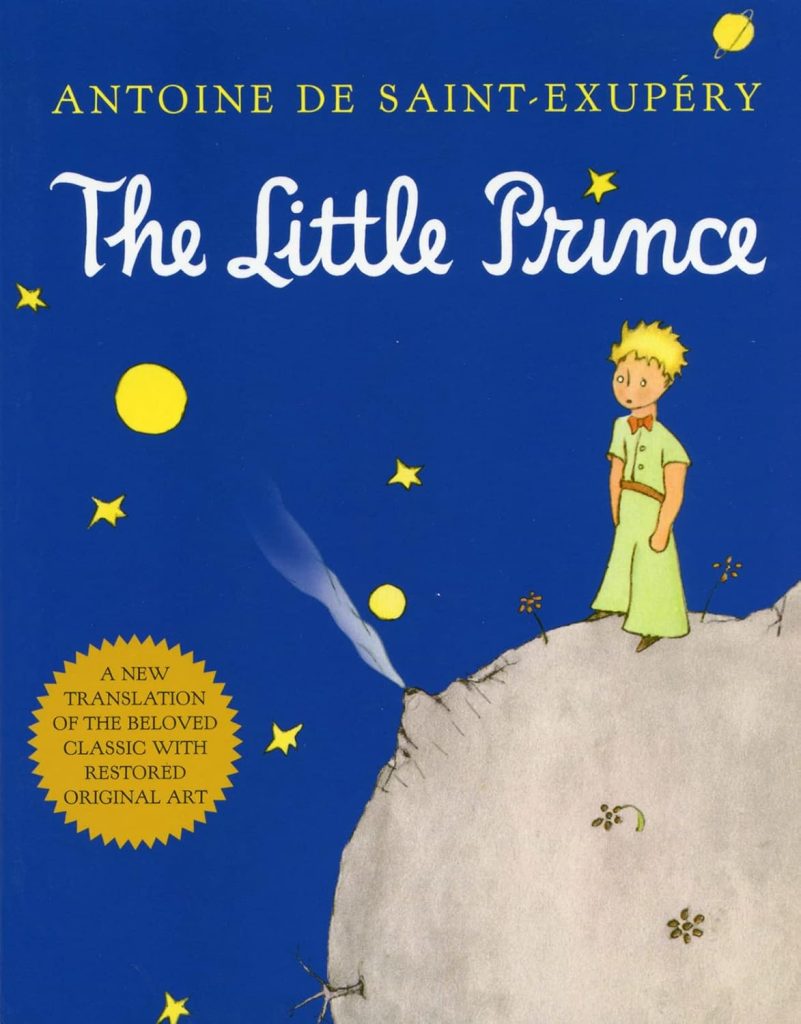
Published in 1943, The Little Prince has lived more lives than its author ever did—which is saying something, considering Saint-Exupéry was a wartime pilot who vanished mid-flight. Originally written in French (Le Petit Prince), this slim book has been translated into over 500 languages, making it one of the most translated and best-selling books in literary history. But the thing that always strikes me about it is how it masquerades as a children’s book, when really it’s a quiet existential crisis in disguise. It’s a fable, a love story, a philosophical meander, and a lonely man’s message in a bottle—all folded into one.
What’s it about?
The narrator, an aviator (a not-so-subtle version of Saint-Exupéry himself), crashes his plane in the middle of the Sahara desert. While trying to repair it, he meets a peculiar little boy who asks him to draw a sheep. The boy, it turns out, is the titular Little Prince—a golden-haired child who has fallen to Earth from an asteroid, B-612, where he lived alone with three volcanoes and a very moody, very vain rose.
The Little Prince doesn’t just arrive—he wanders, and every encounter he recounts is an allegory. Before Earth, he visited other planets, each one populated by a single absurd adult: a king with no subjects, a vain man who wants applause, a drunk trying to forget his shame, a businessman who claims to own the stars, a lamplighter bound by orders, and a geographer who never explores. Each adult represents something broken or ridiculous about grown-up logic. And to the Little Prince, it all seems terribly sad.
When he arrives on Earth, he meets more creatures: a snake who speaks in riddles about death, a field of roses that shatters his illusions, and most importantly, a fox who teaches him the meaning of love and taming—that once you’ve made someone important to you, their pain becomes your responsibility, their uniqueness becomes the source of your joy and your grief.
Through their days in the desert, the pilot grows to love the Prince and his quiet wisdom. The Prince, meanwhile, longs to return to his rose—even though she was difficult and vain, she was his. Eventually, with the help of the snake, he chooses to leave Earth, in a scene that is gentle and deeply unsettling. The book ends with the pilot back home, haunted by stars, drawing maps in the sand and listening for laughter he might never hear again.
What’s tricky to explain is how The Little Prince is both incredibly simple—barely a novella—and loaded with philosophical weight. It speaks in fable, but what it says is often gutting: about loss, about memory, about the loneliness of growing up. It’s the kind of book that reads differently depending on where you are in life. As a kid, it’s odd and whimsical. As an adult? It’s a punch in the chest.
What This Chick Thinks
Small book, big soul
Let’s just get this out of the way: I love this book. Always have. But it’s the kind of love that’s changed. The first time I read it, I was maybe eleven, and it felt like a dreamy adventure. The rose was annoying, the fox was cool, and the snake was creepy. Years later, it’s the aviator who breaks my heart—the way he talks about forgetting how to draw, how grown-ups only care about “figures,” how his loneliness echoes under every word. It’s like he’s trying to speak child-language again, but the words don’t fit anymore. That feeling of having forgotten how to see the world the right way? Oof.
The fox is the beating heart
I know this is a book packed with allegory, but the fox’s chapter is everything. “You become responsible, forever, for what you have tamed.” That line alone could probably fuel a semester of therapy. The Prince taming the fox is about connection, yes, but also about grief. Love doesn’t just make something meaningful—it makes it painful to lose. The fox teaches him how to love, and that love sends the Prince right back into heartbreak. It’s tender, brutal, honest.
Adulting is the real villain
Every planet the Prince visits is a dig at adult absurdity. And it’s not subtle—but it works. The king who rules over nothing. The businessman who “owns” the stars but does nothing with them. It’s all commentary on how we mistake control for meaning, or productivity for worth. Reading it now, I don’t laugh at those characters—I wince. They’re not strangers. They’re me, on a bad week. I think that’s part of why this book lingers: it catches you judging the grown-ups, then quietly holds up a mirror.
Saint-Exupéry’s style feels like being gently haunted
The writing—translated or otherwise—has this quiet, drifting rhythm. It never rushes, but it never feels slow. It’s like a dream you’re only half in control of. There’s something beautifully ephemeral about the whole thing, which makes sense when you know Saint-Exupéry disappeared just a year after it was published. The book has the feeling of a man trying to leave a trace of himself, a message to be found long after he’s gone. And it was found. It’s everywhere now—tattooed on bodies, quoted at weddings and funerals, hanging in nurseries.
Not a perfect vessel, and that’s okay
Now, does it always work? Not totally. Some of the allegories wear thin if you read it too analytically. There are moments where the pacing hiccups—especially for modern readers who might be expecting a plot with rising action. This isn’t that. It’s mood over momentum. Also: the rose, as a metaphor, can come off a bit one-note if you’re not already emotionally invested. But honestly? These aren’t flaws so much as boundaries. The book does exactly what it sets out to do. It’s not meant to dazzle—it’s meant to echo.
Final Thoughts
The Little Prince isn’t a children’s book. It’s a book about children, and how adults forget to be like them. It’s soft-spoken and wise, full of holes that are there on purpose—so you can fall into them. It’s a story you don’t finish so much as absorb, and the older you get, the more of it it seems to contain. It’s not perfect. It’s true.
Rating: 9/10
Try it if you like:
- The Boy, the Mole, the Fox and the Horse — Charlie Mackesy
Another fable-style book with hand-drawn art and gentle wisdom, though less story-driven and more like philosophical comfort food. - The Ocean at the End of the Lane — Neil Gaiman
A novel about childhood and memory that feels like a fairy tale for adults; eerie, melancholic, and deeply moving in ways you don’t fully understand until later. - This Is How You Lose the Time War — Amal El-Mohtar & Max Gladstone
Totally different genre, but the poetic tone, emotional intimacy, and blend of fantasy and philosophy feels like The Little Prince grew up and got swept into sci-fi.
