
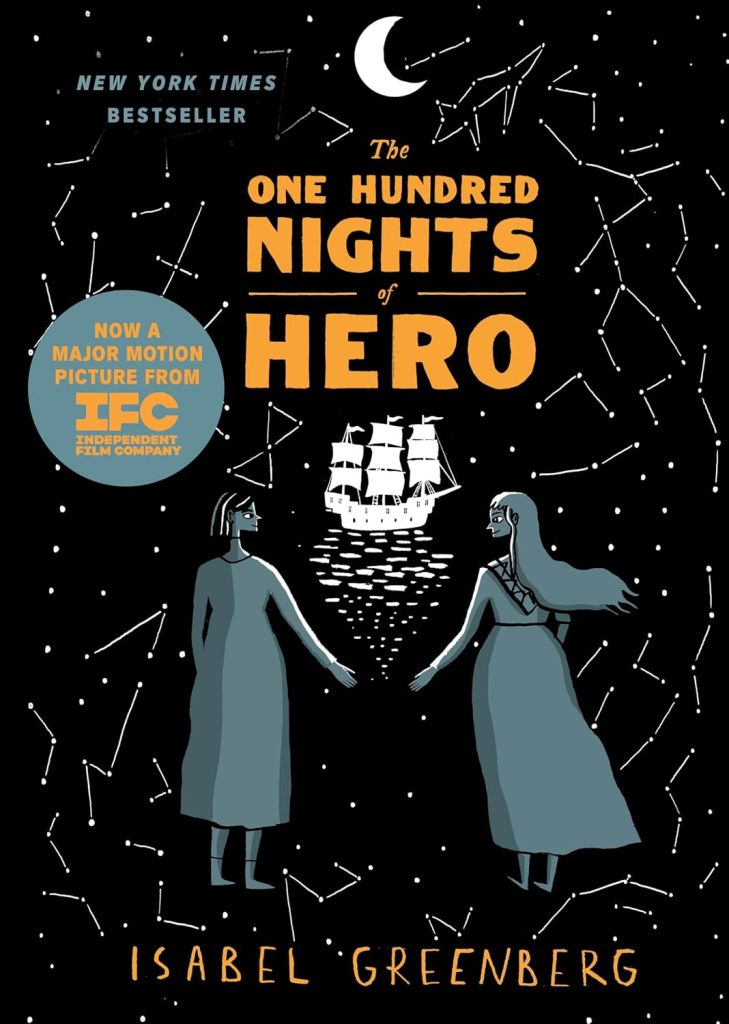
Isabel Greenberg’s second book set in her mythic “Early Earth” is a fairy-tale matryoshka: stories tucked inside stories, stitched with ink, embroidery, and a very sharp needle labeled patriarchy, beware. Published after her breakout Encyclopedia of Early Earth, this one is brasher and more overtly feminist—a love story, a celebration of storytelling as survival, and a sly comedy about men who think they’re the point. It’s a graphic novel, yes, but it reads like a fireside epic told by your favorite aunt who swears artfully and never spares the powerful.
What’s it about?
We start in a country where women aren’t supposed to read or write. Stories belong to men (so say the men), and all the official tales bend toward their glory. Into this struts Manfred, a wealthy blowhard, and his equally dreadful friend Jerome. Manfred has recently married Cherry—lovely, silent (by necessity), and guarded. Convinced he can prove Cherry will stray when left alone, Manfred makes a bet: he’ll leave for one hundred nights, and Jerome will seduce her by the time he returns. If Jerome succeeds, he gets Manfred’s house. If he fails, he forfeits his own. The terms are crude; the certainty is cruder. They shake on it with the confidence of men who have never considered that the women in their lives have interiority, let alone plans.
Cherry, as it happens, has a plan. She’s in love with her maid, Hero. That isn’t a euphemism; it’s the heartbeat of the book. Hero is part of a clandestine network called the League of Secret Storytellers—women who smuggle books, teach each other to read in kitchens and attics, and encode stories into quilts and samplers to keep them safe. She and Cherry have been slipping notes to each other through needlework and practicing the oldest form of defiance: telling the truth when no one is listening. Now they’ll use the same tool to fend off Jerome. Each night, Hero will spin a tale deep enough to hold a man till morning. If she can keep him rapt for one hundred nights, Cherry’s body will remain her own and their love will survive.
Night One: The candle flickers; Jerome drags his chair closer; Hero begins. Her stories draw on Early Earth’s own cosmology: gods who behave like feckless aristocrats; a great Matriarch who guards women’s legacies; the Bird-Man and his quarrelsome offspring. In one tale, two sisters inherit a moon and must keep it lit; men arrive insisting the moon is better in their hands, and disaster follows. In another, a girl outwits a giant by using the one weapon giants never expect—thought. A third threads the origin of the League through a seamstress who rescues banned tales by sewing them into a wedding gown. Each story is self-contained and also a mirror held to Jerome: look at this hunger for control, this fear of clever women, this habit of confusing desire with entitlement.
The book plays a gorgeous game with its frame. By day, Cherry and Hero live under surveillance—maids watching maids, neighbors eager for a scandal. They speak in glances, exchange scraps of embroidered code, and plan the next evening’s defense. By night, Hero performs a kind of narrative fencing. If Jerome grows bored, she pivots, splits a story into two, then three, nesting cliffhangers like eggs to be hatched the following evening. The rhythm becomes ritual. He arrives with wine and swagger; Hero feeds him wonder until wine and swagger fall asleep.
Greenberg uses these nights to travel Early Earth. We visit a lighthouse on a cliff where a lonely keeper tells stories to the wind so she won’t forget her own name. We meet the Daughters of the River, who bargain with a king for their freedom and then refuse to act grateful for being less oppressed than before. There’s a tale about a city of scholars where women’s libraries are hidden in plain sight; another about a bird-thief who steals a princess’s voice and learns, fatally, that a stolen voice is just noise. Some stories are shaggy, comedic, slyly modern; others are spare as a parable. All of them keep returning to the same pulse: women saved by each other’s cleverness, loyalty, and refusal to be erased.
And of course the frame keeps tightening. Jerome is not just lustful; he’s competitive. Around the middle stretch—Night Forty? Night Fifty?—he starts arriving with counter-tales, trying to drown Hero’s magic in male myths of conquest and “natural order.” He brings a scribe to trap her in contradictions; he brings a charm to keep himself awake. The League responds by expanding the stage. One night, another storyteller takes Hero’s place to give her rest and widen the net; another night, the housemaids “accidentally” flood the kitchen so the men of the household are busy with buckets. The neighborhood women station themselves as lookouts—“just chatting”—while supply lines of gossip and bread move across courtyards. Defiance looks domestic; it’s actually logistics.
Night Seventy-Five: the cracks show. Jerome, sleep-starved and humiliated by his own failure to seduce a woman who wants no part of him, resorts to trickery. He snoops, bribes, spies. He hears enough to sense that Cherry has a secret that has nothing to do with him. The book shifts gear—from lullaby to thriller—without losing its sly smile. Hero pushes on, stitching together an epic about a queen who fakes obedience, a witch who hides a library inside a forest, a pair of lovers who turn themselves into birds to escape a world that refuses their shape. The parable is plain: freedom is not granted; it’s taken, guarded, shared.
Night Ninety-Nine: breath held. The household is a wire. Jerome teeters between obsession and rage. Cherry and Hero have one more evening to cross. Hero tells a story that reaches all the way back to the beginning—to the Matriarch, to the first telling, to the day someone decided what was “proper” and how women answered. It feels less like a bedtime story and more like a spell. Morning finds Jerome still upright but defeated: the hundred nights are done. By the letter of the bet, he has lost.
But stories don’t stop villains; people do, and power hates to be laughed at. What follows is the cost. A slip, a theft, a letter read by the wrong eyes—something small and human—exposes Cherry and Hero’s bond. The men in charge respond not with logic but with punishment pretended as order. The League moves, fast, in ways that look like accidents to anyone not paying attention. Some endings here are brave and bruising. Others are quiet acts of survival. The book refuses the neatness of a single happily-ever-after; it gives us many—sisters who find each other across miles; girls who inherit stories that kept them alive; two lovers who choose what kind of legend they will become in a world that still thinks loving as they do is a crime.
By the last pages, the frame cracks open to a wider chorus: the League continues; the Matriarch’s thread hums; the men keep telling their versions, but the women’s library is larger, louder, and more crowded than it was one hundred nights ago. The moral, if there is one, is not “love conquers all.” It’s “love conspires”—with wit, with patience, with story—until the world has to make room.
What This Chick Thinks
A feminist Scheherazade with teeth
The premise riffs on One Thousand and One Nights, but Greenberg keeps the agency squarely with Cherry and Hero. The stories aren’t diversions; they’re weapons. Watching a roomful of women run a resistance under the noses of men who’ve never washed a dish was deeply, darkly satisfying.
Nested tales that actually add up
Frame narratives can feel like a trick. Here, every side-story refracts the main one—same themes in different costumes: who holds the pen, who gets punished for desire, how communities save individuals. It’s a quilt, not a scrapbook.
The art is playful and pointed
Deceptively simple line work, limited palette, and panels that snap from cozy to cosmic. There’s a hand-made warmth to the pages that makes the jokes land and the gut-punches… punch.
Love story that stays human
Cherry and Hero are tender and brave, but never sainted. Their intimacy is full of small gestures—hands brushing in a pantry, secret stitches in a hem. It felt real, which made the stakes feel real.
Funny, then furious (my favorite combo)
Greenberg is wickedly funny—petty gods, pompous men, bureaucratic absurdity—and then suddenly cuts to the bone. It’s satire that leaves room for sincerity.
If I’m nitpicking
A couple of the mid-book tales run a page or two long, and readers craving a single tidy ending may bristle at the way consequences ripple. I liked the honesty: history is messy; victories are cumulative.
Final Thoughts
The One Hundred Nights of Hero is a balm and a battle cry—an ode to secret libraries, kitchen conspiracies, and the stubbornness of love. It made me laugh, tear up, and text friends lines out of context (“women will write it down”). If you’ve ever been told a story wasn’t yours to tell, this book feels like an invitation to start anyway.
Rating: 9.5/10
Try it if you like:
- The Bloody Chamber – Angela Carter – Fairy tales retold with knives out; lush, subversive, and gloriously woman-centered.
- Till We Have Faces – C. S. Lewis – A myth reframed from the sister’s viewpoint; more solemn in tone, but the “who gets to narrate” question echoes.
- The Once and Future Witches – Alix E. Harrow – Sisterhood, spells-as-stories, and women building power in the margins when the world refuses them a seat.
