
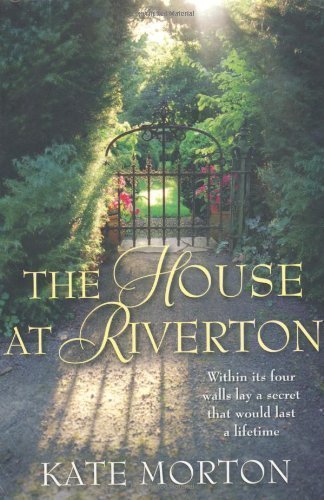
Before she became the go-to name for lush, time-twisting family mysteries, Kate Morton arrived with this: a debut that mixed Downton Abbey atmosphere with a slow-burn whodunnit of the heart. Published as The Shifting Fog in Australia and The House at Riverton elsewhere, it set up Morton’s signature blend—an elderly narrator with a long memory, a crumbling estate, sisters bound by a secret, and the kind of reveal that makes you rethink every teacup scene.
What’s it about?
Our narrator is Grace Bradley, ninety-eight and rarely visited by sleep, who once worked below stairs at Riverton, the grand country seat of the Hartford family. A young filmmaker asks Grace to consult on a movie about a notorious 1924 midsummer party where the brilliant poet Robbie Hunter died by the lake. History calls it a suicide. Gossip whispers the Hartford sisters, Hannah and Emmeline, were there. Grace knows more than both versions, and with the film dredging up the past, she begins to tell the real story.
We go back to 1914. Fourteen-year-old Grace arrives at Riverton as a housemaid, green as spring and keen to please. Morton settles us into the rhythms of the house—polished banisters, the hiss of lamps, Mrs. Townsend the housekeeper ruling like a quiet queen. Upstairs are the Hartfords: Hannah, the elder sister with a mind like a locked drawer; Emmeline, sparkling and impulsive; and their brother, whose easy charm can’t outpace the war that’s gathering. Grace, diligent and watchful, becomes part of the furniture people forget listens.
War cracks the world. Men leave; some don’t come back. The estate—gardens, linens, traditions—keeps going, but the air has changed. Hannah hungers for a life beyond seasonal balls and suitable matches. Her letters read like maps to places she isn’t allowed to go. Emmeline bends with the times more easily—flapper dresses and gramophones when the armistice comes—but she clings to the gravitational pull of Riverton in ways Hannah can’t.
Grace is promoted to ladies’ maid to Hannah, crossing an invisible line between downstairs and upstairs. She learns the exacting ballet of her new role—buttons, hairpins, secrets—and becomes a confidante by proximity. When Hannah is married off to a wealthy, respectable older man whose admiration feels more like acquisition, Grace goes with her to London. The townhouse is elegant and airless. At dinners, men talk about stocks and empires while women pretend those conversations don’t decide their lives. Hannah plays the game passably well, but behind the veils she is making her own plans.
Enter Robbie Hunter—war-scarred, newly lionised for his poems, and once connected to the Hartfords before the war rearranged everyone. He and Hannah meet again amid London glitter, and the old ease between them turns incandescent. The flirtation is talk first, then touch. With Grace’s help (letters ferried, meetings set, the careful crafting of alibis), Hannah sketches the outline of escape from a marriage that cages her. Emmeline circles this heat like a month to a lamp—partly protective, partly captivated by Robbie herself, partly terrified of being left behind.
Back at Riverton for the summer of 1924, the house throws a grand party to announce itself as alive and glittering in the new decade. Cameras flash; cocktails cascade; the grounds glow with lanterns. Underneath the sparkle, the triangle tightens: Hannah and Robbie have decided to run, Grace has assembled the practicalities (money tucked into hems, a bag packed beneath a bed), and Emmeline has discovered enough to know she is not the center of either of them anymore.
The night fractures. In the shadowed folly by the lake, words are thrown like knives—love, betrayal, promises, and the desperate arithmetic of how to leave without destroying the people who will be left. A gun is produced. The official story, as the world will read it the next day, is that Robbie Hunter took his own life by the water. What actually happens—and who holds the gun at which moment—is messier, more human, and much more dangerous to say out loud in a world that protects men’s reputations and punishes women’s mistakes. Grace and Hannah make a choice in those next frantic minutes that will bind them for life: they protect Emmeline, they protect Riverton, they bury the truth.
After the party, the house declines by inches. Fashion and fortune shift; servants leave; scandals calcify into anecdotes told with a smile that doesn’t reach the eyes. Hannah’s marriage tightens its grip with every year. Grace carries secrets inside her like stones: what she saw, what she helped orchestrate, and something more private—an intimate chapter of her own life that twines with Riverton’s history in ways the film crew could never guess. The decades pass; Riverton is sold; its grand rooms are loaned to film sets where make-believe props sit on the places where real lives once broke.
Back in the present, Grace records her memories for the young director and for the family she built after Riverton. As her story catches up to the lake, you realize the “mystery” isn’t a puzzle-box of clues so much as a portrait of class, duty, and the kind of love that is indistinguishable from desperation when the world gives you no good options. The final reveals slide into place with Mortonesque inevitability: one secret was hidden to save a sister, another to save a child, and all of them reshaped the lives of people who thought they had steered straight past the past.
What This Chick Thinks
Why the frame narrative works
I’m a sucker for an elderly narrator pulling the string on old knots, and Grace is the right kind of unreliable—careful, kind, and finally ready to admit where loyalty ended and complicity began. The film-within-the-book gives Morton a neat way to explore how we rewrite history, literally and emotionally.
Sisters, class, and the cost of wanting
Hannah and Emmeline are opposites on paper, but both are trapped by the era’s narrow corridors for women. The house isn’t just a setting; it’s a machine that grinds desire into decorum. Morton makes that system the true antagonist, which gives the ultimate “who did what that night” a bruised, human logic.
Atmosphere you can inhale
If you love period detail, this is catnip: the choreography of a dinner service, the quiet politics of rooms, the changing hemlines and what they signal. But the best texture is psychological—the way a staircase can feel like a border, the way a lake can hold a secret for decades.
The romance is a fuse, not the whole fire
Hannah and Robbie’s affair lights the plot, but the book is really about bonds that outlast desire—maid and mistress, two sisters who love and ruin each other by turns, a woman and the house that shaped her. That breadth keeps the final act from shrinking to a single tragic kiss.
Pacing and reveals
Morton is a patient storyteller; the first half luxuriates. I never begrudge a slow drift when the payoff recontextualizes everything, but if you want your mysteries sprinting from page ten, adjust expectations. The last hundred pages turn inexorable in the best way.
If I had a couple of snags
A modern-day subplot brushes melodrama for me, and one late coincidence arrives a touch on-the-nose. Also, a couple of downstairs characters are painted in brisk strokes where I wanted one more scene. None of it dulled the overall spell.
Final Thoughts
The House at Riverton is a grand, melancholy waltz through memory—part ghost story without ghosts, part love letter to (and indictment of) the old order. It’s elegant, emotionally sly, and quietly devastating when it wants to be. I finished it feeling like I’d stepped out of a shuttered ballroom and could still hear the echo of a waltz—and a gunshot.
Rating: 9/10
Try it if you like:
- The Remains of the Day — Kazuo Ishiguro – A servant’s-eye view of regret and loyalty, where what isn’t said weighs the most.
- The Thirteenth Tale — Diane Setterfield – Gothic siblings, unreliable narrators, and a house stuffed with secrets that refuse to stay shelved.
- Atonement — Ian McEwan – War-era class divides, a fatal night, and a narrator wrestling with what stories can and can’t atone for.
