
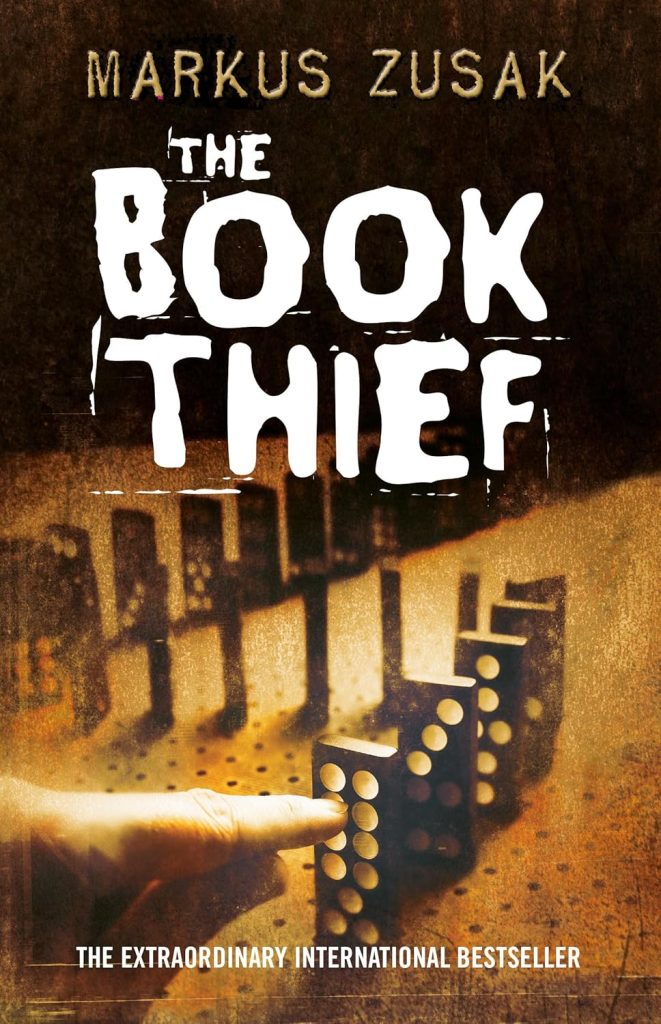
Before it became a modern classic taught in classrooms, The Book Thief was a quiet gamble by an Australian novelist who decided to let Death narrate a World War II story about a German girl who steals books. Published in 2005, it slid between shelves—YA, adult, historical, literary—and ended up everywhere, winning prizes and hearts because it’s equal parts gutting and gentle. Zusak’s trick isn’t just the voice; it’s the way he makes reading itself an act of resistance, a lifeline thrown across a very dark river.
What’s it about?
It begins on a train, in winter. A skinny nine-year-old named Liesel Meminger is traveling with her mother and younger brother to a small German town called Molching, where foster parents are waiting on Himmel Street. The brother dies en route; the burial crew drops a book—The Grave Digger’s Handbook—by accident. Liesel, who can’t yet read, steals it because grief needs something to hold. Death, our wry and weary narrator, watches and follows.
Himmel Street means Hans and Rosa Hubermann. Hans is a housepainter with a soft accordion and softer eyes; Rosa is a washerwoman whose insults are odd little valentines. Liesel wakes from nightmares, screaming for her brother; Hans sits up with her, teaching her letters on the cement wall of their basement, then sounding out words from The Grave Digger’s Handbook until the book becomes a bridge between them. At school, Liesel is placed with younger children to catch up; in the playground, she meets Rudy Steiner—lemon-haired, Jesse Owens–obsessed, all loyalty and daredevilry—who will become her best friend and constant partner in petty crimes and big courage.
Molching hums with the rise of Hitler: parades, swastikas, scrips of fear. On Hitler’s birthday, there’s a book burning. The town gathers; the mayor speaks; flames lick pages and ideas. When the fire dies, Liesel plucks a warm, half-burned book from the ashes. Someone sees her—Ilsa Hermann, the mayor’s withdrawn wife—and instead of condemning her, she quietly invites Liesel into her home, where a magnificent private library waits behind a door. Liesel visits, holds the spines like relics, and begins to read for real. When the Hermanns stop paying Rosa for laundry, pride and anger collide; Liesel “breaks in” after hours to keep borrowing books. The thefts are tiny revolutions. Words become sustenance.
War tightens. One evening, a stranger arrives at the Hubermanns’ door: Max Vandenburg, a young Jewish man whose father once saved Hans’s life in the first war. Hans owes a debt; hiding Max in the basement is how he plans to repay it. Max is all bone and exhaustion, a man trying not to take up space; Liesel brings him snowfall and soccer and stories. In the damp basement, Max sketches a handmade book over white-painted pages of Mein Kampf—The Standover Man—a story for Liesel about fear and friendship and the power of being seen. He and Liesel share nightmares and exchange them like currency; they count the days by the pages she reads aloud.
The street’s heartbeat deepens: Frau Holtzapfel, the prickly neighbor, begins paying Liesel in coffee beans to read to her after her sons go to war; Rudy and Liesel run barefoot for apples with a thief’s gang, then scatter breadcrumbs for birds on the way home because kindness and mischief share a pocket in this book. In the bomb shelter during air raids, while adults grip hands and whisper prayers, Liesel recites stories to a packed room until the fear thins. Words do not stop bombs; they make minutes survivable.
Pressure finds the basement. Illness nearly ends Max; the Hubermanns hide him deeper and hope. There is a day when a parade of emaciated Jews is marched through town toward Dachau. Hans, unable not to be human, steps forward and offers bread to a stumbling man. A guard whips them both. Hans’s kindness paints a target on the house. Max must flee. He leaves Liesel with a second handmade book—The Word Shaker—about a girl who plants a forest of words and resists a Führer who would chop it down. It’s a parable, and it’s a promise.
Hans is punished in the quiet, official way: drafted into the LSE, an air raid–cleanup unit. He rides trucks to ruined cities, risks death on roads that glitter with bombs that didn’t. Rudy’s father is drafted too. Rosa, who has loved fiercely under a crust of bark, sleeps with Hans’s accordion on her chest like it’s his shoulder. Liesel keeps reading, keeps stealing, keeps sending prayers into the air that look suspiciously like stories.
Late in the war, another prisoner march comes through Molching—and there, among the broken faces, is Max. Liesel throws herself at him, clings, and is torn away by guards. They both live through it; they both carry the bruise. The town grows thin; the sky grows busy. Death tells us early—because he is that kind of narrator—that nobody on Himmel Street but one will survive what’s coming. The foreshadowing doesn’t blunt it when it hits.
It hits at night, without sirens. A single bombing raid erases a street. Hans’s instrument falls silent; Rosa’s insults stop mid-word; Rudy does not wake in time for their kiss. Liesel is in the basement, rewriting her own story in a tattered notebook Ilsa Hermann gave her. The walls crack; the ceiling buckles; she is spared by a meter of bricks and a habit of reading. In the ash-grey morning, she kisses Rudy’s cold mouth because he always asked and she always said later. She weeps over Hans and Rosa. Death sits nearby, unwilling to interrupt.
After the rubble, there is living. Alex Steiner returns from the war. Liesel, rootless and stubbornly alive, works in his tailor shop, stitched to the world by thread, then by a shock of joy: Max returns. The reunion is quiet and enormous. They stand, they breathe, they smile, and the book moves forward. In an epilogue that telescopes decades, Liesel grows old in a distant country, a woman with a life built on ordinary kindnesses and extraordinary losses. Death, who has carried her homemade book—the one she wrote about stealing books and saving nights—shows it to us and confesses what haunts him: not the cruelty, but the humans who could be so kind.
What This Chick Thinks
Death as narrator, life as subject
It sounds like a gimmick until it isn’t. Death’s voice—tired, curious, occasionally amused—lets the book be both fable and eyewitness account. It also gives us grace notes we wouldn’t otherwise get: colors in the sky, quiet forewarnings, a frame that holds grief without squeezing it.
Found family with splinters
Hans and Rosa are two of the best “parents on the page” I’ve read. He’s gentle without being saintly; she’s sharp without being cruel. Their love looks like soup, lessons, and sacrifice. Max and Liesel’s bond—born of hiding and stories—feels fragile and unbreakable at once.
The power (and danger) of words
Zusak hammers this chord without overplaying it: words burn; words heal; words rally crowds and knit rooms back together in basements. The handmade books inside the book are perfect artifacts of that idea.
Style that swings for the fence
Fragments, bolded asides, color metaphors—this is a stylized novel, and I loved the risk. The voice keeps it from floating off into preciousness. When it lands a punch, it lands it clean.
Moral clarity without simplification
Telling this story from a German street risks false equivalence; the book doesn’t flinch. It shows complicity, fear, small defiance, and the cost of bravery without pretending everyone had the same choices.
Small quibbles
The early foreshadowing—telling us who will die—flattens a few shocks. And a couple of Rudy’s “Jesse Owens” beats echo once too often. But the emotional timing is so good I forgave the telegraphing.
Final Thoughts
The Book Thief is a novel about ordinary love under extraordinary pressure—about a girl who learns to read so she can learn to live, and a street that shows you how history feels at doorbell level. It’s tender, inventive, and quietly devastating. I finished it years ago and I’m still carrying those ash-dusted pages around in my head.
Rating: 9.5/10
Try it if you like:
- Salt to the Sea — Ruta Sepetys – Multiple teens on a collision course with one of WWII’s least-known tragedies; lean prose, huge heart.
- Suite Française — Irène Némirovsky – An unfinished masterpiece about occupied France, written as events unfolded; intimate, piercing, human.
- The Librarian of Auschwitz — Antonio Iturbe – Based on a true story of a secret library in a concentration camp; the courage of keeping stories alive when everything else is forbidden.
- All the Light We Cannot See — Anthony Doerr – A luminous braid of lives in wartime, where radios and small mercies carry more than they should.
