
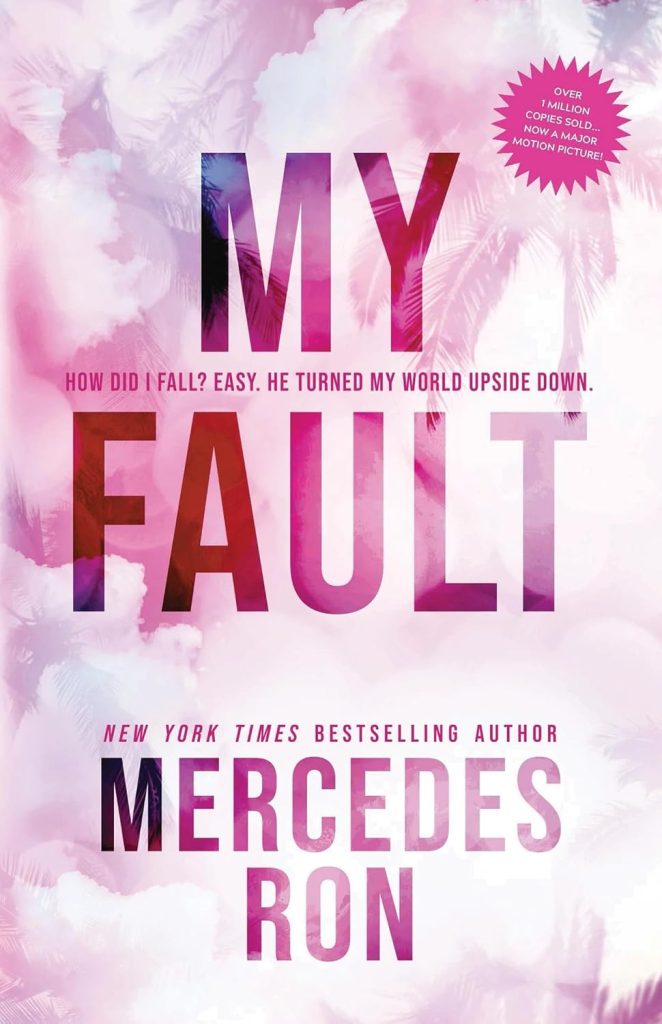
Before it was a glossy movie, My Fault was a wildly popular Wattpad phenomenon—the first book in Mercedes Ron’s Culpables trilogy. It’s pure high-octane NA/YA romance: a good girl uprooted into wealth, a bad-boy stepbrother with too many secrets, and an enemies-to-lovers spiral soundtracked by engines, late-night parties, and spectacularly messy feelings. You can feel the serial roots in the pacing (always another cliff, another confession), but the hook is timeless: two people who absolutely shouldn’t fall for each other trying—badly—not to.
What’s it about?
Noah’s life is already wobbling when the book opens. Her mum has remarried a very rich man, and the plan is for Noah to trade her familiar, scrappy routine for a gated mansion, a private school, and polite sets of cutlery she’s not convinced have touched actual food. The house is quiet-expensive, the kind of place with staff you don’t see and rooms that echo. Her stepfather is courteous and distant in that moneyed way—nice to everyone but also never fully present. Noah’s not buying the fairytale, but she is trying to keep the peace for her mum’s sake.
Then she meets her stepbrother, Nick. He’s the kind of trouble that announces itself before he speaks: motorcycle, scars, a look that says rules are for other people. He oozes confidence and boredom in equal measure. Their first encounters are electric in the combative sense—sniping in hallways, sideways glances across posh breakfasts, he calls her princess and it’s somehow both insult and dare. He’s orbiting a world of underground races, private parties that start at midnight, and a crew who treat danger like a hobby. Noah is not impressed. She’s also not immune.
School is no refuge. Noah’s the new girl among sharks: curated uniforms, whispered hierarchies, gossip traded like currency. Nick is a legend there—feared, coveted, conveniently absent. Noah finds two normal-ish friends who speak plain human and provide commentary; she also finds herself dragged to parties where expensive houses pretend to be nightclubs and the soundtrack is testosterone. Nick turns up in doorways whenever she’s about to do something reckless, as if he has a radar for her stubborn streak. He warns her off his world. She tells him where to stick his warnings. The more they fight, the more the air crackles.
The push-pull escalates through a string of almost-moments: he shows up when she needs a ride at 2 a.m.; she patches him up after a fight; he steps between her and a creep at a party and she’s angrier at how safe she felt than at the creep. Gradually, the snark thins and their confessions get heavier. Noah admits her old life wasn’t all grit and sunshine; there were reasons she runs hard at independence. Nick admits his father isn’t just strict—he’s a force you don’t cross lightly—and that some of his swagger is armour. Secrets accrue: scars that aren’t from sports, debts you can’t pay with allowance, grudges that wear real faces.
They don’t mean to start something. They definitely mean not to. But the line blurs: a dare becomes a kiss, the kiss becomes a secret, the secret becomes oxygen. They keep it quiet because what else can they do? Step-siblings in a brand-new family, living under a roof where silence is the only way anything functions—of course they’re hiding. The secrecy amps everything: one shared look across a formal dinner, a brush of fingers in the garage, whispered arguments that end with them pressed against the wrong wall.
Inevitably, the world notices. Exes sniff around; friends ask too many questions; a rival from Nick’s scene makes it a game to goad him into jealousy. The adrenaline hits a peak during one of the night races—sirens, headlights, stupid decisions—and the fallout leaves Noah shaken and Nick furious in that protective way that reads as love if you squint and as control if you don’t. Their dynamic gets thornier: he wants her safe; she wants to be treated like a person with agency; both of them are right and wrong at once.
Family pressure closes in. The stepfather sees more than he says and chooses denial until he can’t. Noah’s mum senses the storm through walls. Something ugly from Nick’s past claws back into the present (a debt, a threat, the kind of mistake that doesn’t stay paid), and suddenly their flammable little bubble is a bonfire. A confrontation blows the secret open—raised voices in the wrong room at the wrong time—and the dream of keeping love separate from consequence evaporates. There’s an accident (because of course there is), the kind that clarifies what matters and what hurts, and then the adults do what adults do: declare lines, erect rules, promise punishment.
The final chapters are equal parts adrenaline and anguish. Noah and Nick are forced apart, at least officially. Friends scatter to loyalties. The house returns to museum-quiet. And the series does the very Wattpad thing it’s built to do: end on a knife-edge. Their feelings haven’t gone anywhere; the obstacles haven’t either. Cue book two.
What This Chick Thinks
Addictive pacing, unapologetically so
This is shot-gunned chapters and cliffhanger muscle. The serial DNA shows, and it works—I sped through scenes the way Nick takes corners, and I’m not sorry about the whiplash.
Chemistry you can spark a match on
Noah/Nick is textbook enemies-to-lovers with turbo boosters: bickering that lands, stolen moments that sizzle, and just enough vulnerability to make the swoon feel earned. It’s messy and magnetic.
Toxicity… handled or hand-waved?
Here’s the knot. The book flirts with possessiveness, jealousy, and “I know what’s best for you” behaviour. Sometimes it interrogates these; sometimes it glamorises them. I liked Noah best when she pushes back, sets boundaries, calls things by their names. I could have used more of that balance throughout.
Class fantasy with sharp edges
The wealth-gloss is part of the fun—cars, mansions, private schools—but the story also shows how money buys silence and makes bad choices look like rumours, not records. That’s where it felt richer than the trope.
Step-sibling taboo: your mileage will vary
If the step-sibling angle is a hard no for you, this isn’t the book to change your mind. The taboo is the engine here; removing it would stall the car.
Wattpad voice, in good ways and bad
High emotion, big set pieces, dialogue that sometimes swings melodramatic—that’s the package. I’m not against melodrama when it’s this propulsive, but subtle it isn’t.
Final Thoughts
My Fault is glossy, messy, and compulsively readable—an angst-fuelled ride that knows exactly what kind of fantasy it’s serving. I tore through it, rolled my eyes at a handful of toxic beats, and still reached for book two because the hook is barbed and the characters are hot-headed, not hollow. If you’re here for high drama and bad decisions with heart, you’ll eat it up.
Rating: 8/10
Try it if you like:
- After by Anna Todd – College-age, Wattpad-rooted angsty romance with a volatile, magnetic pairing, messy choices, and a cliffhanger appetite.
- Paper Princess by Erin Watt – Stepbrothers, private-school politics, luxe settings, and a heroine battling both attraction and power plays.
- Beautiful Disaster by Jamie McGuire – Bad-boy fighter energy, push-pull intensity, and a relationship that’s equal parts red flags and real feeling.
