
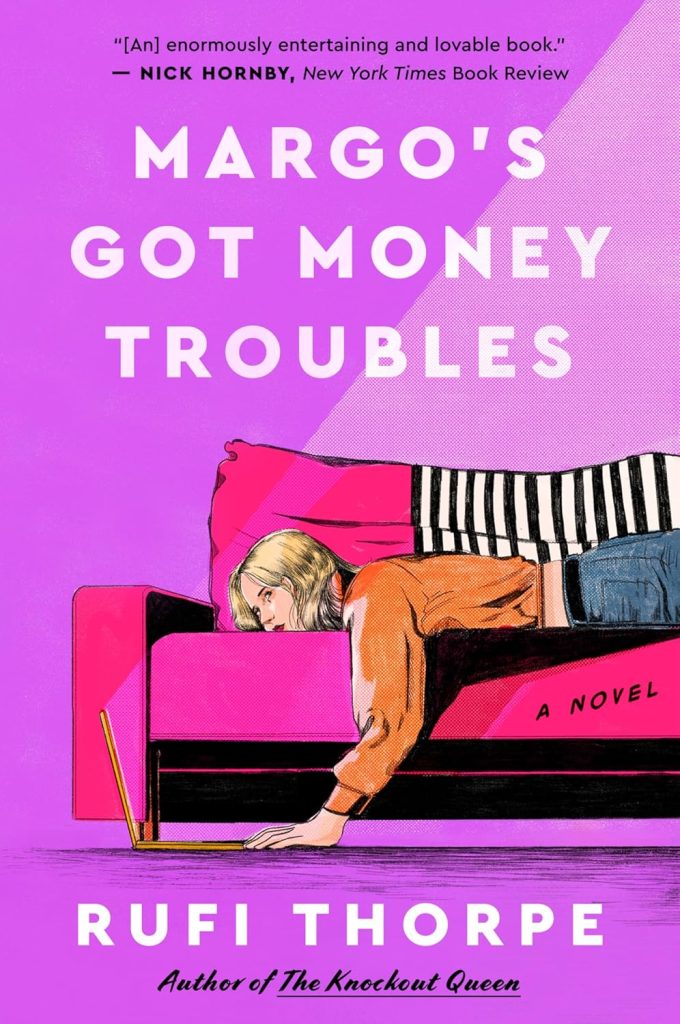
Rufi Thorpe has a thing for messy, funny, deeply human women—see The Girls from Corona del Mar and The Knockout Queen—and Margo’s Got Money Troubles might be her most compulsively readable yet. It’s a capitalist fairy tale flipped inside out: a young single mum in SoCal, a once-famous pro-wrestler dad who reappears like a plot twist with biceps, and the very-online economy where attention can buy groceries until it bites back. Thorpe writes with that warm, wry x-ray vision I love—every page is jokey until suddenly it’s vulnerable and true.
What’s it about?
Margo is twenty, basically broke, and trying very hard to pretend her life is not a game of Jenga. She’s juggling community college classes, a low-wage job that smells like fryer oil, and a pregnancy she didn’t plan with a man who knows exactly how to send complicated texts and exactly how not to show up. When the baby arrives—a fierce, tiny sun who rearranges every orbit—Margo discovers the arithmetic of modern single motherhood: childcare is a second rent, diapers breed like rabbits, and an emergency is just a Tuesday with better lighting.
Her mother helps how she can (love, casseroles, opinions), but money is the loudest person in the room. Enter Margo’s estranged father, a former pro-wrestling star with a stage name that once filled arenas and a present-day vibe of “still famous in the comments.” He’s been gone forever and arrives with gifts, apologies, vague promises, and the kind of charisma that’s equal parts protective and performative. He wants to make amends. Margo wants a life that runs on less chaos and more cash.
The pivot happens in slow, believable increments. Margo realizes that the quickest way to cash is not another minimum-wage job stacked on top of exhaustion; it’s the internet’s oldest sleight of hand: turning the gaze into income. At first it’s tentative—anonymous photos on a subscription platform, boundaries written down like commandments. There’s an alias, lighting hacks, strict rules about what she will and won’t do, and a little production team of one: Margo in a messy apartment with a ring light and a baby monitor. It starts as numbers (subscribers, tips, goals), then becomes a routine (shoot, feed the baby, edit, laundry, collapse), then an identity she wears like a costume she tailored herself.
Success is incremental and seductive. She pays a bill early. She upgrades the stroller. She moves into an apartment where the walls don’t listen to the neighbors. The subscribers want more. Some are delightfully normal; some are boundary-whisperers. There’s a parasocial boyfriend or two, a troll community that treats cruelty like a hobby, and a fan who thinks paying gives permission. Margo learns the attention economy’s real syllabus: intimacy as performance, performance as labor, and labor as a thing everyone thinks they understand until you send an invoice.
Meanwhile, Dad steps in with complicated support. He knows about spectacle and branding, contracts and leverage, and he’s strangely good at being a grandfather. He also loves an audience. Their relationship becomes the second engine of the book: daughter and father rebuilding something on the fly, one part tenderness, one part PR strategy, one part old ache they keep joking around instead of lancing. He offers help that looks like management; she takes it because diapers, but sets rules that make him flinch. He shows her how to think like a business; she teaches him how to be useful without being the main character.
Complications multiply, because of course they do. The baby’s father wants varying degrees of involvement depending on who’s watching. A subscriber crosses a line and Margo has to decide whether to fold, fight, or go public. A “brand opportunity” dangles real money and even realer strings. There are school emails, lawyer emails, mom emails, and one truly stomach-dropping moment when online life seeps into her real hallway. Thorpe threads every escalation with humor—Margo’s internal monologue is a gift—but the stakes never feel cute. Rent is not cute. Safety is not cute. Reputation, when you’re a mother on the internet, is a loaded word.
The back third is a reckoning: Margo has built something that works—financially, practically—and now she has to decide if it works for who she wants to be. She wants a future for her kid that isn’t lived under a ring light. She wants a version of love where help doesn’t come with strings and “I’m proud of you” isn’t code for “I get a cut.” She also wants to stop apologizing for the fact that she solved a problem in a way people love to judge. So she renegotiates, both literally and metaphorically: contracts, custody, boundaries with Dad, boundaries with the audience, boundaries with herself. There’s a near-disaster that clarifies what matters (her kid, her safety, her name), and then there’s a small, hard-won reset—the kind of ending I like best: not neat, not tragic, but human.
What This Chick Thinks
A money novel that actually understands money
This isn’t hand-wavy “she just monetized vibes.” Thorpe shows the grind: the pricing, the edits at 1 a.m., the customer service smile you wear while mentally writing a snarky memoir. It’s a keen, compassionate look at how women fund their lives when the respectable options don’t pay.
Sex work, without sermon or smirk
The book never turns Margo’s choice into either a morality play or a punchline. It’s work. It carries risks and rewards. I appreciated how Thorpe lets Margo hold the mic on ethics—what she owes her kid, what she owes herself, what she doesn’t owe strangers.
Father–daughter mess that rings true
The wrestler dad is a gem: equal parts cartoon and heartbreak, a man who can sell any story but doesn’t know how to be small in the room. Watching him try, fail, and sometimes succeed made me tear up, then laugh, then text my own dad.
Maternal tenderness with bite
Baby scenes are real (sticky, loud, deliriously sweet) and never weaponized for pathos. Motherhood here is both ballast and chaos—a reason to keep going and a reason to burn down anything that threatens peace.
The voice is the star
Margo’s narration is breezy-smart, self-mocking, and devastating when it drops the mask. I flagged so many lines I felt like a manic grad student.
A tiny quibble
One late plot turn hinges on a coincidence that felt a hair convenient, and a side character crowds the frame briefly before exiting. But the emotional landing is so earned I shrugged it off.
Final Thoughts
Margo’s Got Money Troubles is whip-smart, warm, and bracingly honest about the way we hustle for a life—and how that hustle collides with love, judgment, and the internet’s endless appetite. It’s a capitalism comedy with a beating heart, a motherhood novel that refuses piety, and a coming-of-age story where the job title is part of the point. I loved it.
Rating: 9/10
Try it if you like:
- Luster – Raven Leilani – A sharp, funny, unflinching look at a young woman’s art, money, and messy choices in a world that keeps moving the goal posts.
- Pizza Girl – Jean Kyoung Frazier – A voicey SoCal tale of a young mother adrift and clawing toward a self that fits.
- The Knockout Queen – Rufi Thorpe – Different setup, same electric mix of humor and tenderness, with Southern California heat and complicated relationships at the core.
