
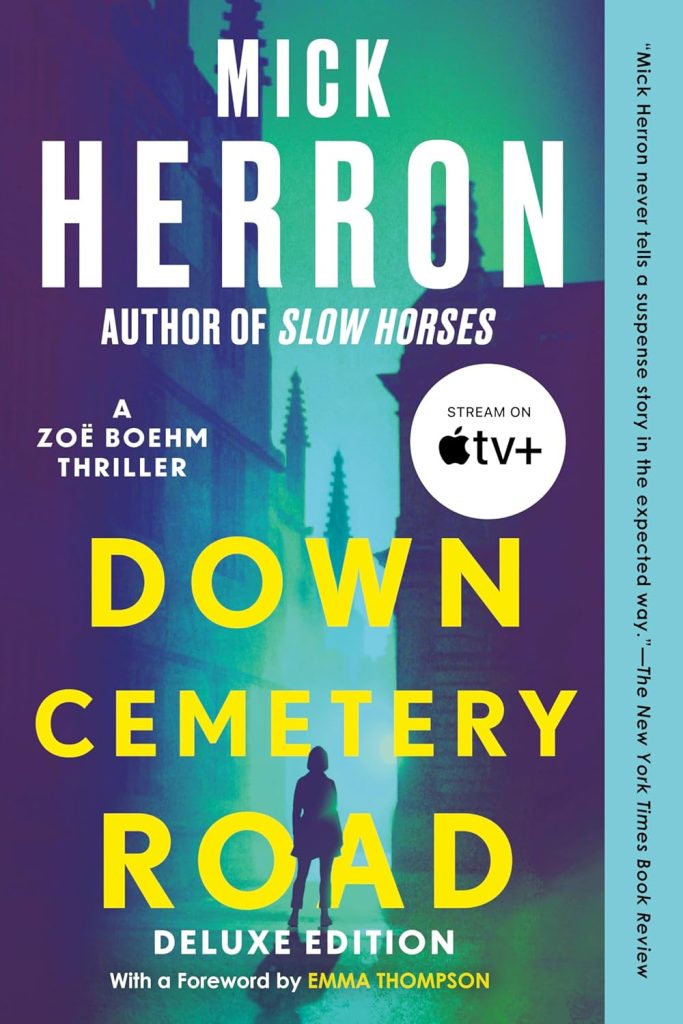
Before he became “the Slough House guy,” Mick Herron was honing that bone-dry wit and talent for human messiness in an Oxford-set quartet. Down Cemetery Road is the first of those books, and it already has the Herron hallmarks: ordinary people blundering into the long shadow of official secrets, gallows humor that lands like a slap and a hug, and a mystery that keeps swapping masks just when you think you’ve got its measure.
What’s it about?
It starts with a bang—literally. A suburban Oxford street is ripped open by a gas explosion that turns one house into a smoking crater. Neighbors gather in bathrobes. Sirens slice the early morning. Among the onlookers is Sarah Tucker, whose life lately has been an uneasy stew of boredom, low-grade marital drift, and the feeling of standing in the wrong queue. She watches the flames, the firefighters, the officials who arrive too quickly and corral everyone just a little too efficiently. The story everyone settles on is tidy: tragic accident, move along. But something about the scene needles Sarah. In the confusion, she thinks she glimpsed a small shape in an upstairs window; later she hears a fragment of conversation about a child who isn’t on any list. By the time the cordon comes down, Sarah is convinced: a child went missing in the chaos—and no one seems eager to find her.
She starts by doing the obvious civilian things: pestering the police, knocking on doors, scouring the local news. The answers are blank smiles and closed files. So she widens the circle. A name reaches her—Zoë Boehm, a private investigator with a reputation for getting into rooms she isn’t invited to and a talent for looking like she belongs there. Zoë, prickly and practical, isn’t thrilled by the job at first glance; “lost child” cases seldom end well. But Sarah’s insistence—and the odd way officials keep trying to nudge her away—pricks Zoë’s curiosity. They team up: one amateur with more nerve than sense, one professional whose good sense comes laced with fatalism.
The early stages of their hunt feel like straight detective work. They map the street’s routines. Who lived in the wrecked house? Where are the utility records? Who signed off on the gas inspection? In interviews, neighbors repeat details like they’re reciting lines. A repairman clams up the second a certain name is mentioned. A council office “misfiles” a whole folder with suspicious efficiency. Sarah and Zoë get used to hearing, “You’re mistaken,” from people who don’t bother to check. And then they encounter the first break: a document that shouldn’t exist, pointing not to a family with a child but to a house leased via a shell company. The tidy story frays.
Once they tug that thread, the city changes. Oxford’s postcard face—bicycles and spires—recedes, and its service corridors open: estates where everyone knows who not to ask; pubs where the wrong question buys you a long, quiet stare; offices where “off the record” means “forget you ever came.” A man in a good suit shows up twice on two different streets and pretends he hasn’t. A woman with a civil-service smile knows the names of people Zoë has never met. The explosion starts to look like a hinge event rather than an accident, and the missing child starts to look less like a neighborhood tragedy and more like a problem someone designed.
Sarah is not a trained sleuth, and the book doesn’t pretend otherwise. She makes mistakes—talks to the wrong person, gets tailed, trusts her temper when patience is required. Zoë plays ballast and decoy by turns, steering Sarah away from cliff edges while poking those same edges herself to see what gives way. They split up and compare notes at odd hours in bad cafés, because the clock here is not just about finding a child; it’s about staying ahead of the official story hardening into stone.
When violence arrives, it does so with Herron’s signature casual cruelty. A witness who hinted at more goes missing; a parked car accrues a new dent from a driver who doesn’t look back; a stranger “accidentally” shoulder-checks Sarah hard enough to bruise. A warning is delivered that manages to sound like advice. And then there’s a proper scare: a late-night confrontation that forces Sarah to understand there’s a gulf between “nosy neighbor” and “participant.” She crosses it anyway.
Midway through, the mystery pivots. The missing child, it turns out, is not a simple domestic loss but a loose end from something older and uglier—a project that lived in a gray space between government oversight and deniable enterprise. There were payouts. There were lies told for the greater good. There was a child whose existence complicated everything. Paper trails are thin where they should be thick and thick where they should be thin. People who can’t be officially connected to each other start stepping into the same rooms. Zoë’s professional caution ratchets up; Sarah’s moral outrage keeps pace.
They trace the trail out of Oxford and back again, through burned-down addresses and archived reports that exist only as rumors. A former colleague of someone who isn’t supposed to have colleagues coughs up a name he immediately regrets saying. A burnt ledger yields a phone number. A surveillance tail yields a surprise: they’re not the only ones looking. Other hunters—leaner, meaner—are also on the trail, and their idea of a good outcome doesn’t require the child to be found alive, or even found at all.
The endgame unfolds across a handful of sharply staged encounters. Sarah ends up in a place she has no business being, face to face with someone who has built a career on not leaving fingerprints. Zoë leverages a professional acquaintance into a single, crucial hour behind a door that doesn’t open for civilians. Two versions of the past collide: the official one, sanitized and filed; and the real one, which involves terrified people making shameful choices. The missing child’s truth—who she was, who hid her, who decided to stop looking—lands with Herron’s typical mix of bleakness and bite. It isn’t neat. It is, unfortunately, believable.
The cost is counted up afterward. Sarah’s marriage, already listing, takes on water; you can’t chase ghosts for weeks and come home unchanged. Zoë, who keeps her life compartmentalized as a survival tactic, discovers that even good compartments leak. Some people pay on paper; others glide away because that’s what power buys you. And yet there is a kernel of justice: not the parade kind, but the quieter version—truth spoken aloud where it most matters, a life redirected, a person found who can now choose. The last pages aren’t triumphant; they’re steady. Herron’s universe rarely offers more.
What This Chick Thinks
A bored neighbor becomes a battering ram
I love a civilian-turned-sleuth who doesn’t suddenly acquire superpowers. Sarah’s stubbornness is her weapon, and Herron lets it be both heroic and dangerous. Watching her learn the rules of the game as she breaks them is half the fun.
Zoë Boehm: flinty, funny, haunted
Zoë’s the kind of PI who plays her cards close, and the glimpses we get are tantalizing—enough bite to anchor a series, enough bruised humanity to keep you caring. I’d follow her into very stupid buildings.
Conspiracy at street level
This isn’t glossy spy fantasy; it’s grim corridors, plausible deniability, and the way bureaucracies bury sins under memos. Herron’s talent is making systems the villain without turning people into cartoons.
Humor that whistles in the dark
The jokes aren’t escape hatches; they’re survival tools. One-liners land right when the dread threatens to overtake you. Herron’s deadpan is delicious.
If I’m nitpicking
One reveal hinges on a conveniently timed discovery, and a secondary heavy leans archetypal. But the momentum and moral clarity carry you past the wobbles.
Final Thoughts
Down Cemetery Road is a lean, sly, very English thriller about what happens when ordinary curiosity meets institutional rot. It sets up Zoë Boehm beautifully, gives Sarah Tucker a hell of an origin story, and proves Herron had the goods long before Slough House made him a household name—well, in households like mine.
Rating: 9/10
Try it if you like:
- Case Histories — Kate Atkinson – A PI story that cares as much about people’s grief and bad decisions as it does about clues.
- A Spy by Nature — Charles Cumming – Realistic espionage where ambition and compromise do most of the damage.
- The Crow Trap — Ann Cleeves – A slow-burn investigation that peels back a landscape and its secrets one patient layer at a time.
