
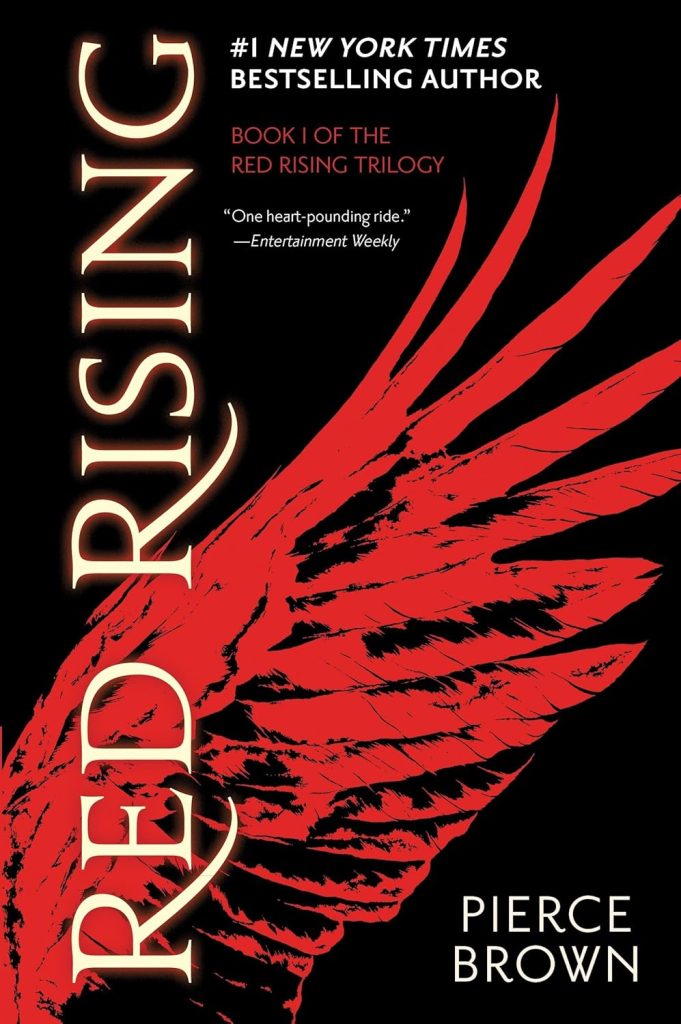
Pierce Brown’s 2014 debut arrived like a meteor: a gladiatorial school story inside a far-future caste dystopia on Mars, told in a raw, propulsive voice. It launched a trilogy that then exploded into a larger saga, and you can see why. Red Rising starts with a simple, brutal promise—one lowborn miner will infiltrate the ruling class—and turns that into a full-blooded revolution-in-the-making. Come for the games; stay for the political teeth and the characters who won’t leave your head.
What’s it about?
Darrow of Lykos is a Red, the lowest color in a rigidly stratified society. He works beneath Mars, tethered to a drill in claustrophobic shafts, believing his people are nobly toiling to make the planet habitable for future generations. Life is short and narrow but full of fierce community: the Lambda helldivers race for quotas; Auntie and Uncle keep order; and Eo, Darrow’s wife, hums forbidden songs and urges him to imagine more than survival.
The truth arrives with a crack of the whip. Darrow steals a forbidden moment topside to gift Eo a glimpse of the stars; the authorities catch them. The punishment is public and medieval. Eo is hanged for treason. Before she dies, she presses a dream into Darrow’s hands: break the chains. Darrow tries to follow her into death; rebel agents calling themselves the Sons of Ares steal his body from the gallows and offer a different path. He can die with Eo, or he can become a weapon.
Dancer, a handler for the Sons, lays out the lie at the heart of Darrow’s world: Mars has been terraformed for centuries. The surface is rich with cities and pleasure gardens. Reds are not pioneers—they are slaves kept ignorant and underground while Golds, the apex caste, rule. The Sons propose an impossible gambit. They will remake Darrow into a Gold—literally, through a grisly surgical process called Carving—and send him into the elite Institute where the empire trains its future rulers. If he survives, he can gut the system from within.
The Carver, Mickey, rebuilds Darrow bone by bone: longer limbs, higher density, killer reflexes, a raptor’s grin. The transformation is body horror and rebirth. Months later, a man who used to be a miner stands in a glittering exam hall with the children of gods. He needs a patronage mark to enter the Institute; he earns it with test scores and a well-timed act of violence. He takes a new name—Darrow au Andromedus—and points himself toward the heart of the machine.
The Institute is not a campus; it’s a crucible. New initiates are sorted into Houses named for Roman gods and thrown into a war game that is closer to civilizational boot camp than capture the flag. Each House must conquer a territory, enslave or ally neighboring Houses, and produce a leader capable of making an army move like one mind. Proctors—elite Gold adults—are meant to supervise but not interfere. In practice, they cheat for their favorites.
Darrow lands in House Mars, led by a charismatic Primus who promptly gets murdered in the night. The cohort fractures into packs. Darrow chooses to start from the dirt: he allies with rough-edged, loyal Pax au Telemannus; sharp, wolfish Sevro and his Howlers; and poets like Roque who see more than they admit. Across the valley, House Apollo fields golden boys with perfect teeth and zero mercy; House Minerva boasts Virginia au Augustus—Mustang—whose cool competence makes her as dangerous as any sword.
Strategy is learned the ugly way: starvation, raids, slave-taking, punishments carved into skin. Darrow cobbles together a tribe by offering something novel in Gold culture—justice. He treats captives like citizens instead of cattle, rewards initiative, and spreads influence through bread as much as blood. It works. He topples a local tyrant, frees an entire House from a petty warlord, and learns to become the kind of leader who can sleep in the mud beside his soldiers and still command their fear.
Then the game goes personal. Julian, a gentle boy Darrow met during trials, is murdered off-page in a duel that reveals the Institute’s first real sin: the initiation required each student to kill another in a blind match. Darrow’s opponent was Julian. The knowledge detonates when Cassius—Julian’s golden, vainglorious brother—learns the truth. Their bond flips to blood feud. Cassius wounds Darrow in a staged duel and leaves him for dead. Mustang drags him out of the river of humiliation and back to purpose, setting up one of the series’ most satisfying partnerships: two predators deciding to be principled together.
The mid-game becomes nation-building. Darrow conquers castles; frees slaves who expected only cruelty; and crafts a banner worth bleeding under. He and Mustang rally disparate Houses into something like a republic inside a game designed to breed tyrants. They also flirt with a precision that makes alliances feel inevitable. Across the map, a new threat sharpens: the Jackal—Adrius au Augustus, Mustang’s twin—whose cruelty is matched by patience. Where others charge, he traps. He invites, then amputates.
In a set piece that leaves fingerprints on the series, Darrow walks into the Jackal’s hospitality and loses. Friends die. Trust snaps. He escapes by the meanest margins and returns with nothing but rage and a broken tribe. Sevro saves him from his own despair with a truth bomb: loyalty can be chosen, and so can ruthlessness—for the right reasons. Darrow chooses again. He abandons noble gestures and starts playing to win the meta-game, not just the map.
The Proctors’ cheating peaks. Apollo interferes to keep his chosen students atop the scoreboard; other Proctors look away. Darrow does not. He drags a Proctor from the sky—literally—and forces a confession. The Institute’s gods bleed; the students see it. The illusion of meritocracy bursts. Darrow leverages the scandal into a rallying cry and an armistice between Houses that should hate each other more than they hate the grown-ups pulling strings.
The endgame is both siege and show trial. Darrow breaks the Jackal’s last holdout, turns his enemies into signatories to a new order, and walks out of the Institute not as Primus of Mars but as a symbol of something the Golds forgot to plan for: a leader the lowborn would follow because he offers dignity alongside victory. The prize is feudal: each winner gets courted by the great houses. Nero au Augustus—arch, lethal, father of Mustang and the Jackal—claims Darrow as his new heir. The miner from Lykos becomes the ward of his enemy, holding a knife that can cut at the throat of the empire or his own future.
Quietly, the Sons of Ares send a message. The mission is far from over. Darrow rides in a gravCar through a city Reds built, wearing a Gold’s sigil, and decides to end the world by rewriting it, one betrayal and one mercy at a time. Curtain down. Sequel loaded.
What This Chick Thinks
Character first, even with all the carnage
The marketing promised action, and it delivers, but what kept me glued were the people: Darrow stubbornly learning better ways to lead; Mustang matching steel with strategy; Sevro being feral and somehow the moral compass. The friendships hit as hard as the fights.
Yes, it invites Hunger Games comparisons—then takes a left turn
Arena, teens, televised-adjacent brutality; sure. But the Institute is less about survival and more about statecraft. It’s a civics lab. The shift from “win” to “how you win matters” is the book’s spine.
World-building with bite
Color-coded castes could have been a gimmick; instead, the details accrete until you feel the weight—language, etiquette, genetic engineering, the Proctors’ rigged game, the way propaganda keeps Reds underground in more ways than one. It’s pulpy and pointed.
Brown’s voice: jagged and propulsive
Short, punchy sentences; rough poetry in the swearing; battle scenes that are spatially clear and emotionally sharp. I’m not usually a gore girl, and I winced plenty, but the momentum is undeniable.
Moral courage feels like a plot device—and a choice
Darrow’s shift from vengeance to justice is gradual and earned. When he stops acting like a Gold to beat Golds and starts acting like something new, the book clicks.
Caveats and content notes
It’s violent: war-crime levels at times, including assault and cruelty. A couple of side characters tilt archetype (the boy-poet, the golden jerk) before deepening later in the series. If slang and swagger aren’t your thing, the opening stretch may feel like a wall—I promise it softens.
Final Thoughts
Red Rising is a brutal, addictive, surprisingly thoughtful kick-off to a saga about power, myth-making, and the cost of building a better house with bricks stolen from a rotten one. It sticks the landing on both the blood and the brains, and it leaves you itching for Golden Son with the kind of urgency that ruins sleep.
Rating: 9/10
Try it if you like:
- The Hunger Games by Suzanne Collins — A rigged arena, rebellion simmering under spectacle, and a protagonist who learns that symbols are a burden and a blade.
- Mistborn: The Final Empire by Brandon Sanderson — Class revolt, undercover infiltration of a seemingly invincible elite, and leadership that hinges on trust and audacity.
- The Poppy War by R. F. Kuang — A school-to-war pipeline, a ferocious heroine, and a narrative that refuses to blink at the moral cost of power.
