
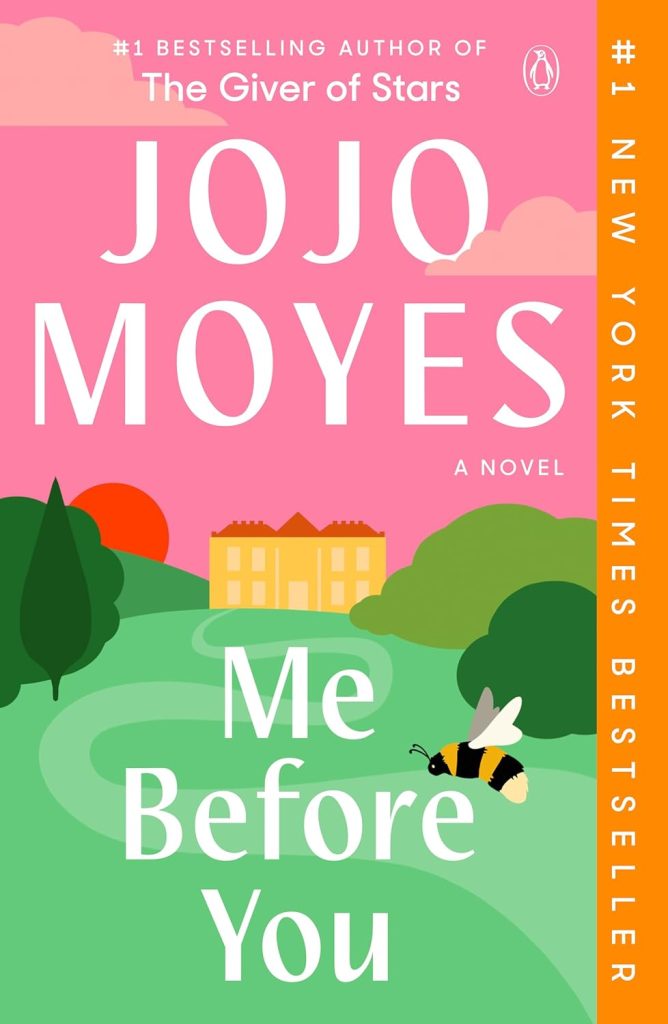
Jojo Moyes had been writing smart, warm-hearted women’s fiction for years before this book detonated into a global phenomenon. Me Before You (2012) is the one that turned “bring tissues” into a genre tag, spawned sequels, and kicked off a fierce debate about autonomy and romance in the shadow of disability. I went in expecting a tear-jerker in nice shoes; what I found was a character piece with teeth—funny, prickly, and very clear-eyed about how love doesn’t fix everything (and maybe shouldn’t try to).
What’s it about?
Louisa Clark—Lou to everyone—lives in a small English town where life has settled into a shape that doesn’t quite fit. She’s twenty-six, cheerful to a fault, and wears outfits like a walking confetti cannon (bumblebee tights, anyone?). She works at a cosy café she loves, helps out financially at home (parents, granddad, younger sister and her son), and keeps the horizon comfortably close. Then the café closes. Redundancy check in hand and options thin, Lou signs up with a temp agency and lands an interview for a six-month contract as a carer/companion. No qualifications required—just patience. The client is Will Traynor: early thirties, ex–city boy and adrenaline junkie, now a quadriplegic after a traffic accident two years earlier. Lou turns up to the Traynor house in her best, brightest clothes and gets frostbite from the posh air-conditioning—especially from Will’s formidable mother, Camilla.
Day one is bruising. Will is angry, bored, and capable of weaponised sarcasm. He has a full-time nurse, Nathan, for medical needs; Lou’s job is to keep him company, make tea, and absorb the moods. She’s not a nurse; he’s not a saint. They circle each other. Lou is chatter and sunshine over armour; Will is armour over a man who used to ski before breakfast and close million-pound deals before lunch. She needs the money; he needs… well, the book is very honest about how much he thinks he doesn’t.
Lou learns the basics: transfers, feeding, the ominous roll call of risks (pressure sores, respiratory infections, autonomic dysreflexia), and the necessities that make caring feel both intimate and invisible (timers for meds, a watchful eye for fatigue, the exact angle he prefers in his chair). Will learns that Lou’s flustered babble can be very funny. The days lengthen, soften. Nathan, all calm competence, becomes the translator between them. They move from tense silence to sparring, from sparring to jokes that land, from jokes to a kind of tentative truce.
Then Lou overhears a conversation she wasn’t meant to hear. Will has attempted suicide before, and the family has struck a devastating bargain: give him six more months. If, at the end, he still wants to go to a clinic in Switzerland to end his life on his own terms, they will not stand in his way. The time clock on the novel starts ticking at that moment for Lou, not Will. She decides, with the panicky certainty of someone who refuses to lose without trying, to make the six months so full of life that he will choose to stay.
The middle of the book is Lou learning to plan a life like an itinerary: small adventures tailored to what’s possible. A haircut from a stylist who treats Will like a man, not a project. A concert where the music swallows the room and Will’s hand squeezes hers in the dark. A trip to the racetrack that goes wrong and then right. A birthday with too many candles and not enough grace from Will’s ex and old friend—who show up inconveniently engaged to each other. There’s the infamous “maze” scene, where a castle’s tourist attraction becomes a parable for how easily Lou panics at hedges she could push through, and Will refuses to look away from that truth. He challenges her relentlessly: stop fitting yourself into small spaces, Clark.
We watch Lou’s world expand in inches. At home she negotiates pride and pressure (her sister Katrina is the clever one; Lou is the “good girl” expected to subsidise the household). With her boyfriend, Patrick—a personal trainer whose true love is his own marathon times—Lou starts to see the difference between being a habit and being seen. With Will, the banter turns to the bone. He asks about her abandoned dreams. She admits she never had permission to have any. He tells her she does now—then dares her to use it.
Lou plans the big one: a proper holiday—accessible resort, medical logistics sorted by Nathan, everything triple-checked—so that Will can feel the texture of sunshine and sea again, not just central heating and routine. The trip is gorgeous and complicated: lazy days by the pool, a snorkelling excursion Lou takes while Will watches, a late-night conversation where the word love doesn’t need to be said to be obvious. It’s also where the emotional fuse hits the powder. Lou finally tells Will she knows about Switzerland. She says: choose me, choose this, choose more. He loves her enough to tell her the truth: he cannot choose to live a life he doesn’t want for another forty years because it will make other people less sad. He wants the right to end it while it’s still his to decide.
The return home is a heartbreak in ordinary clothes: airport queues, the quiet car ride, the family house where everything smells the same and nothing is. Lou is angry—at Will, at herself for believing she could outrun his decision, at a world that shrank his life to a chair and then dared him to be grateful. She quits the job, goes to bed, and tries to calcify. Camilla comes, brittle and broken; Nathan comes, gentle and furious at the universe; even Katrina manages the perfect sister move: pep talk as slap. Lou gets up. She goes to Switzerland. She holds Will’s hand. He says goodbye like a man who has decided and will not be argued with. She does not forgive the decision; she respects it. He dies the way he chooses.
After, there’s the letter—financial provision and a charge: live boldly. Lou sits in a Paris café wearing the dress he once teased her into buying, tastes something delicious, and lets grief and gratitude co-exist for a minute without cancelling each other out. The book ends not on a wedding but on a horizon: not easy, not clean, but open.
What This Chick Thinks
A love story that refuses the fairy tale
I respect that the book never promises love will “cure” disability, depression, or grief. It lets love be love—transformative, yes, but not a magic wand. That honesty is why the ending hits so hard.
Lou’s glow-up is more than a haircut
Her arc isn’t makeover + confidence montage; it’s learning to want. Watching her push beyond the smallness she’s been assigned—by family, by her own risk-aversion—was my favourite thread.
Will: charming and complicated
He’s witty and generous and sometimes arrogant; he’s also unmovable about his choice. The book doesn’t ask you to agree with him—only to listen. I did, and I argued with him in my head the whole time.
Disability and autonomy (and the thorny middle)
The story’s ethics have sparked real debate, and I get why. For me, the book works because it centres consent and the right to decide for oneself, while also showing how ableism and access shape what choices feel possible. It’s tender without being pat.
Funny, truly
People remember the ending; they forget how often this is laugh-out-loud. Lou’s voice, the clothing mishaps, the family chaos—this isn’t one long sob. It’s life: ridiculous and heartbreaking in the same afternoon.
Tiny quibbles
A couple of side characters are sketched as types (Patrick’s gym bro energy is turned to eleven), and a mid-book set piece leans manipulative. But the emotional truth kept me fully onboard.
Final Thoughts
Me Before You is an unabashedly emotional novel that earns those emotions by treating its characters like adults—messy, witty, scared, brave. It’s about love, yes, but more about choice: who gets it, who withholds it, and what it costs to claim it. I finished it feeling wrung out and weirdly hopeful—like Lou had pressed a little permission into my palm to want more.
Rating: 9/10
Try it if you like:
- One Day — David Nicholls – A decades-long almost-love that asks whether timing is the cruelest character; witty and devastating in equal measure.
- The Light We Lost — Jill Santopolo – Big feelings, life choices, and the long echo of a first love you can’t file neatly away.
- A Man Called Ove — Fredrik Backman – Different tone, similar heartbeat: prickly grief, found connection, and the reminder that ordinary days can be life-saving.
