
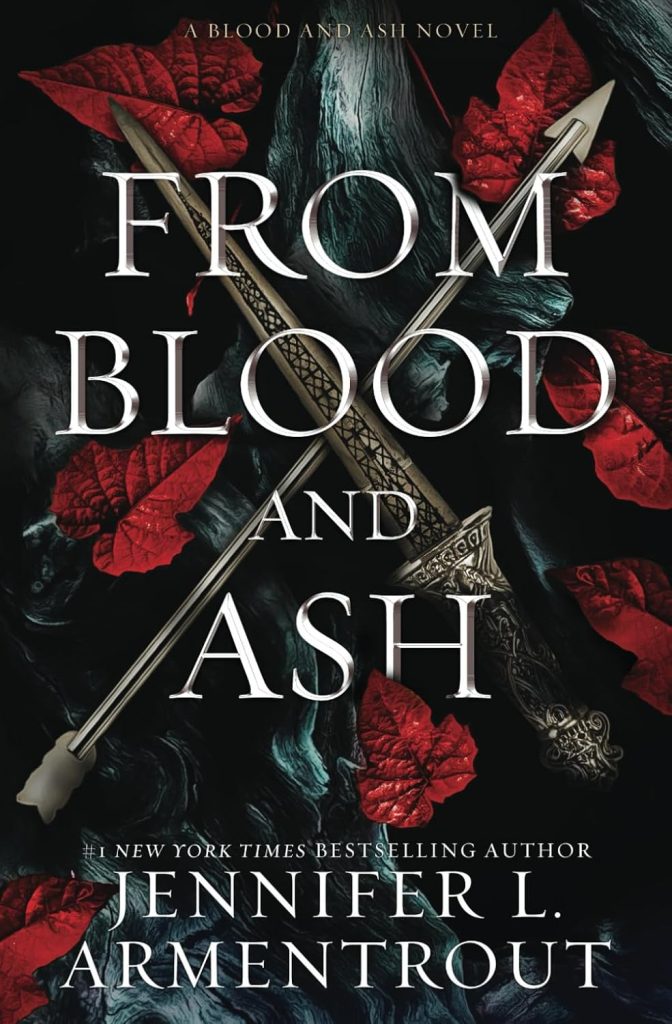
Jennifer L. Armentrout has spent a decade ruling the cliffhanger-and-kiss economy, and this one blew up into a whole universe: a high-fantasy, high-heat opener that launched a sprawling saga (and a thousand BookTok gushes). From Blood and Ash sets its hook with a classic fairy-tale constraint—the veiled “Maiden” who must not be touched, looked upon, or spoken to—and then pulls the rug with a mid-book turn that re-labels the monsters, the saints, and the boy with the dimples. It’s a big, glossy, melodramatic ride, and somehow it still sneaks in a conversation about choice, faith, and who gets to write history.
What’s it about?
Penellaphe “Poppy” Balfour has been raised to be a symbol. As the Maiden of the kingdom of Solis, she’s meant to be kept pure: veiled in public, guarded day and night, never kissed, never cut, never even truly seen. Her future is promised to the gods via the Ascension—a ritual everyone speaks of with holy hush and almost no details. Poppy obeys because she was taught to, and defies because she’s Poppy: she trains in secret with a dagger tucked in her skirts; she slips out to watch the city breathe at night; she wants a life, not just a role.
On one of those illicit nights, she lands at the Red Pearl, a pleasure house where anonymity feels like oxygen. A masked stranger with a soldier’s posture and a sinful smile offers her the first genuinely kind conversation she’s had in forever. They kiss. She flees, rattled and giddy, and tells herself it was a once.
The morning after, her world recoils. One of her bodyguards, Rylan, is murdered outside her chamber by an assassin who whispers of the Dark One—a boogeyman linked to Atlantia, the enemy kingdom beyond the mountains. His replacement? Hawke Flynn, a golden-eyed guard with very familiar dimples and a habit of standing too close. He’s appointed to protect her; he’s also excruciatingly good at making her question all the rules that have made her life so small. Poppy’s friend and lady-in-waiting, Tawny, encourages careful rebellion. Vikter, her mentor-guard and father figure, begs caution. The Duke and Duchess who “oversee” Poppy in the city of Masadonia enforce obedience with sanctimonious cruelty. The Duke’s punishments are ritualized—scars Poppy hides under veils and silence.
Whispers of unrest grow teeth. There are Kraven attacks—feral, light-averse monsters that rip through outlying villages—and murmurs of Descenters, people who reject the Ascended (the immortal, alabaster-skinned rulers) and the tithe the church extracts from the poor. At a grand Rite meant to celebrate the gods, the square becomes a kill box: masked assailants crash the ceremony; Kraven swarm the Rise (the city’s massive wall); civilians die; Vikter falls buying Poppy seconds she spends fighting like the girl she is when no one’s watching. In the bloody aftermath, the royal line decides Poppy must be escorted to the capital at once to prepare for her Ascension. The subtext: keep the symbol safe; keep the story intact.
Hawke is assigned to lead the escort. The road south is a braid of flirtation and danger. Hawke teaches Poppy to trust her instincts; Poppy teaches Hawke that she’s not a relic. There are ambushes that don’t feel random, nights where she senses pain in others like a pressure change (a forbidden gift she’s learned to hide), and long, quiet conversations where the guard and the girl who shouldn’t speak to anyone realize they’ve already said too much. Lord Mazeen—a pet predator of Masadonia’s elite—forces a confrontation that ends with Poppy’s blade exactly where he deserves it. The Duke soon dies violently too; whether by justice or coincidence is left deliberately murky as the entourage hurries on.
They take shelter in a village called New Haven, and that’s where the neat labels split. The people there talk about Ascended in the wrong tone. They talk about Kraven like symptoms, not curses. They hint at another story: that the Ascended aren’t holy at all, that the Ascension changes people into something hungry, and that Atlantia’s “Dark One” might have more reason on his side than anyone in Solis wants spoken aloud. Hawke’s men—Delano, Niall, and a quiet tracker with watchful eyes—move like a unit that has trained somewhere other than a Solis barracks.
The reveal lands with a thud and a kiss. Hawke isn’t Hawke. He’s Prince Casteel Da’Neer of Atlantia—the Dark One himself—embedded in Solis to accomplish a very specific mission. The flirty guard routine? Not a lie about his desire, but a mask over his aim. He and his people intend to take Poppy across the mountains as leverage to free his brother Malik, held by the Ascended. Cue betrayal, denial, fury, and yes, a frankly dangerous level of chemistry that refuses to dissolve just because the truth came out.
With the escort compromised and New Haven revealed as a haven for Atlantian sympathizers, Poppy fights like a cornered cat—daggers, teeth, every ounce of training Vikter hammered into her. She loses and wins at the same time. Casteel’s crew disarms her; Poppy still manages to bloody every man who comes within range. Somewhere in the melee, her rare gift spikes—she can sense and soothe pain, not just feel it. Whatever she is, it’s more than the Maiden’s legend ever accounted for.
The back stretch shifts from travelogue to hostage road-trip with the worst captor to develop feelings for. Poppy agrees to go with Casteel because she has no immediate alternative, because innocent people will keep dying in the crossfire, and because some part of her wants the larger truth more than she wants the small safety she never truly had. The longer she rides with him, the more the Solis catechism frays: the Ascended’s “divinity,” the origins of the Kraven, the ethics of the tithe, the real history between Atlantia and Solis. Casteel is merciless toward his enemies, tender toward his friends, and infuriatingly honest in the ways that complicate Poppy’s hate.
It builds to a private battle bigger than any skirmish: what Poppy will choose to be now that she knows her life as an icon was built on omissions. Casteel makes an outrageous, strategic, utterly on-brand proposal: marriage. A union gives him legal and symbolic claim that could keep her alive long enough to barter Malik’s freedom and to expose what Solis has become. It’s equal parts ploy and promise and the worst idea Poppy has ever wanted to consider. The book ends on that precipice: stunned heroine, infuriating antihero, mountains ahead, and a world cracked open enough to swallow them both.
What This Chick Thinks
The trope cocktail that just works
Bodyguard who is very much not just a bodyguard; forbidden girl with a blade under her skirts; enemies-to-lovers slow burn that isn’t actually slow. It’s all very extra, and it’s delicious.
World-building that sharpens as you go
Early chapters feel like comfy fantasy wallpaper—veils, gods, sacred rites. Halfway through, the wallpaper peels back to show rot in the walls. I loved the re-labeling: saints to monsters, monsters to men, symbol to person.
Poppy’s agency is the spine
She’s not a sassy-quippy cutout; she’s a sheltered survivor with a steel learning curve. Her choices—fighting, lying, forgiving, not forgiving—drive the book. When she says no, it matters.
Heat with negotiation
There’s plenty of spice, but consent and boundaries are on the page. Power imbalances are acknowledged, not hand-waved, which kept me on board even when the hormones made objectively terrible timing look great.
On Casteel (and morally spicy love interests)
He lies by omission and manipulates outcomes; he’s also protective without going full cage. If you like antiheroes who have to earn trust instead of being handed it because abs, he scratches the itch.
Pacing and purple edges
Action set pieces sing (the Rite; the New Haven turn). A few middle bits run repetitive, and the prose can dip into melodrama—frankly part of the charm, but your tolerance may vary.
Final Thoughts
From Blood and Ash is a glossy, wildly readable fantasy-romance that invites you in with tropes and keeps you with a heroine growing teeth and a world that doesn’t match its own propaganda. The final reveal sets up a bigger saga about history, hunger, and the cost of freedom. Did I roll my eyes once or twice? Sure. Did I barrel into book two anyway? Absolutely.
Rating: 8.5/10
Try it if you like:
- A Court of Thorns and Roses — Sarah J. Maas – Mortal girl, dangerous immortal, shifting politics, and a romance that complicates the map.
- Serpent & Dove — Shelby Mahurin – Enemies-to-lovers with a secret-identity twist, sacred rules, and a heroine whose stubbornness is her superpower.
- The Bridge Kingdom — Danielle L. Jensen – Marriage-as-weapon, knife-edge politics, and two leads who must decide if love can survive the mission.
- Empire of Sand — Tasha Suri – Sacred rites, a fierce heroine, and a romance threaded through duty and defiance in a richly built world.
