
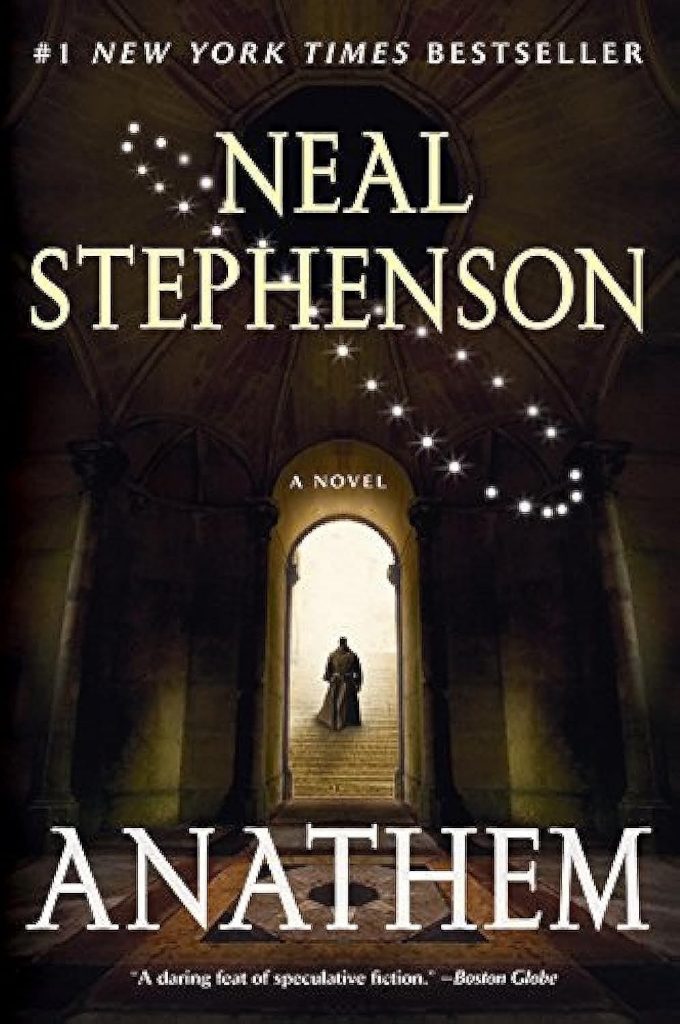
Neal Stephenson is the reigning monarch of big-idea storytelling—cyberpunk beginnings, the sprawling Baroque Cycle, then apocalyptic hard SF like Seveneves (a personal favorite). With Anathem (2008), he goes full philosopher-novelist: a first-contact epic disguised as a monastic campus novel, written in a made-up scholarly dialect that somehow becomes addictive by page 200. It’s audacious, brainy, and weirdly cozy—equal parts thought experiment and adventure yarn.
What’s it about?
On the planet Arbre, knowledge is quarantined. Scientists, mathematicians, and philosophers—called avout—live behind high stone walls in self-contained communities known as concents. They dress plainly, eat simply, and follow rituals that treat curiosity like a sacred discipline. The outside world, the Saecular, is noisy with politics and fashion; inside the walls, attention is the currency. Each concent is divided by cycles: some avout can leave during a yearly festival called Apert, others only once every ten years, or every hundred, or—almost mythically—every thousand. It’s a society designed to safeguard knowledge from power and power from knowledge, after past catastrophes where the two combusted together.
Our narrator, Fraa Erasmus (Raz to his friends), is a young avout at the Concent of Saunt Edhar. His circle includes quick-witted Jesry, earnest Arsibalt, reckless Lio, and, towering above them all, their brilliant, prickly mentor Fraa Orolo. Life is study, chores, debates called Symposia, and formalized arguments called Dialogs. Stephenson lets us live there: the smell of the refectory, the shared notebooks, the thrill of discovering you finally understand the proof that baffled you a year ago. It’s monkish, yes, but also buzzing—these are nerds with a vocation.
Strange things nudge at the edges. Orolo has a forbidden hobby: he’s jury-rigged a telescope-like device (a big no-no in their tech-averse rules) and spends nights staring at the sky. He hints at something up there—a shape in low orbit that behaves unlike anything natural. Then the Warden Regulators (the secular authority tasked with keeping concents tidy and harmless) show up, and Orolo is expelled for breaking rules. He leaves with a grim look and not enough provisions, and Raz sees, for the first time, how small their walled world might be in the face of whatever is coming.
The outside pressure builds. Rumors seep in at Apert: odd lights, a widening government presence around remote northern territories, whispers of an object people can’t quite agree on naming. Then history shifts. For the first time in ages, the world’s leaders call a Convox—a grand council summoning avout of all cycles out of their walls to help the Saecular address an existential threat. The gates swing open. Raz and several peers are drafted into a traveling cell of thinkers and problem-solvers and sent into the Saecular proper, wearing borrowed clothes and wonder on their faces.
Road novel time—by way of Platonic dialogue. Raz and company cross cities and tundra toward the far north, where a strange Facility has risen and soldiers patrol like their maps have grown teeth. Along the way, Stephenson plays his favorite game: let characters argue ideas until those ideas become plot. They hash out cosmology (one world or many?), consciousness (what is a mind?), and the philosophy of mathematics (discovered truths or human-made structures?). Each debate seeds a later reveal.
They also meet people who rearrange the diagram in Raz’s head. There’s Fraa Jad, an elderly, almost spooky-clever avout whose calm makes danger look manageable. There are Ita, layfolk who serve the concents and move quietly through both worlds. There are Saecular officials radiating a particular bureaucratic confidence that says they’ve already decided what reality is. And, because this is a Stephenson adventure, there are scrapes that test bodies as well as minds: narrow escapes, snowbound marches, and a perilous descent into an abandoned complex where wrong machines hum.
At the northern Facility, the truth uncloaks. Arbre is being visited—watched—by an extracosmic presence. Not just aliens from another star, but intelligences from another cosmos entirely, whose physics rhyme with Arbre’s but don’t match. The orbiting craft are not a single ship but a small fleet from different “branches” of reality, and their purpose isn’t uniform. Some factions might want to observe. Others might want to extract, to influence, to conquer. Stephenson threads this with the many-worlds idea his characters have been batting around: if reality branches, what does it mean to meet a version of yourself that took the other fork? Or, more chilling, to meet a civilization that did?
Orolo’s exile turns out to be a side effect of his stubborn clarity: he guessed before anyone else what the object in the sky meant and refused to pretend otherwise. When Raz’s group finds traces of him—handmade instruments, notes, a last message carved where only a student would think to look—it lands like a gut-punch and a relay baton. The young avout step into work their teacher began: triangulating orbits, modeling trajectories, crafting a way to talk to a mind that does not share assumptions with theirs.
The middle third becomes first contact via chalkboard. The avout collaborate with Saecular scientists, stitch together a common mathematical “language,” and try to signal the visitors without inviting annihilation. Politics keeps jabbing: the Saeculars want control of the conversation; the concents insist that miscommunication could be fatal. There are snags—messages garbled by differences in geometry, a surveillance system that behaves like it’s being watched from the wrong angle, a tense meeting where soldiers see only targets while philosophers see a mirror.
Contact lands with a jolt. The visitors respond—slowly, opaquely—and the mission choices crystallize: Who represents Arbre? Who gets to decide what constitutes a threat? Raz’s group splits, some arguing for caution and delay, others (including Raz, buoyed by Jad’s eerie assurance) pushing for a risky rendezvous. They travel—through snowfields and then by craft—to a remote, almost mythic location where rumor says the visitors’ Anchor touches the world. In a set piece that feels like a cathedral built of ice and math, they meet what can be met: not tentacles or translators, but a structure of thought sophisticated enough to hold a conversation if you speak in the right concepts.
The climax braids the book’s threads. A coup of ideas (and a literal skirmish) decides who gets to stand at the mic. Raz’s little circle—friendships strained, loyalties tested—becomes a working brain under stress: one person the intuition, one the formalism, one the courage to throw away a beautiful model when the data says it’s wrong. Fraa Jad, who’s been quietly five moves ahead all along, makes a sacrifice that feels both cosmic and intimate, closing a loop the novel has been drawing in chalk since page one.
The final movement is aftermath and aperture. A crisis is averted—but not by a missile or a heroic punch. It’s solved by understanding: two civilizations recognizing enough of each other’s structure to step back from harm. The Convox dissolves, the avout return to their cloisters, and the Saecular world pretends the emergency was always under control. Raz walks back through the gates older, sadder, and—wonderfully—wider. The walls still stand. But everyone who matters knows what’s beyond them now, and the next time the bell tolls, the conversation won’t start from zero.
What This Chick Thinks
A monastery of minds I didn’t want to leave
I’m all-in on character-first stories, and somehow Anathem makes debates feel like action scenes. Raz, Jesry, Arsibalt, and especially Jad aren’t just mouths for ideas—they’re friends whose victories and losses sting.
Dense? Yep. Worth it? Also yep.
Stephenson builds a lexicon (avout, concents, saunts, apert…) that asks you to trust him. Around the 150–200 page mark the language clicks, and then it’s immersive rather than alienating. If dense prose isn’t your usual jam (it isn’t mine), this still sings because the human stakes stay front and center.
First contact by way of philosophy
I love that the big set pieces are conversations—about math, perception, and how to be legible to someone who doesn’t share your priors. It’s Contact with chalk dust on its sleeves.
World-building with moral memory
The cycles, the walls, the ancient “Sacks” that scar institutions—this society remembers what happens when knowledge is captured by power. The structure feels lived-in, not just clever.
Occasional ballast you’ll feel in your wrists
There are passages where the digressions (on cosmology, epistemology) run long. I flagged a few “we could tighten” moments. But when the story kicks, it sprints, and the payoff recontextualizes the lectures.
My Seveneves brain was happy
Different vibe, same bigness: minds under pressure, systems thinking, a finale that rewards patience. If Seveneves hooked you with its survival math, Anathem courts you with metaphysics and delivers no less a rush.
Final Thoughts
Anathem is a doorstop with a beating heart: cloister drama, road adventure, and a brainy first-contact story that believes understanding is an action. It asks a lot—attention, patience, curiosity—and gives back a world I felt homesick for when it ended. If you’ve ever wanted an SF novel to leave chalk on your hands and warmth in your chest, here it is.
Rating: 9/10
Try it if you like:
- A Canticle for Leibowitz — Walter M. Miller Jr. – Monks, memory, and the long arc of knowledge sheltered from power; quieter, but shares the “sacred scholarship” vibe.
- Blindsight — Peter Watts – First contact as epistemic horror, where communication and consciousness are the battlegrounds; darker, razor-sharp.
- The Quantum Thief — Hannu Rajaniemi – Dense, idea-rich SF that drops you in the deep end and rewards swimmers with fireworks of world-building and mind games.
