
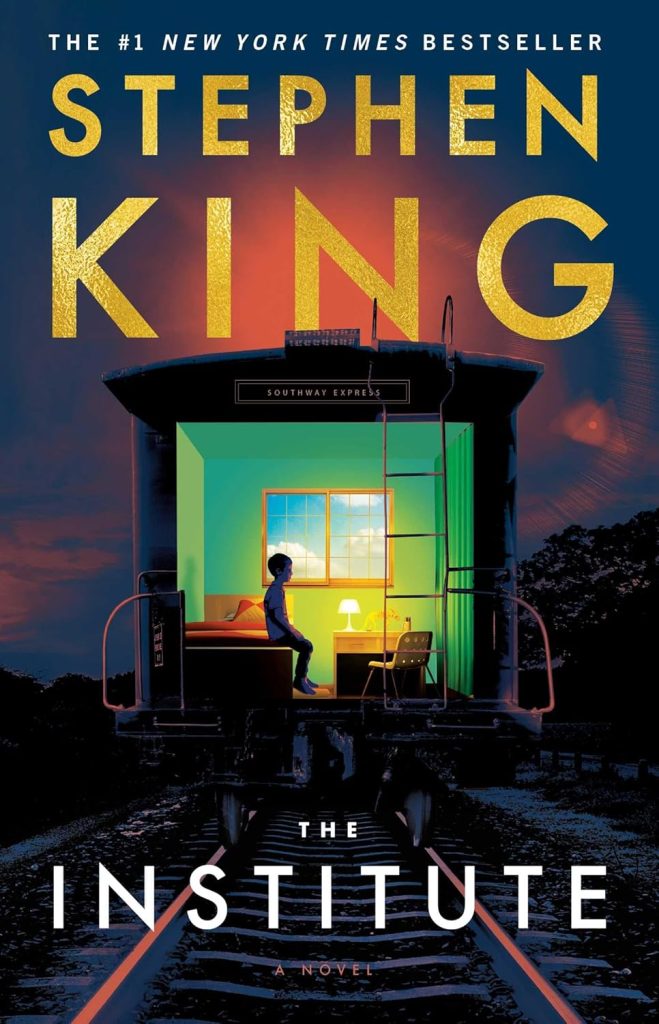
Stephen King has a long, spooky history with extraordinary kids—think Carrie, The Shining, Firestarter—and The Institute sits right in that lineage, swapping haunted houses for a weaponized think tank. Published in 2019, it’s a big-hearted thriller about stolen childhoods, state-sanctioned “greater good” logic, and the kind of small-town decency that can still throw a wrench in a grand machine. It’s King doing an “X-Men in a black site” story, only angrier and more tender than that logline suggests.
What’s it about?
We open not with a kidnapped wunderkind, but with Tim Jamieson, a former cop who gives up his airline seat on impulse and winds up in DuPray, South Carolina—a sleepy town with front porches, late-night freight, and a police department willing to pay a drifter to be a “night knocker.” Tim ambles sidewalks, checks doors, and tries to outwalk the ghosts he picked up on the job. It feels like a novella grafted to the front of someone else’s book—until King turns it into a fuse.
Cut to Minneapolis and Luke Ellis, a 12-year-old prodigy who’s about to start at MIT and still crushes standardized tests before breakfast. He has a tiny telekinetic quirk he barely notices—pencils slide an inch when he’s stressed—but he’s mostly just a polite, brainy kid with loving parents and a best friend. One night, masked men invade the house with professional calm. Luke’s parents are murdered in a way that reads as tidy home invasion. Luke is drugged and swallowed by the dark.
He wakes in a room that looks almost exactly like his bedroom—same posters, same bedding—but there’s no window and the hallway outside is wrong. Welcome to The Institute, a secret facility in the Maine woods where children with trace telepathy or telekinesis are warehoused under fluorescent kindness. The staff calls the living quarters Front Half. They smile a lot. They also zap kids with a handheld pain device when the smiles don’t work.
Luke meets the others: sharp, steady Kalisha; sly Nick; big-hearted George; anxious Iris; and, soon, Avery, an eight-year-old whose telepathy is off-the-charts and whose innocence makes the place feel even crueler. The kids have a culture: trade contraband tokens for snacks; never cry in front of Mrs. Sigsby (the director, all pearls and poison); and don’t ask what happens when you get “graduated” to Back Half—because no one comes back. Every day brings tests that feel like torture dressed as science: needles, isolation boxes, screens that flicker odd patterns, injections that “enhance” their gifts and scramble sleep. A few kids party-line across their minds; others can nudge objects or people. Staff names recur: chilly Dr. Hendricks, loyal-to-a-fault Trevor Stackhouse, and a night nurse with a conscience, Maureen, whose guilt will change everything.
Front Half becomes friendship under siege. Avery latches onto Luke like a little brother. Kalisha shows Luke how to hoard tokens and dignity. The rumor mill says Back Half isn’t death—it’s “work.” The Institute insists the kids are patriots recruited for necessary tasks. The kids know a lie when they taste one. One by one, Luke’s friends are marched through the security door and don’t return. Lights blink in back buildings at odd hours. The air hums when the kids are pushed too hard. Luke’s gift is small, but his will isn’t. He plans.
King builds the escape like a heist made from kids and pocket change. Luke cultivates Maureen, who has a personal disaster only hush money can treat; he sabotages a few tests, learns the rhythms of the guards, and maps hallways by sound and shoe-squeak. When the window finally opens—sedatives timed wrong, a shift change off by minutes—Maureen bets her soul and helps Luke slip outside the fence into the cold Maine night with cash, a map, and a prayer. She pays for that choice. The Institute doesn’t do mercy.
Luke’s flight is scrappy and thrilling: freight yards, stolen rides, the slow terror of realizing your face is on bulletin boards no one will ever see. He follows a breadcrumb logic across states until the map says he’s near DuPray. There he collides with Tim—the patient ex-cop whose life seemed like a digression. Luke’s story is too wild to believe; Tim believes it anyway because he’s seen too much not to. The town—its chief, a few deputies, and citizens who still step onto porches when trucks idle too long—forms a small, stubborn wall.
Meanwhile, back in Maine, Back Half is no rumor. It’s the real mission: strap gifted kids into rigs, pool their talents, and “push” carefully chosen targets across the world—judges, ministers, activists—so a speech is softened, a vote is delayed, a car gently veers the wrong way. The Institute’s theology is utilitarian: a handful of children hurt to prevent catastrophes you’ll never hear about. Mrs. Sigsby believes this with the fervor of a believer whose salary depends on it. The kids pay with nosebleeds, seizures, and the slow erosion of self. Avery, weaponized as the youngest and strongest, becomes both linchpin and liability.
The Institute sends a recovery team to DuPray—professionals with shiny credentials who expect a bumpkin sweep. What they get is a bored ex-cop with a spine, a tight-knit department, and a town that doesn’t like bullies. The confrontation escalates from uneasy interviews to a siege. King flips between the standoff in South Carolina and the pressure-cooker in Maine, where the kids are done waiting to die young for someone else’s math. Luke, Avery, and the ones still left in Front and Back Half reach for each other across distance—telepathic flashes, a desperate plan to synchronize revolt with rescue.
When the door blows (figuratively and literally), it happens almost at once. In DuPray, the Institute’s men underestimate the townsfolk and overestimate fear; bullets and bad decisions make widows and heroes. In Maine, the children—exhausted, furious, and newly united—turn their pooled gifts on their captors and on the very infrastructure of the place. Some villains meet fitting ends; some slip through cracks power always seems to have ready. Mrs. Sigsby learns what it’s like to be hunted in woods she thought she owned. Not all the rescuers live. Not all the kids do, either. The book counts the cost out loud.
After the smoke, King lets the big argument breathe. The Institute wasn’t rogue; it sat in a shadow network with oversight that looks suspiciously like a thumbs-up and a blind eye. Did the pushes prevent atrocities? Sometimes, probably. Were the means monstrous? Absolutely. Luke—who started as a genius with a tiny party trick—becomes the voice saying: if your better world demands child sacrifice, find another way. Avery, traumatized but alive, finds something like a home where the story began, watched over by people who’ll never let a clipboard near him again. Tim, whose wandering looked like running, turns out to have been walking toward a purpose he didn’t know to ask for.
What This Chick Thinks
King’s kid POV still sings
He writes children like people—not props—funny, brave, and prickly. Luke, Kalisha, and especially Avery felt heartbreakingly real. The friendship glue in Front Half is the book’s soul.
Institutional horror is the scariest kind
No ghosts required. The fluorescent benevolence, the euphemisms, the “for your own good” tone—this is the nightmare of being small in a system that thinks it’s righteous. It’s the clean, clinical cousin of Firestarter’s wild labs.
Two-novella structure that pays off
The Tim Jamieson opening looks like throat clearing until Luke hits DuPray and you realize King has been setting a chessboard: one kid in flight, one town with a spine. The collision is delicious.
Big ideas under the chase scenes
The book asks a real question: do ends ever justify means when the means are children? King doesn’t sermonize; he dramatizes. You can feel him poking at utilitarianism and finding the rot under the math.
Pacing: propulsive with a few speed bumps
The middle lab sections are gripping; a late exposition dump about the Institute’s purpose runs a bit long. A couple of villains are more function than character. Didn’t kill the buzz, but I noticed.
Small-town decency as superpower
I’m a sucker for communities closing ranks against slick-bad power. DuPray’s stand is old-fashioned in the best way—courage that looks like showing up.
Final Thoughts
The Institute is King in humane-thriller mode: a page-turner with a conscience, a kid-led jailbreak with something sharp to say about what we tolerate in the name of safety. It’s less gory than some of his classics and more morally chewy. I turned the last page feeling both wrung out and a little vindicated: love and stubborn decency still beat a beautifully organized cruelty.
Rating: 8.5/10
Try it if you like:
- Firestarter – Stephen King — Government labs, psychic kids, and the moral line between protection and exploitation.
- The Darkest Minds – Alexandra Bracken — Teens with powers rounded up by the state, escape on the run, and a found-family fight back.
- Never Let Me Go – Kazuo Ishiguro — A quieter, devastating portrait of children raised for a “greater good,” and the ethics that unravel when you listen to them.
