
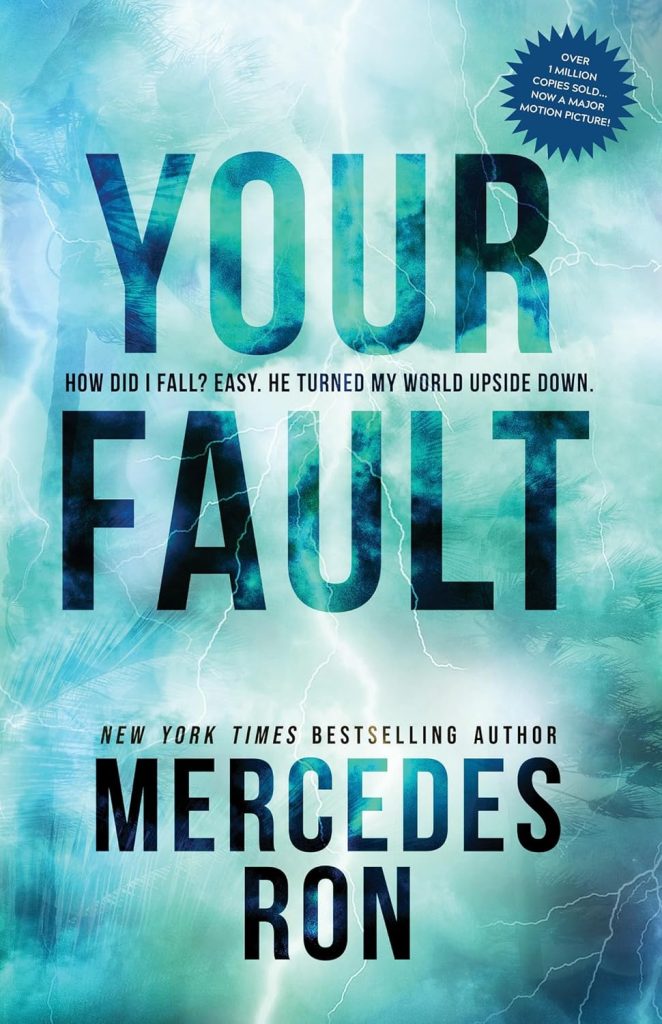
Mercedes Ron’s Culpables trilogy started life on Wattpad, and you can still feel the cliffhanger bones under the glossy, high-drama skin. Book two, Your Fault, picks up right where the first left us: secret step-sibling romance, rich-kid chaos, and a hundred terrible decisions made at 2 a.m. It’s bigger, messier, and more emotionally tangled—very much the “everything you thought you wanted comes with consequences” chapter.
What’s it about?
We open with Noah and Nick doing the world’s worst tightrope walk: they’re together, but it’s the kind of together that lives in shadows—garage kisses, locked-screen texts, the stolen hour at dawn. Around them, the mansion is a museum of self-control. Noah’s mum pretends she can’t see what’s happening; Nick’s father most definitely can and sets rules that sound like house policy but throb like threats. At school, the gossip engines are revving. People noticed how fast Nick would cross a room if Noah entered it; they clock the way she watches the driveway for that bike’s growl. Everyone’s playing dumb. No one’s fooled.
Ron builds the tension by letting the everyday grind sharpen: class, homework, long dinners with weaponised politeness, Nick’s side life of underground races and debts that don’t accept IOUs. He’s still wearing danger like a jacket—cocky, fast, stubborn—but the edges fray whenever Noah is in the splash zone. She wants to choose him without losing herself. He wants her safe without turning into a prison. They are both right and wrong at the same time, constantly.
Enter accelerants. An ex from Nick’s orbit—perfect hair, perfect malice—slides back into view at the exact moment a well-meaning boy in Noah’s class starts being the kind of kind that could easily become a rebound. A party in a glass-box mansion explodes into a late-night race that ends with sirens and a very expensive fence in pieces. The adults storm in: Noah’s mother lays down new borders; the stepfather goes from watchful to controlling; Nick’s father leverages lawyers and influence to make the mess vanish—then presents Nick with a bill written in obedience.
Noah tries to be practical. She focuses on school, on two good friends who tell the truth, on the baby steps of having a life outside the boy who detonates calm simply by existing. But the secrecy is a drug; each time she and Nick swear they’ll slow down, something pulls them back: a bruise he won’t explain, a panic she won’t admit, an apology that feels like the first good breath in hours. They try “just friends.” It lasts until the next crisis.
Then the private stops being private. Photos leak—one from a party, one from a parking lot, just ambiguous enough to destroy plausible deniability. A rival parades the evidence at school with an influencer’s sense for spectacle. The house morphs from chilly quiet to a tribunal. Noah’s mother sees pain coming like weather and does what mothers do: tries to move her daughter out of the storm. Nick’s father, who hates losing even more than scandal, decides to break the habit rather than the boy—he can split them with logistics and leverage. Suddenly there are curfews with teeth, a new schedule for Noah, and a calendar for Nick that keeps him miles away at the exact hours she’s free.
They fight back with the only weapon they have—audacity. Midnight meetings. A burner phone. A road just far enough out that nobody recognizes the bike. It’s romantic and reckless and, predictably, unsustainable. The stakes notch higher when trouble from Nick’s racing scene comes knocking for real: a debt that wasn’t as settled as he claimed, a grudge with muscle, the kind of threat that doesn’t care how pretty you look in a school uniform. Noah gets pulled into the circle simply by proximity, and the book’s glossy fantasy flickers to something darker—what happens when you love someone who attracts danger like a magnet?
The breaking point isn’t one fight; it’s a convergence. A blow-up at school, a confrontation at home, and a night that ends in blue lights and bruises force Noah to look at the version of herself inside this romance: always hiding, always flinching, always waiting for the next shoe. She loves him. She hates what the love turns her into. Nick, convinced he’s the problem that must be removed to keep her safe, does the martyr thing—cold words meant to push her away, silence where there used to be heat. It works because it hurts.
The final stretch is fallout. Friendships wobble under the weight of secrets kept too long. Families pick sides you can’t unsee. Noah tries to build routine out of rubble—notes, classes, small plans that don’t include a motorcycle. Nick disappears into something that looks like compliance and smells like punishment: family obligations, business dinners, a leash disguised as a suit. When they inevitably cross paths again, it’s not fireworks; it’s ache. They’re still in love. The obstacles are still real. And the book ends with the particular cruelty of a second-act romance: the door isn’t closed, it’s just locked from both sides—see you in Our Fault.
What This Chick Thinks
Pace like a runaway engine
Short, punchy chapters; cliffhanger exits; new dramas queuing up before the last one cools. It’s unapologetically serial and extremely consumable—I inhaled it.
Chemistry plus consequence
Noah/Nick still sizzles, but the sequel smartly shifts from “can they?” to “should they like this?” The secrecy, jealousy, and control aren’t just cute obstacles; they have costs the book actually shows.
Toxic beats deserve the content note
Possessiveness, public humiliation, and “I’ll decide for you to protect you” moments pop up. Sometimes the narrative interrogates them; sometimes it romanticises the angst. Readers who need clear boundaries won’t love those stretches.
Family power is the real villain
Money and reputation do the dirty work—moving teens like chess pieces, closing doors with a phone call. I liked how the book lets institutional power, not just cartoon bad guys, drive the conflict.
Character growth… in inches
Noah gets the most internal movement—she learns where her lines are. Nick’s growth feels deferred to book three, which fits the cliffhanger arc but left me wanting more accountability in this installment.
Final Thoughts
Your Fault is the “reality bites” chapter: still addictive, still glam, but heavier with the kind of choices you can’t undo. If you enjoyed the rush of My Fault and you’re willing to sit with messier consequences, this delivers exactly the middle-book ache it promises.
Rating: 8/10
Try it if you like:
- Paper Princess — Erin Watt – Filthy-rich family drama, stepbrothers, and a heroine negotiating power and desire in a world that eats naivety for breakfast.
- After — Anna Todd – Volatile, can’t-look-away romance where love and chaos keep trading the wheel.
- Pushing the Limits — Katie McGarry – Good-girl/bad-boy sparks with real-world scars and families that complicate every decision.
