
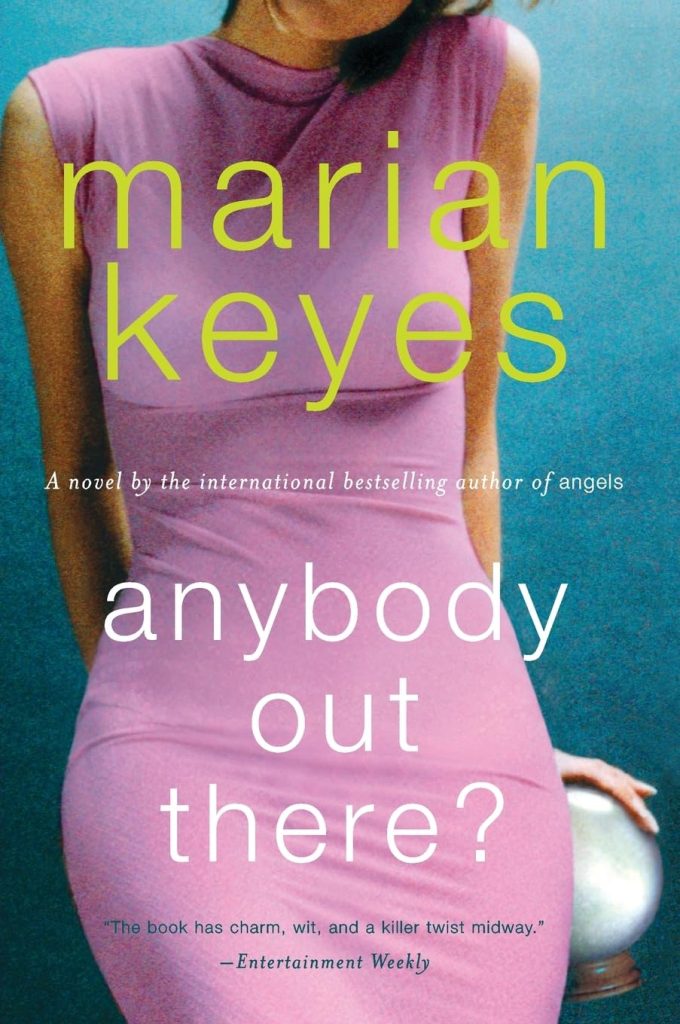
By the time Marian Keyes reached the fourth Walsh sister novel, she’d perfected her trademark gearshift: a laugh-out-loud voice that quietly carries a ton of weight. Anybody Out There? hands the mic to Anna—free-spirited makeup PR girl, Dublin-born New Yorker—and pairs Keyes’s fizzy dialogue with a story about grief that doesn’t blink. It’s the one where the jokes feel like life jackets, the city is both a playground and a minefield, and the Walsh family arrive like a rescue squad armed with sarcasm and sandwiches. If Watermelon and Rachel’s Holiday showed Keyes can do heartbreak and recovery, this one proves she can write grief with a grin and never trivialise it.
What’s it about?
We meet Anna Walsh back in her parents’ house in Dublin, stitched, scarred, and furious at the universe. There’s been an accident in New York—ugly, life-upending—and now Anna is on Mammy Walsh’s floral sofa, stuck in a limbo of painkillers, daytime TV, and Walsh-family interference. Mammy fusses, Dad dispenses gentle quiet, Helen treats boredom like a hostage situation, and every sister provides a different brand of alarmed love. The only thing Anna wants is to get back to New York, back to her life, and—most urgently—back to her husband, Aidan. She talks to him in her head. She writes emails. She waits for a message that doesn’t come.
Keyes lets the truth land slowly, the way it does in real life when your brain ration-cards reality: Anna isn’t just recovering from an accident; she’s recovering from a loss she can’t absorb. The novel’s early chapters are a blur of denial, black humor, and Mammy trying to fatten her back to health with casseroles that could sustain a small army. Once Anna can hobble onto a plane, she bolts. New York is where her life is—her job in beauty PR, her two chaotic roommates (Jacqui and Maura), her shoe collection, her streets. Most of all, it’s where Aidan is supposed to be.
Back in Manhattan, the city hits like weather: cabs leaning on their horns, steam from grates, delis that know your order. Anna limps back into the apartment she shared with Aidan, and the silence is deafening. She tries to outpace it by returning to work—lipsticks to launch, influencers to charm, crisis emails at midnight—as if a packed schedule can smother absence. Colleagues tiptoe, clients overshare, and Anna finds herself doing the corporate-smile thing over bathroom-sink tears. New York is merciless that way: it will let you cry on the sidewalk, but it won’t stop for you.
Grief is messy; Anna makes it messier on purpose. She startles herself with weird rituals: checking Aidan’s voicemail, sending emails into the void, bargaining with the universe for a sign. She trawls their old haunts, half-hoping to bump into him around a corner like she used to. Friends stage gentle interventions—group dinners, sleepovers, one terrible blind date engineered by well-meaning people who think distraction is medicine. She tries everything: grief counselling, support groups, even a brush with the woo-woo (psychics, signs, the whole New York spiritual buffet). Some of it helps for a minute. Some of it hurts in a useful way. Mostly, it reminds her that grief is a job you can’t delegate.
In classic Keyes fashion, the family chorus keeps calling. Mammy’s updates are a symphony of worries; Helen offers “assistance” that borders on surveillance; Claire and Rachel send love packaged as insults. They’re funny, infuriating, and essential—the lifeline that keeps Anna from drifting too far off the map. When the practicalities bite—paperwork that reduces a marriage to data fields, boxes to be sorted, the bureaucratic coldness of loss—Anna leans on them, then shoves them away, then leans again. That push-pull is the heartbeat of the book: autonomy vs. being held.
Aidan himself lives on the page through memory. Keyes gives us a marriage in fragments: the jokes that never got old, the fights that did, the quiet Friday nights when city noise felt like lullaby. We see why Anna loved him—and why the love remade her into someone braver than she thought. Those memories aren’t just sepia; they’re plot. They send her chasing answers about the night of the accident, nudging her toward people who were there and who might carry the kind of truth that burns and heals at once.
The middle act becomes a grief quest disguised as a logistics sprint: lawyers, insurance adjusters, last messages recovered from old accounts, a lost-and-found of feelings she’d rather not catalogue. There are days she manages a joke and a clean shirt, and days she can barely stand. There’s a stretch where she clings to the idea that if she just finds one more missing piece—one more email, one more witness—she can make the ending behave. The city disagrees. It keeps moving. She has to decide whether she will move with it.
In the final third, the book gently shifts from “make this unhappen” to “how do I live with it.” Anna starts to let her life expand beyond the outline of what she lost. She says yes to the kind of friendship that feels like family and the kind of family that can be infuriating and right at the same time. She allows work to be a container, not a cure. She walks streets she once walked two-by-two and notices that she can carry both the ache and the afternoon sun. The goodbye she needed—impossible and necessary—arrives not as a single moment but as a series of brave, ordinary acts: reading a last message, returning an object to its place, telling the truth out loud without breaking. The ending isn’t “onward and upward” so much as “onward, honestly”—which is harder and better.
What This Chick Thinks
Grief with a grin (and no cheating)
I laughed a lot reading this, and I also had to take breathers. Keyes never uses jokes to duck the hard bits; she uses them like scaffolding so the hard bits can be climbed. The avoidance, the magical thinking, the paperwork—ugly, accurate, and somehow tender.
Anna is chaos and courage in equal measure
She’s not the “good sister” or the “wild one”; she’s the human one. I loved how the book lets her be messy without making the mess her personality. Watching her choose real help over performative coping was quietly triumphant.
New York vs. Dublin as two kinds of love
Dublin is casseroles and people who refuse to let you be alone; New York is momentum and the possibility of turning a corner into a new version of yourself. The back-and-forth gives the novel a lovely swing.
The Walsh chorus, in peak form
Mammy is a one-woman emergency services department; Helen weaponizes competence; the sisters deliver roast-level affection. They’re hilarious—and they keep the story humane when it could tilt bleak.
If I’m nitpicking
A mid-book detour or two runs long (a couple of comedic set pieces are an inch broader than they need to be), and readers wanting a capital-R Romance might ache at how firmly this is Anna’s story, not a new-love story. For me, that choice is the point.
Final Thoughts
Anybody Out There? is Marian Keyes at full power: generous, sharply funny, and bracingly honest about the work of carrying a broken heart. It’s a grief novel that refuses to be maudlin, a comedy that refuses to be shallow, and a family story that understands love as a verb. I closed it feeling wrung out and strangely hopeful—like someone had handed me tissues, tea, and permission to take my time.
Rating: 9.5/10
Try it if you like:
- The Two Lives of Lydia Bird — Josie Silver – Grief rendered with tenderness and a speculative twist, charting a careful path back to the living.
- Sorrow and Bliss — Meg Mason – Razor-sharp humor braided with pain, about rebuilding a self when the old coping strategies stop working.
- This Must Be the Place — Maggie O’Farrell – A globe-trotting mosaic of love, loss, and the ordinary miracles of staying when leaving would be easier.
